বাংলা
 English
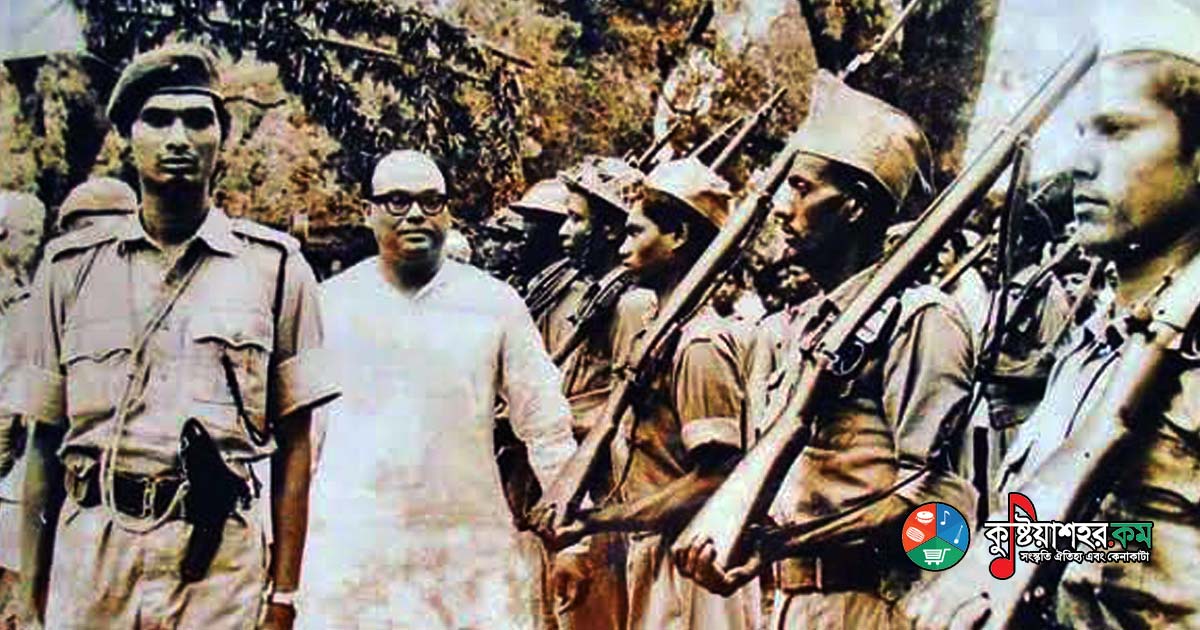
Though graced with many names such as the Mujibnagar Government, the government-in-exile, the revolutionary government, the wartime government and so on, the 'First Government' of the People's Republic of Bangladesh was formed mainly at the Agartala Circuit House on 10 April 1971, in a meeting of the Awami League leaders elected in 1970.
On 17 April 1971, the first cabinet of Bangladesh's first government took oath under the mango grove at Baidyanathtala in Meherpur. With a view to the formal emergence of the Government of Bangladesh, the oaths of the Vice President, the Prime Minister and 3 ministers were administered at a gathering of ten thousand people.
On 18 April the portfolios of all the ministers were distributed and various important responsibilities of the ministries were entrusted to different persons.
- Sheikh Mujibur Rahman: President
- Syed Nazrul Islam: Vice President (because the President was interned in Pakistan, he was entrusted with the responsibilities of acting President, exercising the powers, responsibilities and duties of the President)
- Tajuddin Ahmad: Prime Minister and minister responsible for defence, information, broadcasting and communications, economic affairs, the planning department, education, local government, health, labour, social welfare, establishment, and all other matters not entrusted to anyone else
- Khondaker Mostaq Ahmad: Minister, Ministry of Foreign Affairs and Parliamentary Affairs
- M Mansur Ali: Minister, Ministry of Finance, Industries and Commerce
- A H M Qamaruzzaman: Minister, Ministry of Home Affairs, Relief and Rehabilitation and Agriculture
Ministry of Defence:
S A Samad was the defence secretary. The Commander-in-Chief of the Liberation War was M A G Osmani, the Chief of Staff Colonel Abdur Rab, the Deputy Commander A K Khondkar, and the DG of Medical Services and staff officers of various ranks were connected with this department. The Ministry of Defence divided the war zones into 11 sectors and appointed a sector commander for each. However, Sector No. 10, or the naval sector, had no sector commander; wherever the commandos carried out operations, they remained under the sector commander of that sector. Besides, three brigades were formed named Z Force, K Force and S Force. Their commanders were respectively Major Ziaur Rahman, Major Khaled Mosharraf and Major K M Shafiullah.
Ministry of Foreign Affairs:
During the war this ministry established Bangladesh missions abroad and, by sending diplomatic delegations to various countries, tried to win the support of the governments and peoples of the outside world. To this end diplomatic missions were set up in Calcutta, Delhi, London, Washington, New York, Stockholm and so on, and diplomatic delegations were sent to win the support of the United Nations and of countries such as Afghanistan, Syria-Lebanon, Nepal, Sri Lanka, Burma, Thailand and Japan. Besides, letters were sent from this ministry to the governments and heads of state of various countries for the release of Bangabandhu Sheikh Mujibur Rahman. The heads of the Bangladesh missions abroad were Hossain Ali in Calcutta, Humayun Rashid Choudhury in Delhi, Justice Abu Sayeed Choudhury as special representative in Europe, and M R Siddiqi in Washington. Abdur Razzaq represented the Bangladesh mission in Stockholm.
Among the diplomatic representatives sent by the Government of Bangladesh the notable ones were Molla Jalal Uddin MNA and Dr Mahmud Shah Qureshi in Syria-Lebanon, and Abdus Samad Azad, Ashraf Ali Chowdhury MNA, Maulana Khairul Islam Yasori and Advocate Nurul Qader in Afghanistan. Abdul Malek Ukil, Subodh Chandra Mitra and Abdul Momin Talukdar were sent to Nepal. Led by Advocate Fakir Shahabuddin, Shamsul Haq and Jyotipal Mahathero went to Sri Lanka, Thailand and Japan. Mahbub Alam Chashi served as secretary of the Ministry of Foreign Affairs. The foreign affairs department was situated at 9 Circus Avenue in Calcutta.
Ministry of Finance, Industries and Commerce:
M Mansur Ali was the minister of this ministry and Khondkar Asaduzzaman was the secretary. During the war the Industries and Commerce ministry had no notable work. But the finance department did some important work: formulating the budget of the government's income and expenditure; preparing accounts of the resources received from within Bangladesh and other sources; framing policies for making payments to various organisations and individuals; establishing financial discipline; collecting revenue and customs; and forming committees to prevent any financial irregularity.
The Government of Bangladesh, determining its sources of income and areas of expenditure, first prepared a budget for six months. A treasury was set up to preserve the money received from Bangladesh, and the money received from expatriate Bengalis and from various foreign citizens and organisations was deposited in a fund named the Bangladesh Fund. Apart from the salaries and allowances of the freedom fighters, proposals for the purchase of other necessary goods were presented to the cabinet through the Ministry of Defence, and the money reached the concerned parties through the Ministry of Finance. A committee was formed for the transparency of government expenditure.
Cabinet Secretariat:
Placing various proposals in cabinet meetings, implementing the decisions of the meetings, observing them and recording all these matters were within the purview of the Cabinet Secretariat. After the cabinet was formed, Tajuddin Ahmad recorded with his own hand most of the various decisions of the council's first two months. Then, after H T Imam joined as secretary, the secretariat grew up with the coordination of other officers and employees. The Cabinet Secretariat played an important role in coordinating the work of the various ministries.
General Administration Department:
For the purpose of framing rules on appointments, transfers, promotions and service, the General Administration Department was created under the Ministry of Establishment. Under the direct supervision of Prime Minister Tajuddin Ahmad, mainly various second-class appointments were within the purview of this department. Identifying persons outside the list of the Government of the People's Republic of Bangladesh and creating panels for various appointments were also this department's responsibilities. Nurul Qader served as the establishment secretary.
Zonal Administrative Council:
This council was formed under the General Administration Department. During the Liberation War, since it was impossible for the administration of the Government of Bangladesh to work directly in every district within the country on its behalf, administrative zones were formed, each composed of a number of districts. Through a circular signed by the Prime Minister on 27 July 1971, 9 zones were established, and later two more zones. Each zone had a headquarters, and a chairman (an MNA or an MPA) and an administrative officer carried out the responsibilities of the zone. The administrative council was formed of the chairman, members, administrative officer and other employees of the concerned zone.
Responsibilities and Duties:
Implementing the decisions taken by the cabinet for the zonal administrative councils, establishing political authority over the zones, that is, communication with the people, providing relief assistance to the displaced, coordinating relief efforts with various organisations, giving the youth camps support as far as possible, and helping the sector commands were the main tasks of the zonal administrative councils. Making efforts to establish administrative authority in the liberated areas and taking various steps to make the people understand that the administration of the Government of Bangladesh remained effective were also the responsibilities of the zonal administration. In consultation with the concerned chairman, arrangements had to be made for at least one meeting a month with the administrative officer or secretary, at five days' notice.
Ministry of Health and Welfare:
This ministry began its work at first under the leadership of a director general. Later the director general was given the status of secretary. The work of the health department was divided into two parts: (a) medical services for the fighting freedom fighters under the army, that is, the Ministry of Defence, and (b) providing medical care to civilians or to people who did not fight with weapons in hand. The responsibilities of this ministry were to arrange the recruitment of physicians, collect medicines, send teams of physicians to the field, collect the necessary equipment for surgery, and arrange transport for the wounded and the dead. Dr T Hossain was appointed at first director general of the health department and later secretary of the Ministry of Health and Welfare.
Ministry of Information and Radio:
For propaganda in favour of the Liberation War and for keeping up the morale of the Bengalis living inside and outside Bangladesh, the role of this ministry was extremely important. This ministry mainly conducted its activities through four media: (a) radio (Swadhin Bangla Betar Kendra), (b) cinema, (c) publications, (d) fine arts and design.
Ministry of Home Affairs:
Maintaining law and order in the liberated areas, the refugee camps and the training camps was this ministry's main responsibility. To help the government in building an administrative structure in the liberated areas and to run intelligence operations in the war zones and the liberated areas, an intelligence department was formed. This ministry determined the Bangladesh Police's uniform, badge and monogram. Abdul Khalek was appointed at first Inspector General of Police and later Home Secretary. Towards the end of the war Bangladesh was divided into 4 ranges and four DIGs were appointed, along with an SP in each district. Issuing travel documents to the Bangladeshi people staying in India was also the responsibility of the Ministry of Home Affairs.
Relief and Rehabilitation Department:
For the rehabilitation of the refugees who had taken shelter in India, this department was established under the supervision of the Ministries of Home Affairs and Relief. Considering the appeals of the refugees, assistance was given to them as far as possible. The Relief and Rehabilitation Department was again divided into two parts: (a) the Relief and Rehabilitation Committee and (b) the Displaced Persons Welfare Board.
Parliamentary Affairs Department:
This department worked under the Ministry of Foreign Affairs and Law. Solving the various problems of the members of the provincial and national assemblies and engaging them in various tasks was this department's main responsibility. The council members made important contributions to the selection of freedom fighters, the housing of the refugees and the building of public opinion in favour of the war. They were given allowances for these activities.
Agriculture Department:
This department worked to take initiatives on how the food crisis could be overcome in the post-war period by increasing food production, scientific cultivation and, in view of the wartime damage, giving loans to farmers on easy terms. Nuruddin Ahmad served as the agriculture secretary.
Engineering Department:
To solve engineering problems in the sectors during the war, a number of engineers were appointed under this department, especially for the rapid construction and repair of roads and the repair of bridges. Emdad Ali was appointed chief engineer.
Planning Cell:
In the light of the Awami League's Six Points and the party's manifesto in the 1970 election, the government formed this cell to plan for building the country in the short and long term, especially on how to overcome quickly the losses of the war. Advising on the identification of areas deprived of development during the Pakistan era and on administrative reorganisation was also its work. Initially this cell gave the government expert advice on the rehabilitation of the homeless, the supply of food, health, water and electricity, and the reopening of closed industrial establishments. It was this cell that was later transformed into the Planning Commission. Dr Muzaffar Ahmad Choudhury was the chairman, and Dr Khan Sarwar Murshid, Dr Mosharraf Hossain, Dr S R Bose and Dr Anisuzzaman were members of the Planning Cell.
Youth and Reception Camp Control Board:
Young men interested in taking part in the Liberation War were first sent to the reception camps and later from there to the youth camps for training. Both camps were run under the zonal administrative councils. The chairman of this board conducted its activities with the help of the Ministry of Home Affairs. In the states of West Bengal, Tripura, Meghalaya and Assam there were altogether 106 youth camps and 112 reception camps. On the basis of the board's proposals, both camps were run from the government's budget. Professor Yusuf Ali was the chairman of the Youth and Reception Camp Control Board. Besides, an MNA or an MPA each was in charge of running each camp.