বাংলা
 English
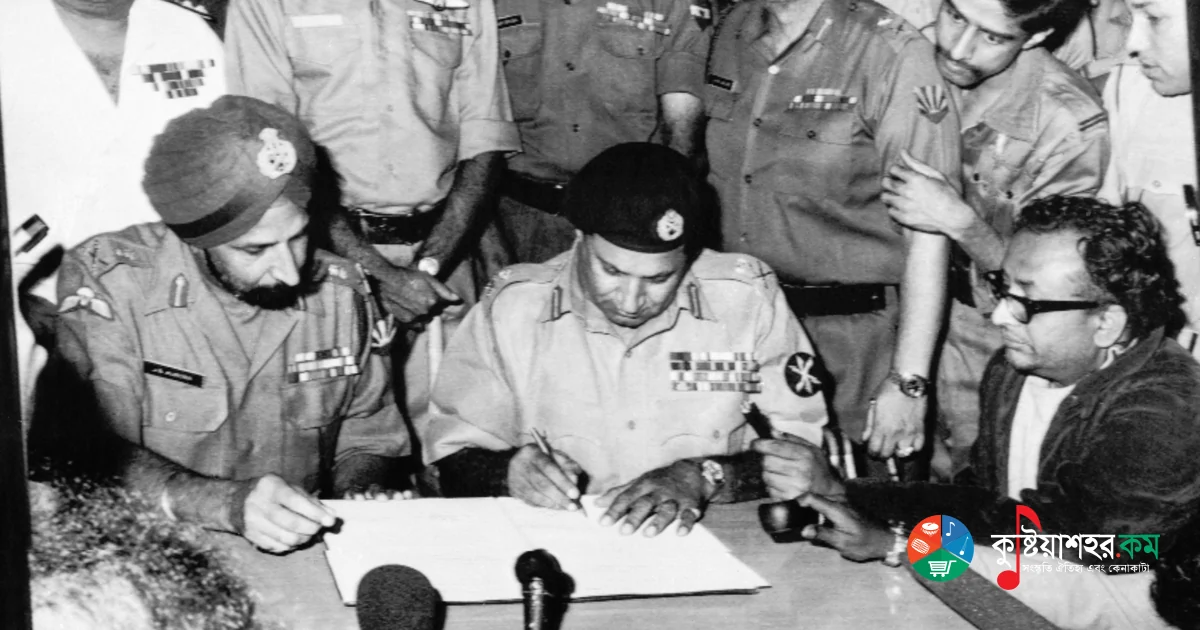
On the afternoon of 16 December 1971, at Dhaka's Ramna Race Course (today's Suhrawardy Udyan), the head of the Pakistani Eastern Command, Lt. Gen. A. A. K. Niazi, sat down at a plain table and put pen to paper. A three-paragraph English document — the Instrument of Surrender — brought nine months of bloody war to an end and gave the victory of independent Bangladesh its formal recognition. This article tells the story of that afternoon: how the events unfolded, what the document said, who was present, and why that ground was chosen.
Background to a Historic Afternoon
16 December 1971. Across Bangladesh, including Dhaka, the war was entering its final phase. After nine long months of armed struggle, the sacrifice of countless people, persecution, displacement and destruction, the defeat of the Pakistani military was all but certain. The joint forces of the Mukti Bahini and the Indian armed forces had encircled Dhaka within the second week of December, and the Pakistani Eastern Command was being cut off and isolated piece by piece.
The messages of surrender began to pass early on 16 December. Maj. Gen. J. F. R. Jacob, Chief of Staff of India's Eastern Command, flew to Dhaka by helicopter and secured an unconditional surrender from the head of the Pakistani Eastern Command, Lt. Gen. Amir Abdullah Khan Niazi; Niazi is said to have been given just 30 minutes to decide. Dhaka at that moment held both the tension of a war's final hours and the atmosphere of a new history taking shape among people waiting for freedom.
Why Was the Race Course Chosen?
The venue chosen for the surrender was Dhaka's Ramna Race Course, known today as Suhrawardy Udyan. The place carries profound historical weight. It was on this very ground, on 7 March 1971, that Bangabandhu Sheikh Mujibur Rahman, in his historic speech, called upon Bengalis to prepare for the struggle for independence. On that same ground, almost nine months later, the Pakistani forces had to surrender.
It was a symbolic turning of history's page. On the field where the Bengali nation had heard the call for independence, the defeat of Pakistani military rule was formally acknowledged. The Race Course thus became more than the site of a surrender ceremony; it stands as a monument to the beginning of Bangladesh's independence struggle, its resistance, and its final victory.
There was also a deliberate decision behind holding the surrender in the open, before the people of Dhaka, rather than behind closed doors in a fortress: Jacob wanted Niazi's surrender to take place in public, and a guard of honour was provided.
Preparing for the Surrender Ceremony
Preparations for the ceremony began at the Race Course on the afternoon of 16 December. The commander of the joint forces, Lt. Gen. Jagjit Singh Aurora, flew in from Calcutta by helicopter, accompanied by Lt. Gen. Sagat Singh, commander of India's IV Corps; Air Marshal Hari Chand Dewan, commander of the Eastern Air Command; and Maj. Gen. J. F. R. Jacob, Chief of Staff of the Eastern Command. For Pakistan, the head of the Eastern Command, Lt. Gen. A. A. K. Niazi, took part, along with Rear Admiral Mohammad Shariff of the Navy and Air Vice-Marshal Patrick Desmond Callaghan of the Air Force.
For Bangladesh, the Provisional Government was represented by Group Captain A. K. Khandker, Deputy Chief of Staff of the Bangladesh Forces. He was present as a key representative of the military leadership of the Liberation War. His presence signified Bangladesh's participation in the ceremony and the role of the war's own leadership.
The stage was put together in the plainest possible way — one table and two chairs. The surrender document itself had been prepared in advance and brought along; according to the state news agency BSS, the Indian brigadier given the job of arranging the seating hurried to the Race Course carrying the table and two chairs taken from Niazi's own office. Another widely repeated account says the table came from the Dhaka Club. There was nothing lavish about the setting; yet on that ordinary table one of the world's largest military surrenders by number of personnel since the Second World War was completed.
What Did the Instrument of Surrender Say?
The document's English title is the Instrument of Surrender. In it, the Pakistani Eastern Command agrees to surrender all Pakistani armed forces in Bangladesh to Lt. Gen. Jagjit Singh Aurora. Aurora is described as the General Officer Commanding-in-Chief of the Indian and Bangladesh forces in the Eastern Theatre, and Niazi as Martial Law Administrator, Zone B, and Commander of the Eastern Command (Pakistan).
According to the document, the surrender covered not only the army but also Pakistan's air force and navy, paramilitary forces and civil armed forces. They were to lay down their arms where they were located and surrender to the nearest regular troops under Aurora's command.
The document further stated that as soon as it was signed, the Pakistani Eastern Command would come under the orders of the joint forces commander, and that disobedience would be treated as a breach of the surrender terms. At the same time Aurora gave a solemn assurance that those who surrendered would be treated with the dignity and respect due to soldiers under the Geneva Convention, and that protection would be provided to foreign nationals, ethnic minorities and personnel of West Pakistani origin.
In other words, this was not merely a ceasefire announcement; it was the formal and comprehensive instrument of surrender of Pakistani military power in Bangladesh.
The Moment the Surrender Was Signed
Then came the long-awaited moment. On the afternoon of 16 December at the Race Course, Lt. Gen. Jagjit Singh Aurora and Lt. Gen. A. A. K. Niazi signed the Instrument of Surrender. Aurora accepted the surrender on behalf of the joint forces, and Niazi signed on behalf of Pakistan's Eastern Command. After signing, Niazi handed over his own revolver to Aurora. Beneath the two signatures on the document stands a single date — 16 December 1971. Standing beside Jacob at the ceremony was Lt. Gen. Sagat Singh, commander of the IV Corps.
Niazi bowed over his signature, and on Aurora's face there was no trace of elation: Britain's Guardian newspaper later described the scene as "the glum Pakistani officer bowed over his signature. The turbaned figure beside him, showing not a scrap of elation". Niazi himself later wrote in his book that he signed with a "very heavy heart". And the crowd packed into the ground burst into celebration the moment the document was signed.
Accounts differ on the exact time. The published text of the instrument states that it was signed at 16:31 hours Indian Standard Time (IST) — the time commonly given as 4:31 in the afternoon. Dhaka time runs 30 minutes ahead of Indian time, so on Dhaka's clocks it was 5:01 in the afternoon. Some Indian reports have mentioned 5:55 in the evening. Whichever it was, the day was 16 December 1971 — a date sealed into history forever.
With that signature the military defeat of Pakistan's Eastern Command was formally complete. Under the instrument, some 93,000 people surrendered — regular soldiers, paramilitary personnel, government officials and their families; of these, an estimated 34,000 to 45,000 were regular soldiers. The final victory in Bangladesh's Liberation War was achieved, and the emergence of Bangladesh as an independent state received historic recognition.
Bangladesh Erupts in Celebration
As the news of the surrender spread, waves of joy and relief swept through Dhaka and across the country. After long months of fear, uncertainty and the horrors of war, people tasted freedom. Crowds poured onto the streets. Embracing one another in the joy of victory, the air filled with slogans.
Mixed with that joy was deep grief, for countless people had given their lives for independence — freedom fighters and ordinary people, teachers, doctors, journalists, peasants, workers and people from every class and profession. Many families lost their loved ones, and millions suffered persecution and displacement. The victory of 16 December was a joyful one, but behind it lay a history of boundless sacrifice.
The Killing of the Martyred Intellectuals on the Eve of Victory
Realising that final defeat was certain, the Pakistani forces and their local collaborators — the Al-Badr and Al-Shams among them — carried out a plan to destroy the intellect and mind of the Bengali nation in December 1971. On 14 December in particular, teachers, doctors, journalists, writers, engineers and many other intellectuals were abducted and killed in a planned operation.
The joy of victory on 16 December could not erase the grief of 14 December. At the very moment of independent Bangladesh's birth, the killing of some of the nation's finest children was a terrible attempt to leave the future state without its brightest minds. Martyred Intellectuals Day and Victory Day are therefore deeply linked in the history of Bangladesh.
The Combined Role of the Mukti Bahini and the Allied Forces
Bangladesh's victory was won through nine long months of the Liberation War. The Mukti Bahini was the Bengalis' own armed resistance, fighting for independence. Across the country, guerrilla operations, frontal battles, and attacks on communications and military installations steadily weakened the Pakistani forces.
In the final phase of the war, the Indian armed forces conducted joint military operations alongside Bangladesh's Mukti Bahini. Operations on land, at sea and in the air quickly brought the Pakistani forces to the verge of defeat. The surrender of 16 December was the culmination of this combined campaign.
The joint command had taken shape in November 1971 under a treaty of political and military cooperation between the governments of India and Bangladesh. On 21 November, Aurora was appointed commander of the joint forces; the Bangladeshi side was headed by General M. A. G. Osmani, commander-in-chief of the Mukti Bahini. Open war began on 3 December, and within just thirteen days it ended in the surrender at Dhaka.
Bangladesh's struggle for independence cannot, however, be reduced to the military campaign of 16 December alone. Its foundations lay in the Bengalis' long political and cultural struggle for rights, and in the mass participation of the people in the Liberation War of 1971.
The Hard Road of Nation-building After the Surrender
The surrender of the Pakistani forces on 16 December brought the war to a military end. But enormous responsibilities now lay ahead: running an independent state, rebuilding the administration, restoring communications, reviving a war-shattered economy and rehabilitating refugees.
The country's infrastructure lay in ruins. Bridges, roads, railways and buildings had been damaged. Countless people who had lost their homes were returning to the country. The rehabilitation of wounded freedom fighters and persecuted people was also urgent. Alongside the joy of independence began the hard reality of rebuilding the state from scratch.
Those who surrendered were held in India as prisoners of war. They were repatriated after the 1972 Simla Agreement and the April 1974 Delhi Agreement between India, Pakistan and Bangladesh; Pakistan formally recognised Bangladesh in February 1974. Niazi was the last to return, crossing the Wagah border on 30 April 1975.
Released from prison in Pakistan, Bangabandhu Sheikh Mujibur Rahman returned to an independent Bangladesh on 10 January 1972. His homecoming added another important chapter to the political journey of the young state.
What Stands at the Site Today?
Where that table once stood, a 150-foot glass tower — the Swadhinata Stambha, the Independence Monument — now rises, built on the very spot where the instrument was signed. Nearby are the eternal flame, Shikha Chirantan, and murals of the Liberation War. The table and the two chairs from the signing are preserved at the Bangladesh National Museum, and the signed original of the instrument is reported to be on display at the National Museum in New Delhi.
The Historic Significance of 16 December
Bangladesh's Independence Day is 26 March and Victory Day is 16 December. Though the significance of the two days is distinct, they are parts of the same continuous struggle for liberation. 26 March commemorates the declaration of independence and the start of the Liberation War; 16 December is the day of the Pakistani forces' surrender and final victory. This article explains the difference between the two days in detail, while the full history of Victory Day traces the war from its beginning to victory.
16 December reminds us that independence was no accidental achievement. Behind it lay a long political struggle, cultural awakening, mass movements, armed resistance and the sacrifice of countless people. This day is a symbol of Bangladesh's sovereignty, national identity and self-respect.
Conclusion: The Afternoon That Changed a Nation's Future
That afternoon of 16 December 1971 was a historic culmination of the Bengalis' long struggle. The instrument of surrender signed on a table at the Ramna Race Course did more than confirm the defeat of an army; it gave final shape to the victory of an independent state.
Even today, whenever 16 December comes, the nation remembers with deep respect the martyrs of the Liberation War, the valiant freedom fighters, those who suffered persecution and all who sacrificed for independence. Carrying this history of victory to the new generation is our responsibility, because knowing history is not merely remembering the past; it is also a way of understanding the value, duty and meaning of independence.
Deep respect to all martyrs and valiant freedom fighters on the great Victory Day.