বাংলা
 English
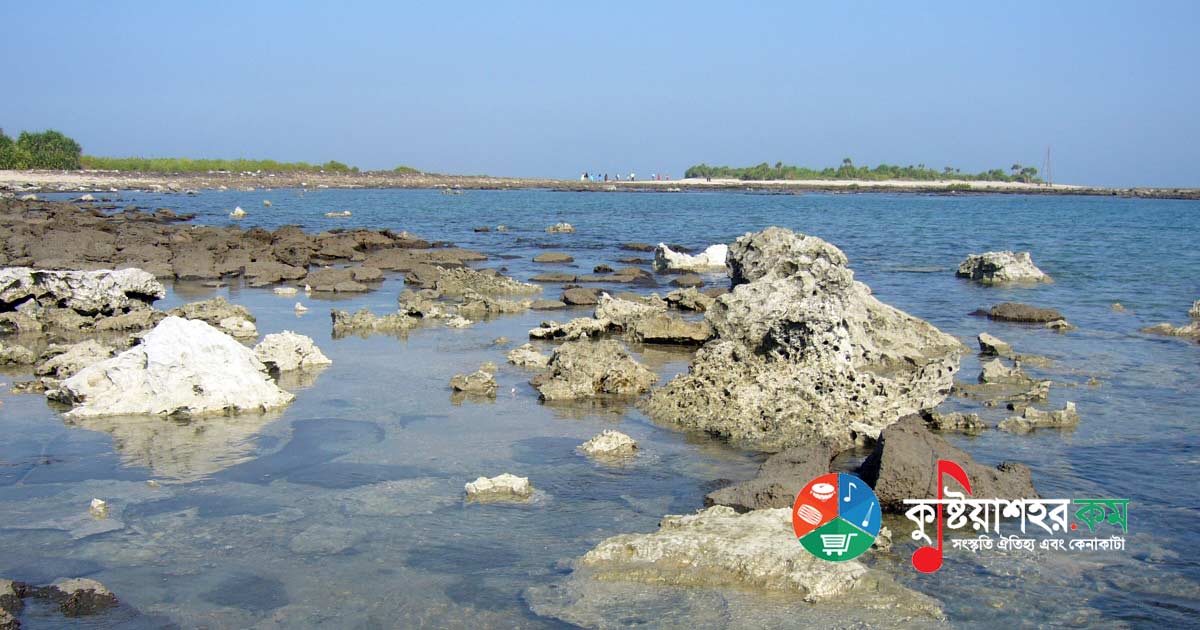
St. Martin's Island
St Martin's Island is a coral island located in the north-eastern part of the Bay of Bengal at the southernmost tip of Bangladesh. It is located about 9 kilometres south of Teknaf in Cox's Bazar district and 8 kilometres west of Myanmar's coast, at the mouth of the Naf river. As coconuts are found in abundance, locally it is also called Narikel Jinjira. It is a widely known name among the sea lovers of Bangladesh. The island's fame grew further through the famous writer and novelist Humayun Ahmed's full-length film named Daruchini Dwip (Island of Cinnamon).
History
It cannot be known when humans first identified this island. Some Arab merchants were the first to name this island Jinjira. It may be noted that they used this island to rest while travelling between Chittagong and South-East Asia. In course of time the people of Chittagong and nearby came to know this island by the name Jinjira. Around 1890 AD some Bengalis and people of the Rakhine community came to settle on this island. They were mainly fishermen. As far as is known, 13 families first settled as the earliest inhabitants. They chose the northern part of this island. In course of time this island became a Bengali-inhabited area. From before, keya and jhau trees were on this island. Probably, as a means of relieving water shortage and weariness, the Bengali fishermen planted a large number of coconut trees on this island. In course of time the whole island at one point became a “coconut tree predominant” island. On this account the local inhabitants began to call the island's northern part Narikel Jinjira. Around 1900 AD a British land survey team took this island as part of British-India. In the survey, instead of the local name, they gave it the name St Martin after the Christian saint Martin. After that, gradually, to people outside this region the island came to be known as St Martin.
Geographic Extent
The area of St Martin's Island is about 8 square kilometres, and it is long from north to south. The bedrock on three sides of the island sinks at high tide and rises at low tide. Counting these, its area would be about 10–15 square kilometres. The island is about 5.63 kilometres long from north to south. The island's width is 700 metres in one place and 200 metres in another. To the island's east, south and west there are countless heaps of rocks far out into the sea. The average height of St Martin's Island from sea level is 3.6 metres. Along the west-north-west of St Martin's lies a coral reef about 10–15 kilometres.
Geographically it is divided into three parts. The northern part is called Narikel Jinjira or Uttar Para. The southern region is called Dakshin Para, and attached to it, spreading to the south-east, is a narrow tail-like area. And the narrowest part is known as Galachipa. To the island's south there is a small island of 100 to 500 square metres, known locally as Chheradia or Siradia/Chhera Dwip. It is an uninhabited island. At low tide one can walk to this island. However, at high tide a boat is needed.
Topography
The topography of St Martin's Island is mainly flat. However, some sandy dunes can be seen. The island's main structural element is limestone. There are wetlands in the middle of both the island's Uttar Para and Dakshin Para. These are rich in fresh water and help crop production. Some agricultural production takes place on the island. However, it is very small compared to the need.
On St Martin's Island about 66 species of coral, 187 species of snails and shells, 153 species of marine algae, 157 species of cryptogamic plants, 240 species of marine fish, four species of amphibians and 120 species of birds are found. Sea weeds or algae, known locally as pegala, are a kind of marine algae found in abundance on St Martin's. They occur in various species, but red algae are the most popular worldwide. There are also 19 species of mammals. Among the invertebrates are sponges, rock crabs, hermit crabs, lobsters and so on. Among the fish are fairy fish, butterfly fish, bol coral, ranga koi, needle fish, red fish, flying fish and so on. The place is famed as a nesting ground of the green sea turtle and the olive ridley sea turtle species.
Plant Diversity
Apart from the keora forest, there is nothing on the island that can be called a natural forest. However, in the south of the island there are keora bushes and groves in large numbers. In the south there are some mangrove trees. Among the other plants are keya, sheora, sagarlata, bain trees and so on.
Inhabitants
Human settlement began here about 100 to 125 years ago. At present more than seven thousand people live here. The island's population is growing fast. The main occupation of the residents here is fishing. Tourists and hotel businessmen mainly buy fish from them. Small fish are laid out on winnowing trays, pitkala fish are laid out on sand, and the larger fish are gutted along the belly and dried on racks. Besides, many islanders trade in fish, coconuts, pegala and shells. Some people also earn a living through shops. Small children sell algae collected from the island to tourists. Coconuts and green coconuts are sold all over St Martin's Island. Bengali-speaking Rohingyas from Arakan in Myanmar are seen quite often in the island region.
Tourism
The island is a popular tourist centre. In the tourist season five launches come and go each day from the Bangladesh mainland. St Martin's Island at present has quite a few good residential hotels. There is a government dak bungalow. The law-and-order situation of St Martin's Island is good.
How to Get There from Kushtia:-
There is no direct vehicle from Kushtia to St Martin's Island. From Kushtia you must come to Dhaka. From Dhaka St Martin's Island can be reached by many means.
To go to St Martin you must first come to Teknaf in Cox's Bazar district. From Dhaka you can go directly to Teknaf by bus. From Dhaka's Fakirapul and Sayedabad, buses such as Shyamoli, St Martin Transport, Eagle, S Alam, Modern Line, Green Line and so on go directly to Teknaf. The 10–12 hour journey fare is usually between 900 and 2,000 taka depending on the bus and the class.
Or from Dhaka come first to Cox's Bazar and then go from Cox's Bazar to Teknaf. Every day from Dhaka many buses such as Green Line, Sohag, TR Travels, Shyamoli, Hanif, Saudia, Eagle, S Alam, Silk Line, St Martin and so on leave for Cox's Bazar; the fare is usually between 1,000 taka and 2,500 taka depending on the bus. Besides, you can go from Dhaka to Cox's Bazar directly by air.
And if you want to come to Chittagong from Dhaka by train, you can travel at your convenience on trains such as Sonar Bangla, Turna-Nishitha, Subarna Express, Mahanagar Provati/Godhuli and the Chittagong Mail from Dhaka. Then Cox's Bazar coaches are available every hour from Bahaddarhat or the New Bridge area of Chittagong. Among them, for good service you can travel on buses such as S Alam, Saudia, Unique and so on.
From Cox's Bazar you can easily go to Teknaf by local bus or by hiring a micro/jeep. Going from Cox's Bazar to Teknaf takes about one to two hours depending on the conditions. From Teknaf ships such as Kutubdia, Keari Sindabad, Eagle, Sundarban and so on come and go to St Martin daily from the morning. Besides, quite a few trawlers and speedboats ply on this sea route. Going by ship from Teknaf to St Martin takes two to two and a half hours. Depending on the ship's class, the round-trip fare is around 550–800 taka. The ships leave the jetty ghat for St Martin daily at 9.00–9.30 in the morning and return from St Martin at 3.00–3.30 in the afternoon. So if you fail to be present at the jetty ghat before the time, the chances of missing the ship increase. And in such a case there is no way but to return by trawler, which is quite risky. Those who stay overnight on St Martin get the chance to return the next day on the ship, which is mentioned on the ticket beforehand.
Usually the ships run for these five months from November to March. Going at any time other than this, one must go by trawler or speedboat. Apart from the winter season the sea remains rough at other times, so travel at that time is not safe. Although if you are an adventure lover, you can take the experience of travelling by trawler on the rough sea.
What to Eat and Where to Eat
St Martin's most famous item is the green coconut, at once sweet and delicious. Anyone going to St Martin should taste at least one dab. For those who like to eat fish, St Martin Coral, Sundari Poya, hilsa, rupchanda, lobster, kalachanda and so on await with all kinds and a variety of flavours. And if you get the chance, you can try kura (the native chicken is called kura). There is also an endless store of loitta, churi, rupchanda, kachki and other known and unknown dried fish. If you go to St Martin in January or February, make sure you do not miss the watermelon.
Besides, some of the hotels and restaurants where you can go and eat are Keari Marjan Restaurant, Beach Point, Hotel Allah'r Dan, Bazar Beach, Assam Hotel, Sea Beach, St Martin, Cumilla Restaurant, Real Restaurant, Haji Selim Park, St Martin Tourist Park, Hotel Sadek and so on. But do check a little first.
Where to Stay
For overnight stays on St Martin there are quite a few good-quality hotels and cottages. Besides, many houses have arrangements for tourists to stay.
Blue Marine Resort (Blue Marine Resort): Blue Marine Resort is located very close to the ferry ghat of St Martin's Island. At Blue Marine Resort the rent of an AC double bedroom is 15,000 taka and non-AC 5,000 taka, each triple bedroom costs 3,000 taka, a six-person bedroom 4,000 taka and a ten-person bedroom 5,000 taka. Contact: 01817 060065
Coral View Resort (Coral View Resort): Coral View Resort has been built on the left side of the St Martin ship ghat, that is, adjacent to the east beach. At Coral View Resort the rent of a sea-view room is 2,500 to 6,000 taka. Contact: 01980 004777, 01980 004778
Praasad Paradise Resort (Praasad Paradise Resort): Going through St Martin Bazar, past Blue Marine Resort and a little further north lies the charming Praasad Paradise. To rent any one of its 16 rooms of various kinds will cost 2,000–5,000 taka. Contact: 01995 539248, 01883 626003
Neel Digante Resort (Neel Digante Resort): Located at Konapara on the south beach of St Martin's Island, Neel Digante Resort is quite far from the jetty. Staying in Neel Digante Resort's various cottage-type rooms will cost 1,500–5,000 taka. Contact: 0173 005 1004
Prince Heaven Resort (Prince Heaven Resort):
Located on the north beach adjacent to Praasad Paradise, Prince Heaven Resort has a total of 24 rooms and a restaurant. The room rent at Prince Heaven Resort is 1,500–3,500 taka. Contact: 01995 539 246, 01883 626 002
Labiba Bilas Resort (Labiba Bilas Resort): Located on the west beach, Labiba Bilas Resort has 43 rooms for overnight stays. And staying here will cost you from 3,500 taka to 12,000 taka. Contact: 01700 969 212, 01834 267 922
Dream Night Resort (Dream Night Resort): Located at the far end of the west beach, Dream Night Resort offers accommodation for 2 to 4 people in each room. Staying at this resort will cost you from 1,500 up to 3,500 taka. Contact: 01825 656326, 01730 235002
Sayari Eco Resort (Sayari Eco Resort): Located at Nazrul Para on the south beach, Sayari Eco Resort is unique in its beauty. In its 18 rooms of various categories there is overnight accommodation at Sayari Eco Resort for 1,500 to 3,000 taka. Contact: 01610 555500
There are also Coral Blue, Mermaid, Panna Resort, Sea Coral, Sea Inn, Hotel Sagor Par, Riyadh Guest House, Hotel Swapna Coral, Srabon Bilas, Sunset View and so on. In the tourist season one can get residential accommodation by talking directly in almost every house; the rates here vary according to the season, but usually a fairly good room can be taken for 200–500 taka.
St Martin Travel Costs
How much any trip will cost depends entirely on you. How you go, where you stay, what you eat and what you do — the cost depends on all those matters, and also on what time you are going. In the peak season (December–January) or on holidays the costs, including staying and eating, will be somewhat higher. To give an idea of how much a Dhaka to St Martin trip will cost, staying one night and eating at a reasonably good hotel at low cost, a list of costs is given below, from which you can get some idea of the costs.
Travel costs:
Bus tickets – 1,800 taka including going and coming (non-AC), 3,100–3,400 taka (AC).
Ship fare – 600–800 taka including going and coming (open deck), 1,000–1,600 taka (AC).
Chhera Dwip – 200 taka by trawler for going and coming.
Local travel – 150–200 taka van fare for going to St Martin's bazar or nearby.
Other costs – 200 taka.
Food costs:
On the day of the journey – dinner at the stopover 100–200 taka.
Day 1 – breakfast 60–100 taka, lunch 120–220 taka and dinner/BBQ 200–300 taka.
Day 2 – breakfast 60–100 taka, lunch 120–220 taka.
On the day of return – dinner at the stopover 100–200 taka.
If you wish, it is possible to arrange food at even lower cost. If you go to the hotels inside the bazar and eat ordinary food, the cost will come down a lot.
Staying costs:
Standard hotel/resort 1,400–1,600 taka. Reasonably good hotels towards the bazar 800–1,200 taka. In the very peak season and on public holidays the rent will rise a little more. If several people stay together in one room, the cost is shared and comes down. This cost has been given as an average. Going outside the peak season and holidays, the cost will be less still. Besides, if you want to stay at even lower cost, you can stay in local people's houses for little money — for that you will have to look around and talk a bit.