বাংলা
 English
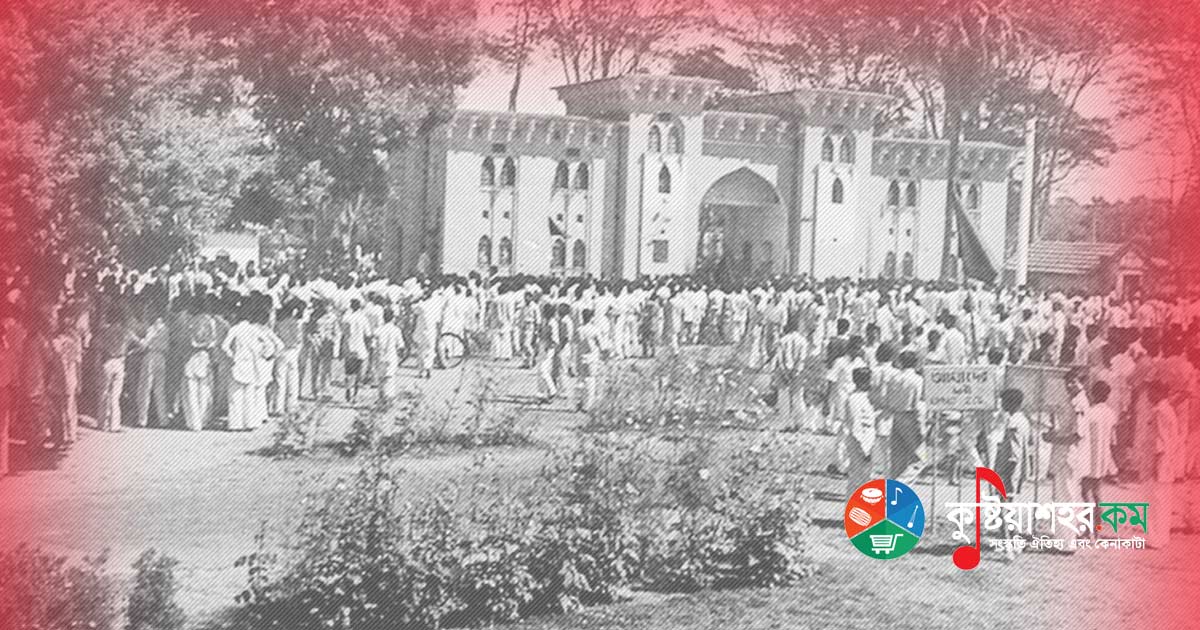
The main driving force behind the renewed intensity of an emotive issue like the Language Movement was Khaja Nazimuddin's speech of 27 January 1952. Khaja Nazimuddin, the then Prime Minister, arrived in Dhaka on 25 January and delivered a long speech at a public rally at the Paltan Maidan on 27 January. Essentially reiterating Jinnah's words, he declared that Urdu would be the state language of Pakistan. In his speech, broadcast live on radio, he further remarked that no nation had ever advanced towards prosperity with two state languages.
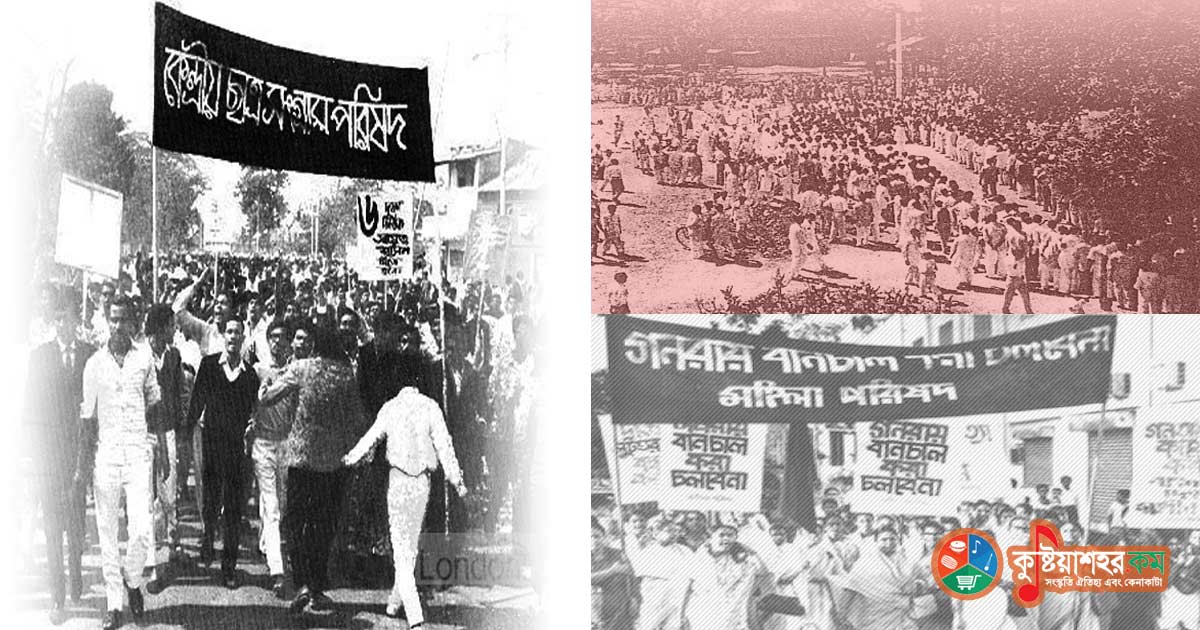
In protest against Nazimuddin's speech, the Rashtrabhasha Sangram Parishad (State Language Action Committee) held a protest meeting on 29 January and a student strike in Dhaka on 30 January. That day the leaders, together with the students, gathered on the Amtala of Dhaka University and decided to hold a strike and protest meeting on 4 February and a province-wide hartal on 21 February. Later they marched with their procession towards Bardhaman House (the present Bangla Academy). The next day, on 31 January 1952, at a meeting held in the Bar Library Hall of Dhaka University, a forty-member all-party central Rashtrabhasha Karmi Parishad (State Language Workers' Committee) was formed under the leadership of Maulana Bhasani. The meeting vehemently opposed the government's proposal to write Bengali in the Arabic script and endorsed the decision to go on strike taken at the 30 January meeting. The Parishad drew up a detailed plan of action for the hartal, rallies and processions of 21 February.
In line with the earlier decision, on 4 February the students of Dhaka University and other educational institutions gathered on the campus of Dhaka University. From the assembly, protest was voiced against the proposal to write Bengali in the Arabic script and the demand was raised that Bengali be adopted as the state language. At the end of their assembly, the students brought out a massive protest procession.
On 20 February, through the local administration, the government imposed Section 144, banning meetings, assemblies and processions in Dhaka for one month from 21 February. The students of Dhaka University held meetings in the various halls and decided to break Section 144. On the night of 20 February, an all-party meeting of the Rashtrabhasha Karmi Parishad was held at the central office of the Awami Muslim League at 94 Nawabpur Road, presided over by Abul Hashim. Although some members of the Parishad favoured defying the ban, it was ultimately decided by 11 votes to 3 not to break Section 144. On the same night of 20 February, separate meetings on the same subject were held in the different halls of Dhaka University. In the evening, at Salimullah Hall, the decision to break Section 144 was taken under the chairmanship of Fakir Shahabuddin. At the meeting held at Fazlul Haq Muslim Hall, the leadership was taken by Abdul Momin. Following Shahabuddin Ahmed's proposal, Abdul Momin and Shamsul Alam took on the responsibility of informing the Rashtrabhasha Sangram Parishad of this decision.
Events of 21 February
According to the pre-announced programme, from nine in the morning of that day the students of various educational institutions began gathering on the campus of Dhaka University. They kept shouting slogans against the imposition of Section 144 and calling on the members of the East Bengal Legislative Assembly to take the views of the general public on the language question into consideration. The police, weapons in hand, cordoned off the meeting venue. The deans of the various faculties and the Vice-Chancellor of the university were present at the time. At about a quarter past eleven, when the students gathered at the gate, prepared to break through the obstruction and come out onto the street, the police fired tear gas to warn them back. Some students ran off towards Dhaka Medical College, while the rest, hemmed in by the police on the campus of Dhaka University, continued to protest against the police aggression. The Vice-Chancellor then requested the police to stop firing tear gas and ordered the students to leave the university area. But when the police began arresting a few of the students on charges of breaking Section 144 as they were leaving the campus, violence spread. Many students were arrested, taken to Tejgaon and released there. Enraged further by the incident, the students resumed their protests.
At around two o'clock, when the members of the Legislative Assembly arrived to attend the legislature, the students blocked their way. But the situation changed dramatically when some students decided that they would go into the legislature and place their demands there. As the students set off towards the legislature for this purpose, at around three o'clock the police rushed in and started firing on the student hostel. In the police firing, Abdul Jabbar and Rafiq Uddin Ahmed were killed on the spot. Besides them, Abdus Salam, Abul Barkat and many others were also killed at the time. That day a boy of eight or nine named Ohiullah was also killed.
News of the killing of the students spread fast, and people set out for the scene. Within moments all offices, shops and transport came to a halt. The movement begun by the students at once took the shape of a people's movement. The radio artistes took an instant decision to call an artistes' strike, and the radio station went on broadcasting previously recorded programmes.
At that time, preparations were under way for the session of the Constituent Assembly. On learning of the police firing, Maulana Tarkabagish, along with several opposition members, left the chamber and stood beside the enraged students. In the Constituent Assembly, six junior members, including Manoranjan Dhar, Boshontokumar Das, Shamsuddin Ahmed and Dhirendranath Datta, requested Chief Minister Nurul Amin to visit the injured students in hospital and proposed that the session be adjourned in mourning. Maulana Abdur Rashid Tarkabagish of the treasury bench, Sharfuddin Ahmed, Samshuddin Ahmed Khondokar and Moslehuddin Ahmed supported this move. Nurul Amin, however, did not heed the request of the other leaders and spoke in the session against the Bengali language.
Events of 22 February
That day the opposition members raised the matter in the Legislative Assembly. They called on Prime Minister Nurul Amin to visit the injured students in hospital and to announce the adjournment of the session. Some members of the ruling party too supported the call. But Nurul Amin, not responding to their appeal, continued the session and refused to go to the hospital.
On 22 February the whole country rose up, turbulent with processions and protests. The people defied Section 144 while observing mourning. Officials and employees of various offices left their workplaces and joined the students' processions. The officials and staff of the Secretariat and the city's civil society visited the Dhaka Medical College hostel; a janaza (funeral prayer) was later held with their participation, and when the janaza was over they joined a huge procession. At around eleven o'clock, a procession of thirty thousand people marched towards Curzon Hall. The police first tried to move them away and at one point opened fire on them. By official count, four people were killed in that incident.
Janazas and processions were held in the same manner in different parts of the city. People came from various colleges, banks and other institutions to take part in the procession. In the afternoon, another huge procession was attacked by the police. The enraged public set fire to the offices of Jubilee Press and Morning News, two front-rank pro-government newspapers. It may be noted that the morning paper had been printed at Jubilee Press.
Various incidents of police attack and killing took place on the same day. The police opened fire on the huge janaza procession on Nawabpur Road. In that firing, Shafiur Rahman, an employee of the Dhaka High Court, Wahidullah and Abdul Awal were martyred. On the same street the body of a nine-year-old boy named Ohiullah was found lying. It is said that the police cunningly removed some of the bodies.
Subsequent Events (1952)
After the events of 21 and 22 February, the government mounted a powerful disinformation campaign against the movement. It tried to make people believe that, incited by communists and anti-Pakistan elements, the students had attacked the police. They kept up this propaganda in various ways, distributing leaflets across the country and putting pressure on the newspapers to report the news as they wished. At the same time, they continued the mass arrest of ordinary people and students. On 25 February, when Abul Barkat's brother tried to file a murder case, the government refused to take it, citing lack of proper papers. When Rafiquddin Ahmed's family made a similar attempt, that too was dismissed for the same reason. On 8 April the government began an inquiry. But its report could show no significant justification for firing on the students at the Medical College. The central action committee rejected the government's promised report. When the Constituent Assembly session began on 14 April, the question of the state language came to the fore. Many members spoke in favour of resolving the issue, but the Muslim League members played a silent role; when they voted against the matter, it was shelved indefinitely. In this way they broke the promise, made after the events of 21 and 22 February, to speak in the Constituent Assembly in favour of the Bengali language. On 27 April, at the Bar Seminar Hall, the central all-party action committee convened a seminar and placed a 21-point demand before the government. When Dhaka University reopened on 16 April, the students held a rally that day. With the arrest of Abdul Matin, the chief leader of the University League Committee, the committee was reorganized once again.
Shaheed Minar
On the night of 23 February, the students of Dhaka Medical College began building a Shaheed Minar. The work was finished before dawn on the 24th. A handwritten paper was planted in it, inscribed with the words 'Shaheed Smritistambha' (Martyrs' Memorial). The news of the building of the Shaheed Minar was sent to the daily newspapers that very day. Under the headline 'In memory of the martyred heroes,' the Daily Azad carried the news of the Shaheed Minar.
The minar was built at the eastern end of the bar-number shed of the Dhaka Medical College students' hostel (barracks), diagonally beside the hostel's central road. The purpose was that it could easily be seen from the outside street, and that anyone stepping out of any shed and standing on the long straight inner road would have it catch the eye. The Shaheed Minar was 10 feet high and 6 feet wide. Supervising its construction was GS Sharfuddin (known as Engineer Sharfuddin), the design was drawn by Badrul Alam, and with them was Sayeed Haider. Two masons helped build the Shaheed Minar. Bricks and sand kept aside for the Medical College's expansion were used, and cement was brought from the warehouse of Piaru Sardar of old Dhaka. After dawn the minar was covered with a cloth. That very day, that is, on the morning of 24 February, the father of the 22 February martyr Shafiur informally inaugurated the Shaheed Minar. On the morning of 26 February, at about ten o'clock, Abul Kalam Shamsuddin, editor of the Daily Azad, inaugurated the Shaheed Minar. On the day of its inauguration, 26 February, the police and the Pakistan army surrounded the residential hostel of the Medical College students and demolished the first Shaheed Minar. A Shaheed Minar was then also built at Dhaka College, which too was at one point demolished on the government's orders.
Finally, after Bengali was granted recognition as the state language of Pakistan, work on the central Shaheed Minar began officially in 1957. Under the supervision of a committee formed under the leadership of the Vice-Chancellor of Dhaka University, Professor Dr. Mahmud Husain, the construction of the Shaheed Minar was completed in 1963, and on 21 February 1963 the martyr Barkat's mother inaugurated the minar.
On 25 February, the workers of mills and factories called a strike in Narayanganj city. On 29 February the participants in the protest suffered a massive police assault.
The Song of Ekushey
After the firing on 21 February, the first song about 'Ekushey' was by Abdul Gaffar Choudhury; the song is 'Amar Bhaiyer Rokte Rangano Ekushey February, Ami Ki Bhulite Pari' (Can I forget the twenty-first of February, stained by my brother's blood?). Abdul Latif first set the song to melody. Later, after returning to Dhaka from Karachi, Altaf Mahmud set it to a new tune again in 1954. From then on it became the song of the Ekushey morning procession. Today it is Altaf Mahmud's tune that is sung. In 1954 the song was published in the Ekushey anthology edited by Hasan Hafizur Rahman; the government of the time confiscated the anthology. After Zahir Raihan used the song in his film Jibon Theke Neya (Taken from Life), its popularity spread widely. After 21 February was recognized as International Mother Language Day, the song's renown began to grow even more in the international arena. It has already been translated into Swedish and Japanese. In a BBC listeners' poll it placed third in the list of the greatest songs in the Bengali language.
The Final Phase (1953–56)
The central all-party action committee decided to observe Shaheed Day in memory of 21 February. Sheikh Mujibur Rahman, acting general secretary of the Awami League, also agreed to observe the day. On 18 February 1953, the students signed an agreement with the administration to observe 21 February peacefully. On the first anniversary of the Language Movement, Shaheed Day was observed across the country with due solemnity. Most offices, banks and educational institutions remained closed. People from different areas joined the morning processions. Thousands of people, wearing black badges as symbols of mourning, came to the university campus and left it in processions. Volunteers were appointed to prevent violence. A massive rally was held at Armanitola in the presence of about a hundred thousand people. A one-point demand was placed at the rally; along with the language demand, the release of political detainees, including Maulana Bhasani, was raised. The railway workers, agreeing with the students' demands, went on strike. The students of the university's various halls paid homage to the martyrs. On the other hand, Pakistan's Finance Minister Fazlur Rahman declared that those who wanted Bengali as the state language were traitors to the country. Disillusioned by his statement, the people showed him black flags. Memorial badges inscribed 'We want Bengali as the state language' were distributed among the general public. The Language Sangram Committee called rallies to mark the observance of the day. Various cultural events were organized to give the movement further momentum. Special periodicals were published on the occasion. The movement's immortal, inspiring song 'Amar Bhaiyer Rokte Rangano...' was published that year as a poem on leaflets. On the night of 21 February 1954, when black flags were hoisted on the roofs of the various halls of Dhaka University, the police arrested some students.
The year 1954 is marked as a year of sweeping change in the political and language-movement landscape of East Bengal. The United Front, formed under the leadership of A. K. Fazlul Huq, and the Awami League censured the ruling Muslim League with the proposal for greater provincial autonomy. With the election ahead, the Muslim League kept up its efforts so that the United Front would not get another opportunity for agitation; for this they arrested several leaders and activists of the United Front before Language Movement Day. On the other hand, to break the deadlock on language matters, a meeting of the Muslim League's parliamentary committee was held in Karachi. Prime Minister Mohammad Ali Bogra presided over the meeting, and it was decided that Bengali would be made a state language with status equal to Urdu. As a result of this decision, the representatives of the various provinces of West Pakistan demanded equal status for the six languages spoken there. Abdul Haq (known as 'Baba-e-Urdu') protested the decision and stood firm against it. Under his leadership, a huge protest rally was organized in Karachi on 22 April. Nearly one hundred thousand people joined the rally and protested the Muslim League's decision. In the violent incidents there, the office of the Sindhi-language daily Al-Wahid was set on fire. On the other hand, on 27 April a rally was held demanding equal status for Bengali and other languages, and the minority Urdu-speakers who opposed the decision were sharply criticized for their mentality. In such an alarming situation, moves to implement the decision came to a halt. In the Constituent Assembly elections the United Front this time won the majority of seats, while the Muslim League's seat count was extremely small.
On coming to power, the United Front established the Bangla Academy. Its constitution stated that the institution would work for the preservation, research and development of the Bengali language, culture and heritage. Within days of the United Front coming to power, Pakistan's Governor General Malik Ghulam Muhammad announced the dismissal of the central and provincial governments on 30 May 1954. The United Front was reconstituted on 6 June 1955; although the Awami League did not join the council of ministers.
In 1956, 21 February was observed for the first time with the government's covert support. A major project was undertaken by the government towards building the Shaheed Minar anew. The proceedings of Pakistan's Constituent Assembly were suspended for five minutes in memory of the martyrs of the Language Movement killed by police firing. Shaheed Day was observed across the country and most institutions remained closed. Maulana Bhasani led a massive rally at Armanitola.
The Language Movement's Influence on Bengali Culture
The Bengali language movement has had a significant influence on the cultural life of the Bengali people. The movement has played a considerable role in creating among Bengalis the mindset of celebrating the Bengali language on various occasions and of working for the language's development. In Bangladesh, 21 February is observed as 'Mother Language Day' or 'Shaheed Day,' and at the same time as a national holiday. The month of February is also celebrated in many other ways, including the month-long observance of the Amar Ekushey Book Fair, widely known as the Ekushey Boi Mela. Also in this month, in honour of the sacrifices of those who made sacrifices in the Language Movement, 'Ekushey Padak,' one of Bangladesh's principal civilian state awards, is announced. To carry the emotion of Ekushey into people's hearts, patriotic songs, plays, poems and films of various kinds have been created on the events and spirit of Ekushey. Most notably among them is the song 'Amar Bhaiyer Rokte Rangano,' written by Abdul Gaffar Choudhury and set to music by Altaf Mahmud. Ever since the Language Movement of 1952, the movement's influence has been manifest in various fields of Bengali literature from various perspectives. Among the works are the play Kobor (The Grave) by the martyred intellectual Munier Choudhury; the poems Bornomala, Amar Dukhini Bornomala and February 1969 by the poet Shamsur Rahman; the novel Ekushey February by Zahir Raihan; and Artonad by the distinguished fiction writer Shawkat Osman. In addition, the film Jibon Theke Neya, directed by Zahir Raihan and centred on the Language Movement, was made.
Two years after the first Shaheed Minar was demolished, a new one was built in 1954 in memory of those killed. In 1957, with the cooperation of the United Front government, work began on a large-scale Shaheed Minar. The architect of the new Shaheed Minar was Hamidur Rahman. This large structure was built on the grounds of the Dhaka Medical College hostel. On the central pedestal, five columns arranged in a semicircle convey that the mother stands with her martyred children. Because of the martial law of 1958, the progress of the monument's construction suffered somewhat. On 21 February 1963, Hasna Begum, the mother of Abul Barkat, inaugurated the Shaheed Minar. During the Liberation War of 1971 the Pakistani forces demolished it. Later, in 1973, the Government of Bangladesh rebuilt it.
Apart from East Pakistan, there was also a movement in India's Assam state aimed at giving the Bengali language equal status. On 19 May 1961, when the demand was raised at the Silchar railway station for Bengali's recognition as a state language, eleven Bengalis were martyred in police firing. Later, Bengali was granted the status of a semi-official language in the three districts of Assam with larger Bengali-speaking populations.
International Mother Language Day
To have 21 February recognized as 'International Mother Language Day,' the Government of Bangladesh placed a written proposal before UNESCO, which was passed with absolute support at the organization's 30th General Conference on 17 November 1999.
Bangladesh's Independence
Although the state-language dispute was settled after 1956, Ayub Khan's military rule forced the debts of Pakistan's Punjabis and Pashtuns onto the Bengalis. Despite being the majority of the population, the Bengalis' presence in the military and civil services was negligible. Moreover, the Bengalis' share of national revenue and government aid was also very small. This discrimination against Bengalis compared with West Pakistan on ethnic grounds gave birth to a simmering resentment. As a consequence, people's support grew overwhelmingly for the Bengali nationalist Awami League, a political party working to protect regional interests. As a result, the people of East Pakistan, inspired by the spirit of the Language Movement, launched the Six-Point Movement demanding greater rights and democracy. That movement later took the shape of Bangladesh's Liberation War.
Reaction in West Pakistan
Although many Bengalis of East Pakistan believe that the Bengali Language Movement was based on ethnic nationalism, through this movement the cultural differences between the two halves of Pakistan became clearly visible. In West Pakistan, the movement was seen as a sectional uprising against the Pakistani national interest. In a state founded on the two-nation theory, rejecting the 'Urdu alone' policy was seen as a grave breach of the Perso-Arabic culture of the Muslims and of the founding ideology of Pakistan. Several powerful politicians of East Pakistan believed that 'Urdu' was part of the Islamic culture of India, while they regarded Bengali as a Bengali culture created in a blend of Hindu culture. Most of those who favoured the 'Urdu alone' policy believed that Urdu needed to be established not merely as the language of the country of Pakistan but as the language of the entire nation. Such thinking too was considered one of the reasons for taking a stand against the Urdu policy; for Pakistan at the time had a number of other linguistically distinct communities. Towards the end of 1967, Ayub Khan said that "East Pakistan ... is still under Hindu culture and influence."
After the movement, the Awami Muslim League began conducting party activities on the basis of Bengali nationalism and dropped the word "Muslim" from the party's name. The Language Movement gave momentum to the activities of the ethnic-nationalist parties of West Pakistan. At the same time, in East Pakistan the political instability and the power struggle between the central government and the provincial government led by the United Front were among the principal causes of Army Chief Ayub Khan's military coup of 1958.
The Bengali Language Movement in the Media
The incident of students being killed in Dhaka was also reported in The New York Times. It stated there: "Pakistani police fire on students in Dhaka over language."