বাংলা
 English
Every late November the United States slips into two very different celebrations at once — Thanksgiving, the family holiday around a laden table, and Black Friday, the dawn-queue shopping frenzy that follows the next morning. In 2026 Thanksgiving falls on Thursday, 26 November, with Black Friday arriving on Friday, 27 November. The pairing looks accidental, yet behind it lies four centuries of history, political wrangling and the arithmetic of retail.
What is Thanksgiving, and when is it?
Thanksgiving is one of the United States' principal holidays — a family festival of gratitude for the year's blessings at the close of the harvest season. The date rule is simple: the fourth Thursday of November. That rule became law in December 1941; before then, the date was a matter of dispute. Doing the maths, Thanksgiving 2026 falls on Thursday, 26 November. Under this rule the holiday can never come before 22 November or after 28 November. In neighbouring Canada, Thanksgiving arrives much earlier — on the second Monday of October; in 2026 that was 12 October, under a proclamation issued in 1957.
Where it began: the Plymouth feast of 1621
The Pilgrims, who had sailed from England on the Mayflower to escape religious persecution, settled at Plymouth in Massachusetts in 1620. Half of them died during the brutal first winter. When the survivors gathered their first harvest the following year, they held a three-day feast in the autumn of 1621. Contemporary accounts record that Massasoit, leader of the local Wampanoag people, arrived with some ninety men, bringing five deer. Historians place the feast somewhere between late September and early November, with a menu of wild fowl, fish, shellfish and corn-based dishes — none of today's familiar potatoes or pies. Curiously, historians argue the event was not strictly a "day of thanksgiving" at all, but a harvest celebration; it became a symbolic holiday of gratitude only over the following centuries.
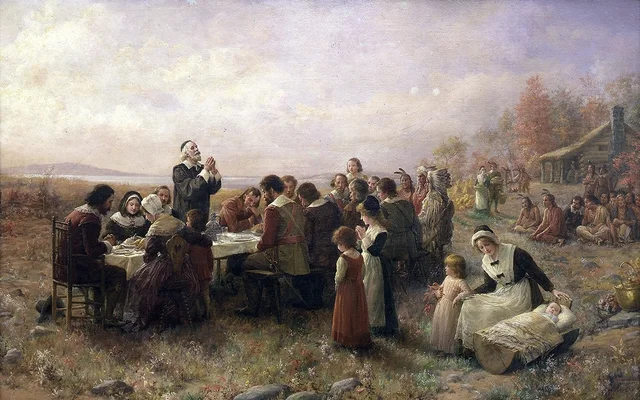
The 1621 harvest feast at Plymouth as imagined by Jennie Augusta Brownscombe (Image: Jennie Augusta Brownscombe / Wikimedia Commons, public domain)
The long road to a national holiday
While states observed the holiday on different dates, national recognition took longer. Sarah Josepha Hale, editor of Godey's Lady's Book, spent decades writing to presidents demanding a national Thanksgiving Day. Largely thanks to her campaign, President Abraham Lincoln in October 1863 proclaimed the last Thursday of November a national day of thanksgiving. But the story does not end there. During the Depression, President Franklin Roosevelt moved the holiday a week earlier in 1939 to lengthen the Christmas shopping season — a decision mocked by critics as "Franksgiving" and prompting a national argument over two rival Thanksgivings. Finally, in December 1941, Congress fixed the fourth Thursday of November by law as the definitive holiday.
The traditions of Turkey Day
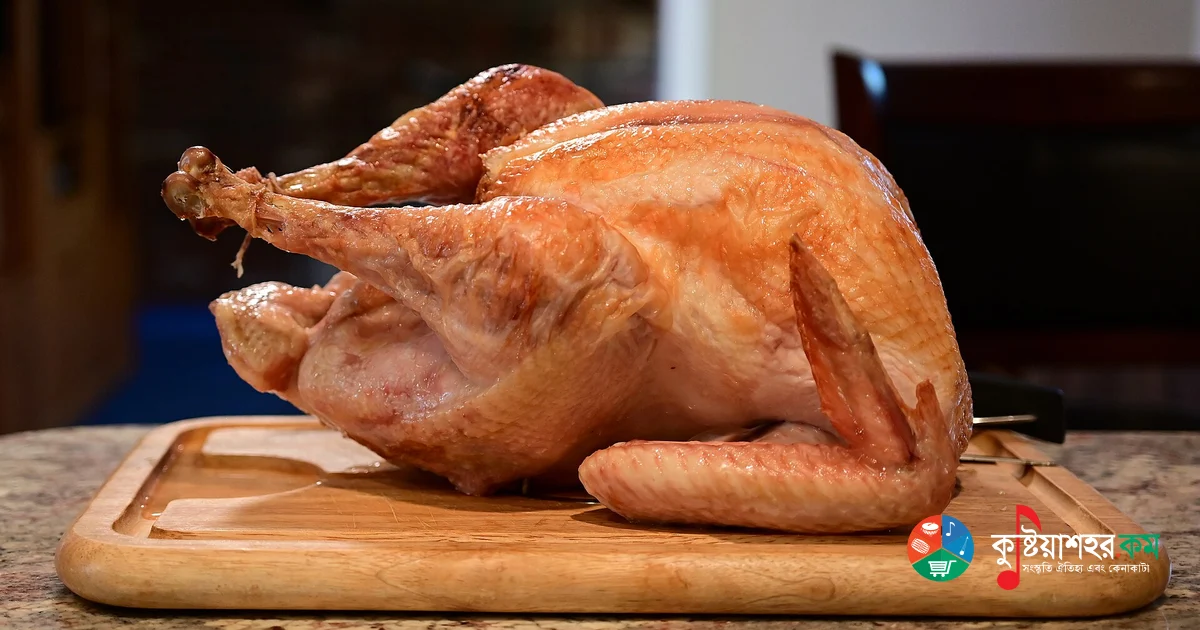
Today Thanksgiving conjures the image of a family table centred on a roasted turkey. One estimate counts roughly 40 million turkeys served in the United States on this single day in 2019. Since 1924, New York's Macy's Thanksgiving Day Parade has been another symbol of the day, its giant balloon figures floating down city streets. American football has an even older tie-in: the NFL has played on Thanksgiving almost every year since its founding, and the Detroit Lions have taken the field on the holiday continuously since 1945. Even the President's "turkey pardon" — comically sparing one turkey from the dinner table — is now a fixture, a permanent tradition since President George H. W. Bush in 1989.
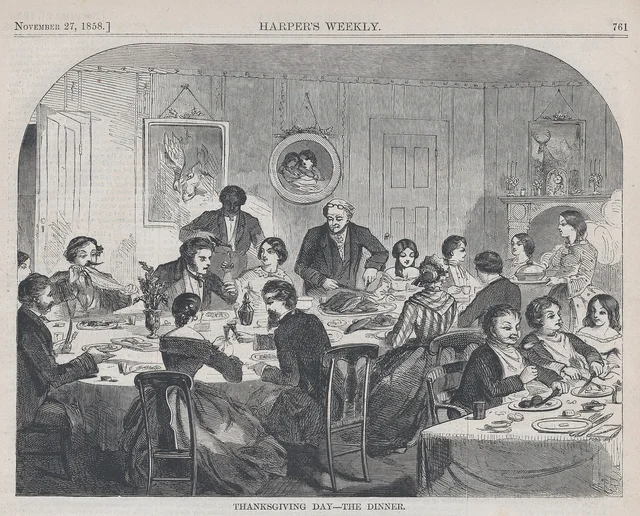
Thanksgiving Day – The Dinner, an 1871 Harper's Weekly engraving by Winslow Homer (Image: Winslow Homer / Wikimedia Commons, CC0)
Where the name "Black Friday" comes from
There is no mysterious curse behind Black Friday — the name was born of very practical circumstances. Its earliest known use appears in November 1951 in the journal Factory Management and Maintenance, describing workers who called in sick to enjoy a four-day weekend after Thanksgiving. Through the 1950s and 60s, police in Philadelphia and Rochester used "Black Friday" to describe the congestion and crowds that descended on their cities at the start of the Christmas shopping season. In 1961 an attempt to rename the day "Big Friday" failed to catch on. By November 1975 the New York Times was using the name in the same sense. In the early 1980s, retailers attached a more flattering explanation — accountants record losses in red ink and profits in black, and Black Friday's surge in sales pushed stores "into the black". Note that an earlier event, the 1869 collapse of the US gold market, is also called "Black Friday", but it has nothing to do with the shopping day.
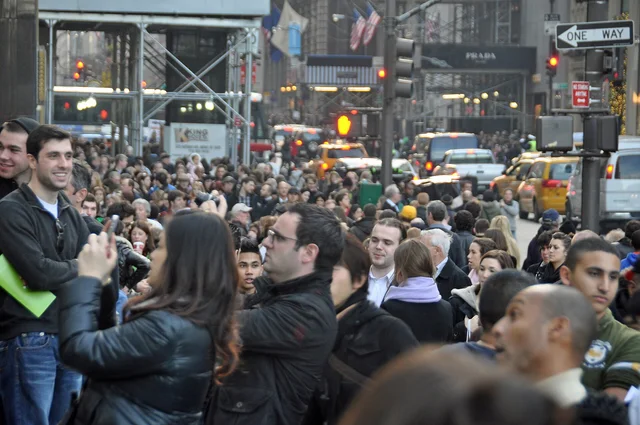
The queue outside the Apple Store on Fifth Avenue, New York, at dawn on Black Friday 2011 (Image: JoeInQueens / Wikimedia Commons, CC BY 2.0)
From Black Friday to Cyber Monday
Black Friday today is no longer a single-day scramble but a season of deals stretching across several weeks from this November holiday to Christmas — the unofficial start of America's holiday shopping season. According to the National Retail Federation (NRF), shoppers spent about $68.8 billion over the Black Friday weekend in 2019, and in pandemic-hit 2020 some 186 million people shopped in stores and online over that weekend. The online trend runs hotter still: US online sales on Black Friday reached about $9 billion in 2020 and a record of roughly $9.12 billion in 2022 — by then more than half of it from smartphones. There were even estimates that US shoppers would spend over $100 billion in the 2025 season. In this same tradition, Shop.org, a division of the NRF, coined the name "Cyber Monday" in 2005 to describe the post-holiday habit of returning to the office and shopping online; by 2013 the day's online sales had reached $1.73 billion.
What Black Friday means to shoppers in Bengal
Black Friday may be an American holiday, but its wave of deals does not recognise borders. Many international companies slash prices on software, app subscriptions, e-books, online courses and gadgets during this week, and shoppers anywhere in the world — Bangladesh included — can buy them online; digital products in particular arrive without any delivery hassle. Asia has its own counterpart: China's "Singles' Day" or 11.11, said to be nearly four times the size of Black Friday and Cyber Monday combined, with 2025 sales exceeding $150 billion. Still, keep in mind: resist entering card details on unfamiliar sites in the heat of a deal, verify the checkout connection is secure (https), and compare the "discount" against the product's earlier price to judge whether it is real.
At a glance: the 2026 dates
- Thanksgiving: Thursday, 26 November 2026
- Black Friday: Friday, 27 November 2026
- Small Business Saturday: Saturday, 28 November 2026
- Cyber Monday: Monday, 30 November 2026
From a three-day feast in Plymouth four centuries ago to today's billion-dollar online marketplace, the pairing of Thanksgiving and Black Friday is a mirror of America's intertwined history and commerce. And what Bengal gets from the story is the part that fits on a phone screen: billion-dollar deals within arm's reach.