বাংলা
 English
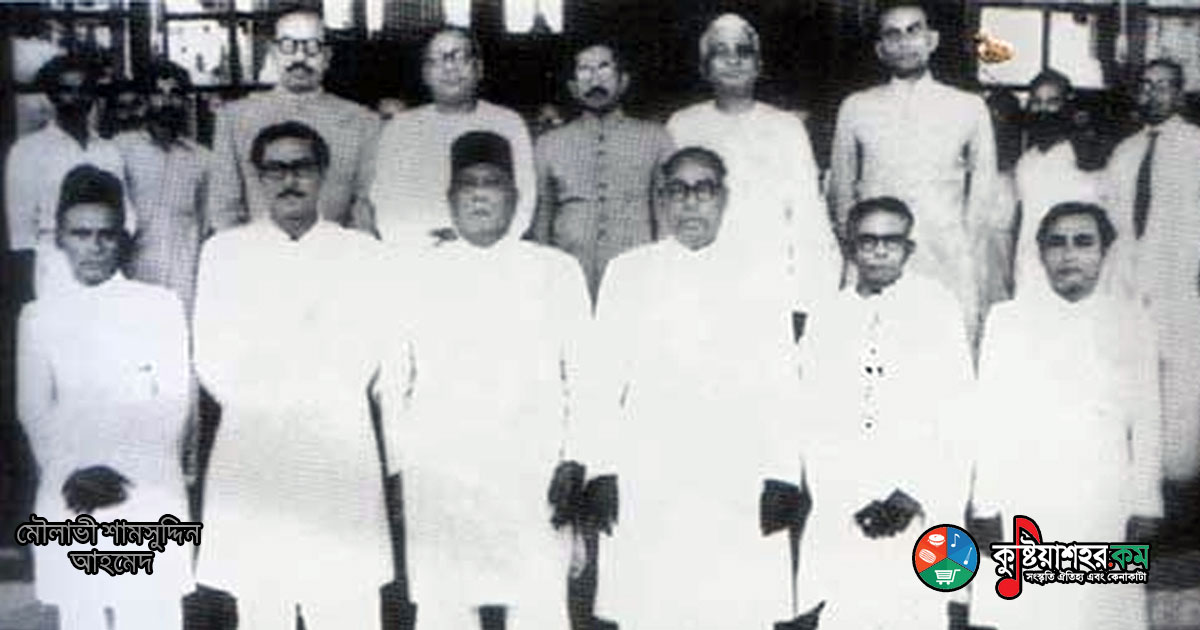
Maulvi Shamsuddin Ahmed (born August 1889, died 31 October 1969) was the first minister of undivided Bengal. A lifelong struggler, a friend of the common people and of workers and peasants, the first minister of undivided Bengal, leader of the Krishak Praja Movement, general secretary of the All-Bengal Khilafat Council and a lawyer of the Dhaka High Court — Maulvi Shamsuddin Ahmed.
A worthy son of Kushtia, the first minister of commerce and industry of undivided Bengal and minister of communications and works in Haque's second cabinet, Maulvi Shamsuddin Ahmed was the principal mover behind Kushtia Government College, and he was its founding president. In 1946 he played the leading role in establishing Kushtia Government College and the Aliya Madrasa. Alongside his political life, he also kept a keen eye on public welfare work, education and literature. He founded numerous schools, colleges and madrasas in undivided Bengal. He was the founder of the famous peasant newspaper of which the rebel poet Kazi Nazrul Islam was the editor. Building a road network from Teknaf to Tetulia was his plan while he was a minister. The Dhaka-Aricha road and the Chittagong-Teknaf road were part of this plan. Today's Kaptai electricity project too was a plan of his time as minister.
Maulvi Shamsuddin Ahmed's life was full of work. All his life he was a devoted, patriotic, selfless social worker for the common people. His contribution, and that of his era, composed the backdrop for the rise of today's independent Bangladesh. But this politician, devoted to the independence of the country, has still not been properly valued. Maulvi Shamsuddin Ahmad was born in August 1887 in Sultanpur of Kumarkhali. His father Mahtab Uddin was a social reformer.
Shams Uddin Ahmad passed from Hooghly Madrasa and studied in Kolkata. He passed his Entrance from Kolkata Collegiate School in 1910, obtained his BA from Presidency College in 1914, and his MA and BL degrees from Kolkata University in 1916. He began his law practice in the district court of Krishnanagar in 1977 and at the Kolkata High Court in 1919 as the junior of Deshbandhu Chittaranjan Das. But why would the profession hold back one who was born to devote himself to the welfare of all the people of his land? Maulvi Shamsuddin Ahmad joined the 'Khilafat Movement' in 1920.
At this time the Khilafat Movement gained strong momentum across the whole of Bengal, including Kushtia district. This movement turned into a political movement against British rule. His elder, Maulvi Afsar Uddin Ahmad, was also involved in this movement, and they were arrested. Those who, alongside Shamsuddin Ahmad, played roles in this movement in this district were: Afsaruddin Ahmad, Hemanta Kumar Sarkar, Sabitri Prasanna Chattopadhyay, Sukumar Bandopadhyay, Someshwar Prasad Chowdhury, Fateh Chand Naita and others. Like the pioneering 'Ali brothers' of India in the Khilafat Movement, they were called the 'Ahmad brothers'.
Released from jail in 1922, Maulvi Shamsuddin Ahmad became widely engaged in politics and social work. Here is a brief account of his notable activities:
- Joining the Khilafat Movement in 1920
- Secretary of the Bengal Congress and the Khilafat Committee in 1922
- Victory as a Congress candidate in the Bengal Legislative Council in 1927
- Taking a role alongside Netaji Subhas Bose in 1928 to suppress the troubles of the Tata company
- Formation in 1929 of the Muslim Nationalist Party founded by Maulana Abul Kalam Azad and appointment to the post of secretary
- Victory in the election for membership of the Kolkata Corporation in 1933
- Assuming the post of secretary in 1936 of the All-Bengal Krishak Praja Samiti formed under the chairmanship of Sher-e-Bangla
- Taking part in the election under the Government of India Act in 1935 and winning 42 seats
- Winning election in 1937 as member of the Bengal Legislative Council as a candidate of the Krishak Praja Samiti
- Appointment in 1938 as the first minister of undivided Bengal in Sher-e-Bangla A. K. Fazlul Haque's cabinet
- Resignation in 1939 from Sher-e-Bangla A. K. Fazlul Haque's cabinet on a question of policy
- In 1942, in Sama Haque's cabinet, serving as minister of works
- Joining the Muslim League in 1946 and, elected to the Legislative Council in the election, serving as minister of industry, commerce and labour in Suhrawardy's cabinet
- In 1951, despite being appointed ambassador to Burma during Liaquat Ali Khan's tenure, resigning from the post of ambassador because of the discriminatory behaviour of the later prime minister Khaza Nazim Uddin
- Shamsuddin Ahmad played a historic role in the formation of the Cloud Commission for enacting the law abolishing the zamindari system of Bengal and in running the Praja Samiti.
He passed away on 31 October 1969. He was buried in the traditional Eidgah cemetery ground of Kaya village. He left behind five sons and four daughters at his death. The ideal he left in politics, the people of the country will remember with respect forever. Because he worked for the ordinary farmers, he will live for thousands of years in the hearts of the farmers of this land.