বাংলা
 English
After attaining prophethood, the great Prophet Hazrat Muhammad (SAW) began preaching the religion of Islam in Makkah. Because of his preaching of Islam, the Quraysh inflicted cruel oppression and persecution upon the great Prophet (SAW) and his Companions (RA). Even after such persecution, when the great Prophet (SAW) continued his call to the faith, the Quraysh at one stage made a plot to kill the great Prophet (SAW).
In this situation, by the command of Allah, the great Prophet (SAW), taking Hazrat Abu Bakr (RA) with him and evading the eyes of the enemies of Islam, left his motherland Makkah on 22 September 622 CE and made the Hijrah to Madinah. Hearing the news that the great Prophet Hazrat Muhammad (SAW) had migrated from Makkah and was coming to Madinah, the people of Madinah rose up, intoxicated with joy. Every day, crowds of young and old, men and women, would come out from Madinah and gather at a place called Harrat of the Quba hamlet, three miles away, and wait for him. But not seeing him, everyone would return in disappointment. One day a Jew climbed the rampart of a fortress, saw dust rising from far away, and cried out the glad tidings of the great Prophet's (SAW) arrival to the people of Madinah. Hearing the news, the people of Madinah at once burst into joy and welcomed the great Prophet (SAW) warmly.
After migrating to Madinah, the Prophet (SAW) first accepted the hospitality of Kulthum ibn Hidm, the clan chief of the tribe of Amr ibn Awf. The great Prophet (SAW) stayed there for 14 days. During this stay he built Masjid Quba on a plot of land used for drying dates belonging to Kulthum ibn Hidm (RA). Masjid Quba was the first mosque of the Ummah of Muhammad (SAW). In rank Masjid Quba comes right after Masjid al-Haram, Masjid an-Nabawi and Masjid al-Aqsa. Verse 106 of Surah At-Tawbah of the holy Quran mentions this mosque. The great Allah Taala instructs: 'The mosque founded on taqwa from the very first day (Masjid Quba) has more right that you should stand in prayer there. In it are people who love to purify themselves, and Allah loves those who purify themselves.' (Surah At-Tawbah, verse 106)
From its first construction to this day Masjid Quba has been renovated and rebuilt several times. After the great Prophet (SAW), Islam's third caliph Hazrat Uthman (RA) carried out the first renovation and rebuilding of Masjid Quba during his caliphate. Afterwards, at different times, the mosque was rebuilt and renovated seven more times. After becoming very old and dilapidated, the mosque was last rebuilt in 1986. In the construction of this mosque, one kind of white stone was used throughout the mosque.
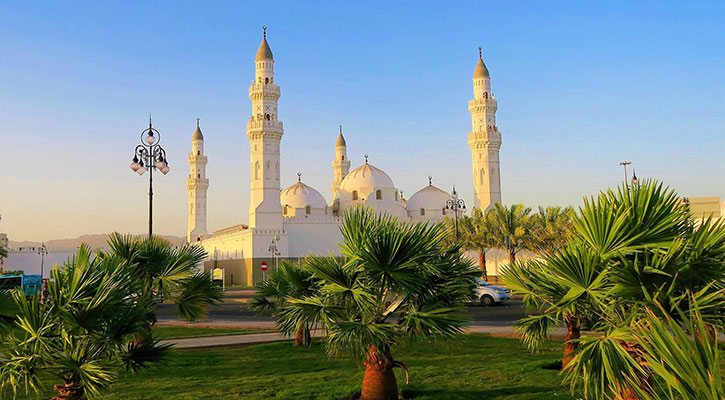
Masjid Quba, with four minarets and two storeys, has 1 large dome and 5 relatively smaller domes on its roof. Besides, the rest of the roof bears many small shapes resembling domes. Beside it lies a garden of date palms, a sight that dazzles the eyes. Seeing the mosque from a distance in the golden afternoon fills the heart.
This mosque is located to the south-west of Masjid an-Nabawi, and its distance from Masjid an-Nabawi is 3.25 km. The Messenger of Allah (SAW) spent 10 years in Madinah. During this time the Messenger of Allah (SAW) would go to Quba Mosque on foot or riding a camel, and then offer two rakats of prayer there. It is narrated in the Hadith Sharif: 'During his life in Madinah, the great Prophet (SAW) would come to Masjid Quba every Saturday, sometimes on foot and sometimes riding a camel. The renowned Companion Hazrat Usaid ibn Hudair al-Ansari (RA) narrated that the great Prophet (SAW) instructed: offering one prayer in Masjid Quba is equal, in reward, to an Umrah.' (Tirmidhi) Because of this honour and dignity of Masjid Quba, even after the passing of the great Prophet (SAW), distinguished Companions (RA) such as Hazrat Abu Bakr (RA) and Hazrat Umar (RA) would often come from Madinah to Masjid Quba in emulation of the great Prophet (SAW) and offer prayers there. Following the great Prophet (SAW), coming here and offering two rakats of prayer is mustahab.