বাংলা
 English
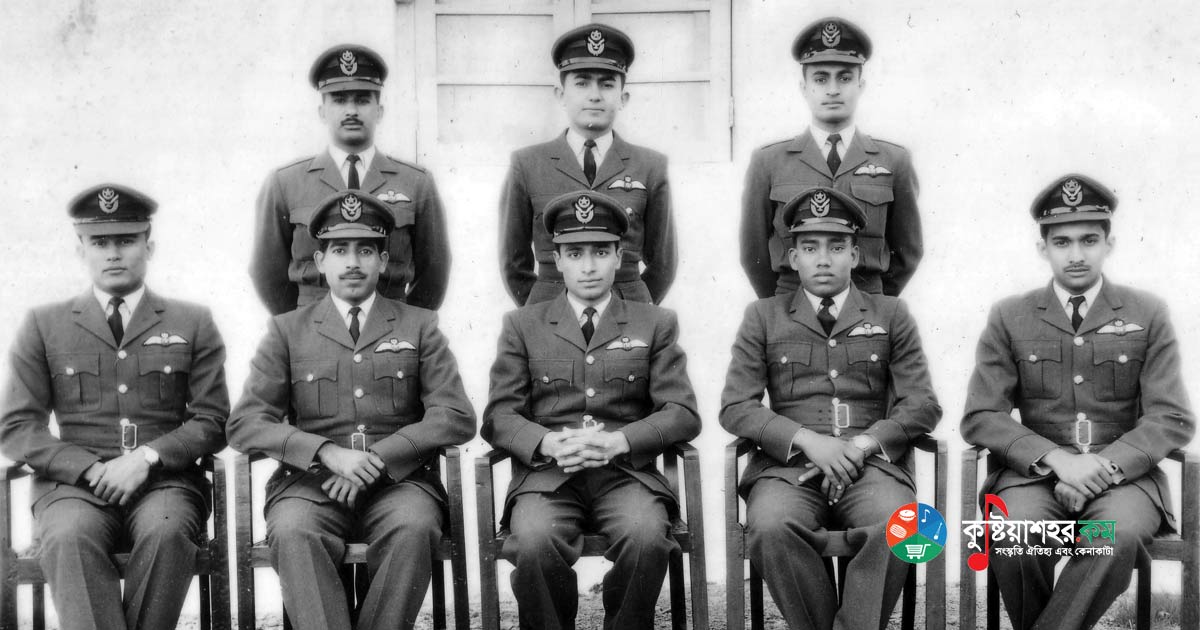
Birshreshtha Flight Lieutenant Matiur Rahman (29 October 1941 - 20 August 1971) was a martyred freedom fighter of Bangladesh. Of the seven heroes honoured with Bangladesh's highest military honour, the title of "Birshreshtha", in recognition of supreme courage and extraordinary valour in the great Liberation War of Bangladesh, he is one.
Matiur Rahman was born on 29 October 1941 in "Mobarak Lodge" at 109, Agha Sadek Road, in old Dhaka. His paternal home is in Ramnagar village of Raipura thana in Narsingdi district, now known as Motinagar. He was the sixth of 9 brothers and 2 sisters. His father was Maulvi Abdus Samad, his mother Sayeda Mobarakunnesa Khatun. After passing class six from Dhaka Collegiate School he was admitted to the Pakistan Air Force Public School at Sargodha. He passed the matriculation examination with success in the first division, with distinction.
Matiur Rahman joined the Pakistan Air Force in 1961. In 1963 he was commissioned as a pilot officer from the Risalpur PAF College. After being commissioned he was appointed a general duty pilot in No. 2 Squadron of the Mauripur (now Masroor) air base in Karachi. There he completed a conversion course on the T-33 jet aircraft and passed with 75.66% marks. He then also took a conversion course on the F-86 Sabre jet and passed with 81% marks. On the strength of the good results in the pilots' conversion course he was posted to Peshawar (No. 19 Squadron).
In 1965, during the India-Pakistan war, he was serving as a flying officer. He then went to Sargodha again for a MiG conversion course. There, on 21 July 1967, while flying a MiG-19 aircraft, when it suddenly failed in the air, he landed on the ground safely by parachute with skill. In 1967 he was promoted to the rank of Flight Lieutenant. He was the only Bengali pilot in the air display held at Peshawar in honour of Iran's Queen Farah Diba. After working for two years as a flying instructor at Risalpur, in 1970 he was transferred and came as a jet flying instructor.
At the beginning of 1971, in the last week of January, Matiur Rahman came to Dhaka on two months' leave with his family. On the black night of 25 March he was at Ramnagar village of Raipura in Narsingdi. When the war broke out, as a Flight Lieutenant of the Pakistan Air Force he opened a training camp at Bhairab with immense risk and courage. He went on training the Bengali youths who had come to fight. He held a public meeting at Daulatkandi and went to Bhairab Bazar at the head of a huge procession. With weapons collected from various places he built up a resistance force of freedom fighters. When the Pakistani troops attacked Bhairab, staying with the EPR of the Bengal Regiment he formed a line of resistance. On 14 April 1971 the Pakistani air force bombed their camp from F-86 Sabre jets. Matiur Rahman had foreseen this beforehand. So he changed the camp, and thus he and his force escaped the damage.
Then on 23 April 1971 he came to Dhaka, and on 9 May he returned to Karachi with his family. Returning to his post, he decided to seize a combat aircraft and join the Liberation War with it. He was then given the responsibility of the aircraft's safety officer. To seize the aircraft he targeted the flying day (20 August 1971) of a trainee pilot named Rashed Minhaj, aged 21. His plan was that when Minhaj received the control tower's permission he would take control of the aircraft from him. According to plan he came to the office and, at the scheduled time, went by car to the eastern side of the runway. In front stood the two-seat training aircraft T-33. Pilot Rashed Minhaj was preparing for his second solo flight with the aircraft. After the control tower's clearance, when Minhaj prepared to take the aircraft onto the runway for take-off, Matiur Rahman, using the safety officer's authority, ordered the aircraft to stop. Minhaj halted the aircraft, opened the canopy (the transparent cover above the seats of a combat aircraft's pilots) and asked why the aircraft had been stopped. At this Matiur Rahman climbed into the aircraft's cockpit and rendered Rashed Minhaj unconscious with chloroform. Before losing consciousness Rashed Minhaj managed to inform the control room that he and the aircraft had been hijacked. As the aircraft was hidden behind a small hill no one could see it, but the control tower heard Minhaj's message and, working out the aircraft's position from the radar, sent four other combat aircraft chasing after Matiur's plane. Knowing death was near, Matiur Rahman flew the aircraft below the prescribed limit, dodging the radar, and tried to make for Bangladesh, that is, the then East Pakistan.
When it had almost reached the border of India, Rashed Minhaj regained consciousness and tried to take control of the aircraft. Rashed wished that, rather than Matiur Rahman's hijacking plan succeeding, it was better for the aircraft to be crashed. At this a struggle went on between Rashed and Matiur, and at one point Rashed pressed the eject switch and Matiur was thrown out of the aircraft. As the aircraft was flying at low altitude, at one point Rashed, along with the aircraft, crashed at Thatta, only 35 miles from the Indian border. As Matiur Rahman had no parachute, he was killed. His body was found about half a mile from the scene.
On 20 August 1971 Matiur Rahman and Rashed Minhaj gave their lives for their respective countries. The government of Bangladesh honoured Matiur Rahman with the title of Birshreshtha for his courageous role, and the government of Pakistan conferred an honorary title on Rashed Minhaj. Incidentally, it is rare for two people, for two opposite roles in the same incident, to be granted their countries' highest honorary titles.
The government of Pakistan buried Matiur Rahman's body in the fourth-class cemetery of the Masroor base in Karachi. Later, after Bangladesh became independent, on 24 June 2006 Matiur Rahman's remains were brought back from Pakistan to Bangladesh. He was reburied with full state honours on 25 June in the Martyred Intellectuals' graveyard.
About Matiur Rahman a docudrama named Agnibalaka was made in 2002, in which Riaz played the role of Matiur Rahman and Tarin that of his wife Mili. Besides, in 2007 the film Astitve Amar Desh was made about his life.
The Jessore air base of the Bangladesh Air Force has been named after him. The air force has instituted a trophy in his name. It is awarded to the one showing the best achievement in flight training.