বাংলা
 English
Syed Altaf Hossain (born 16 March 1923, died 12 November 1992) was a revolutionary journalist and politician. He was born in Bistudia village of Kushtia district, West Bengal, of the then British realm. His father was Syed Yad Ali and his mother Jarina Khatun. Altaf Hossain passed matriculation from Harinarayanpur School of Kushtia in 1939, I.A. from Kolkata Islamia College in 1941 and B.A. in 1944. He obtained his B.L. degree from the University of Kolkata in 1946 and an M.A. in History in 1947.
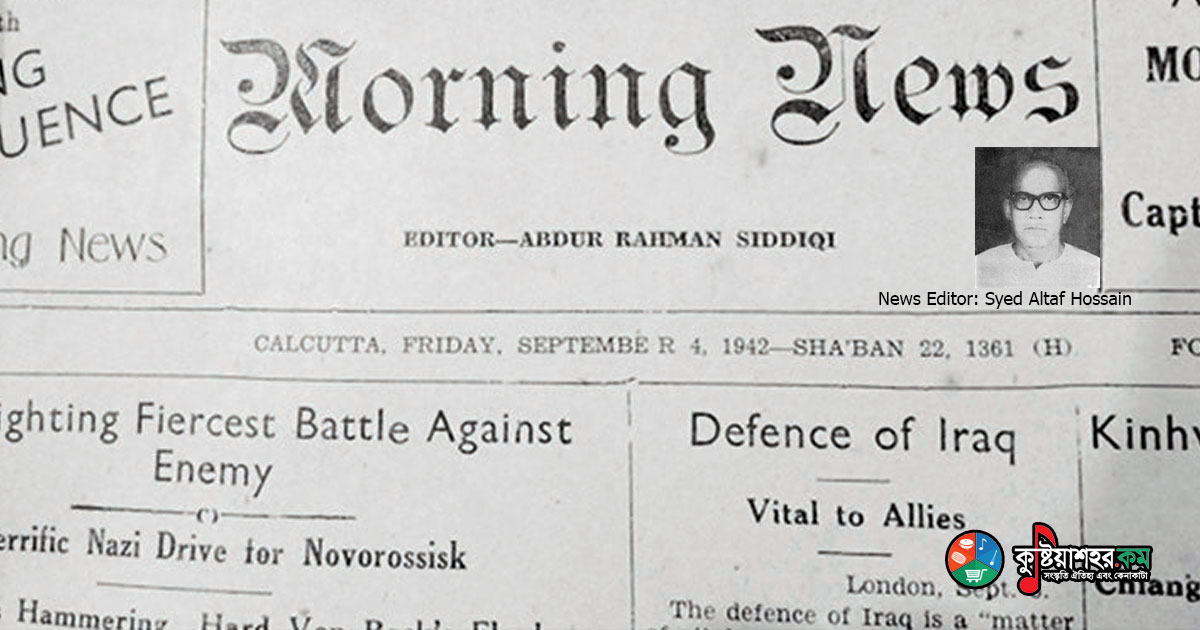
From his student life Syed Altaf Hossain became associated with journalism. From 1944 he worked in the news department of Kolkata's Morning News. After the partition of India he moved to Dhaka and joined the news department of the Pakistan Observer in 1949. Besides, he worked for some time at the Daily Ittehad. He was employed in the editorial department of Dhaka's Morning News from 1950 to 1953. In 1956, under his editorship, the New Nation was published from Dhaka.
Altaf Hossain became involved in politics during his student life too. He joined the students' federation of Kolkata and was elected president of its Islamia College branch. In 1940 he took part in the movement led by Netaji Subhas Chandra Bose for the removal of the Holwell Monument. In 1953 he joined the Awami Muslim League and in 1954 was elected a member of the East Bengal Legislative Assembly as a United Front candidate. When on 30 May 1954 the government imposed Section 92-A and introduced Governor's rule in the province, a warrant of arrest was issued against him. In 1955 he was arrested and underwent several months' imprisonment. When, that same year, a proclamation was issued against him on the charge of his involvement in the police strike, he went into hiding.
In 1957 Altaf Hossain was elected a member of the central and provincial committees of the National Awami Party (NAP), formed under the leadership of Maulana Abdul Hamid Khan Bhashani. When martial law was imposed in the country in 1958, a warrant of arrest was issued against him. At that time he remained in hiding for about 2 years. In 1965 Syed Altaf Hossain was elected general secretary of the NAP's East Pakistan branch. In 1966 he was arrested, and while still in jail he was elected general secretary of the Moscow-leaning wing of the NAP, divided by the ideological conflict between China and the Soviet Union (1967). In 1968, some days after being released by a High Court verdict, he was arrested again in the same year. Later, freed on bail, he took part in the anti-Ayub mass movement. In November of that year he was arrested once more. After Ayub Khan's fall in the mass uprising of 1969 he gained his release. Syed Altaf Hossain took part in the election of 1970 and was defeated.
During the Liberation War in 1971 he assisted in the work of training NAP activists for the war in India and discharged the responsibility of running the 60 youth camps under NAP leadership. Syed Altaf Hossain became a member of the central committee of the Bangladesh Krishak-Sramik Awami League (BAKSAL) formed in 1975. He served as Minister of State for Railways in the cabinet of Bangabandhu Sheikh Mujibur Rahman, and as Minister of State for Communications in the cabinet of Khondkar Mostaq Ahmad. He was the founding president of the Jatiya Ekta Party formed in 1978.
In 1983 he was arrested because of the anti-martial-law movement. In 1985 a warrant of arrest was again issued against him and he went into hiding. In 1986 he was elected convener of the Oikya (United) NAP, formed by the combination of the Jatiya Ekta Party and the two wings of the NAP.
Altaf Hossain played a part in forming the 15-party alliance for the restoration of democracy and in framing the alliance's 5-point programme. In the election of 1986 he was elected a member of the National Parliament from Kushtia as the alliance's candidate. In 1990 Altaf Hossain was elected president of the Ganatantri Party, formed by the combination of the Oikya NAP and the Prajatantri Party, and held that responsibility until his death.
Syed Altaf Hossain was associated with the legal profession. He was an enrolled lawyer of the Supreme Court of Bangladesh. For a long time he was vice-principal of Dhaka Law College. He died in Dhaka on 12 November 1992.