বাংলা
 English
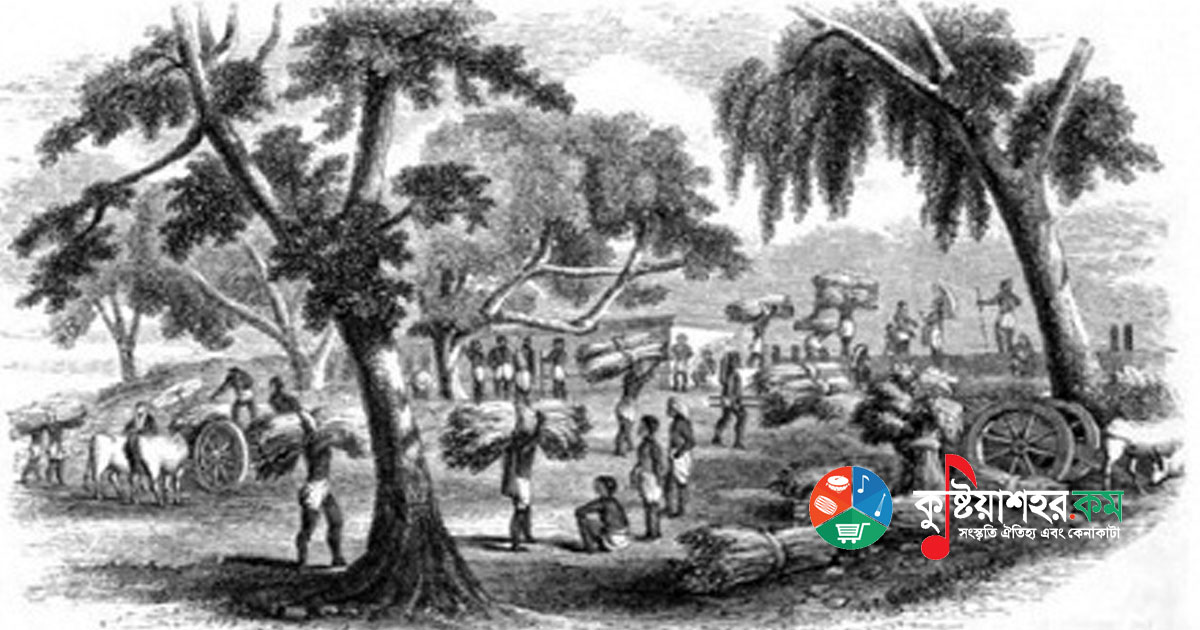
Although the fire of the Indigo Revolt spread across the country in 1858, protest against indigo cultivation had been rising much earlier; from 1810 onwards the tenant masses began organising themselves against indigo cultivation.
Besides their oppression, the indigo planters looked on the native sahibs with disfavour out of a caste-conscious mentality. At that time missionaries, on a large scale, took advantage of the poverty of both Hindus and Muslims and went on converting them to Christianity. The saying arose: "The enemy of the land is indigo, the thorn of work is the clod, and the enemy of the nation is the wily padre." From that very time the tenants began lodging complaints against the planters. But the government, to hush things up, took little measure. In 1830 a law in the tenants' favour on contracts was passed (Regulation V of 1830), but five years later Bentinck withdrew it. Moreover, in the chief indigo districts the first Lieutenant-Governor of Bengal, Halliday, began appointing assistant indigo-planter magistrates. People began to think that perhaps the government itself was a partner in the indigo trade. The planters too, taking advantage of this, multiplied their oppression. They cut the tenants' paddy fields, sugarcane fields and date-palm groves, broke the houses of rebel tenants, and forced indigo to be cultivated on their homesteads. The proverb "bhitey ghughu charano" (setting pigeons on another's homestead) comes from here. Even today the people of Kushtia-Rajbari say at the slightest thing, "tor bhitey ghughu charabo" (I will set pigeons on your homestead). At that time Pabna, the neighbouring district of Rajbari, lay outside the reach of indigo cultivation, or indigo was not grown there as widely as in Faridpur, Jessore, Kushtia and Khulna. Its people, free from the planters' oppression, lived in comfort, and the people of Rajbari used to say, "One who goes to Pabna has no worries."
This proverb is still on the lips of the people of Kushtia-Rajbari. To thrash the tenants they devised a kind of bludgeon called the "Shyamchand", and under its blows the tenants were battered. The kuthi people were spreading the word that the government would soon pass a "Mundor Act" for punishing tenants. In dread of the Mundor Act and the Shyamchand the tenants trembled. When some rebel tenants refused to sow indigo, the enraged kuthiyals shot them dead like birds. Gradually the tenants rose in fury. They vowed that they would not cultivate indigo even at the cost of their lives. In 1858 the fire of revolt blazed up in Faridpur, Rajbari, Jessore and Kushtia, and there appeared an "organised revolt", known in history as the "Indigo Revolt".
Jessore, Faridpur and Kushtia were considered the chief fields of indigo cultivation. The first Indigo Revolt began under the leadership of Bishnucharan Biswas and Digambar Biswas of Chowgacha in Jessore, and later spread over the whole region. In 1858 hundreds of men and women rose up in organised fury against indigo cultivation. From March to June 1859 the revolt took a massive form in Jessore, Kushtia, Nadia and Faridpur. Leading it were Bishnucharan Biswas of Chowgacha, Shishir Kumar Ghosh of Palu in Magura, the zamindar Mathuranath Acharya of Sadhuhati, Pir Dudu Miah son of Haji Shariatullah of Shariatpur, the farmer Hashem Ali of Sonapur in Rajbari, the zamindar Bhairab Nath of Pangsha and others. Dinabandhu Mitra, author of Nil Darpan, of Chowbaria in Jessore; Harish Chandra Mazumdar, editor of the Hindu Patriot of Calcutta; Kangal Harinath of Kumarakhali; the great littérateur Mir Mosharraf Hossain; Roushan Ali Chowdhury of Pangsha and Khandkar Nazir Hossain helped the revolt take the shape of fire through their pens.
In 1860, in the month of Ashwin, Dinabandhu Mitra's Nil Darpan was published from Dhaka. The play held up a living picture of indigo-planter-oppressed Bengal. Within a few months, under the supervision of Padre Long Sahib, the great poet Michael Madhusudan Dutt translated it into English with his pen, and there was an uproar in planter circles. When the planters sued Long, he was sentenced to a month in prison and a fine of 1,000 taka. Kaliprasanna Singh at once paid the 1,000 taka into court, but the imprisonment was not remitted; yet in the tenants' eyes Long Sahib grew great. The poets composed songs to rustic tunes: "Nil-Bander has turned golden Bengal to destitution, lost at the wrong time; Long has been imprisoned — the tenants' lives hang in the balance." After Queen Victoria ascended the throne in England a new era dawned in the administration of India. The famous Sir J. P. Grant, known as an ocean of mercy, became Lieutenant-Governor of Bengal, and Lord Canning became the Viceroy of India. Indeed it was with their support that the planters' tyranny was reduced in this country. Since most of the present Rajbari district had grown up around the Goalanda ghat in 1793, there is no scope for leaving the Rajbari district out. Hence the roles of Shishir Kumar of Palu-Magura in Jessore, Pir Dudu Miah of Shariatpur, Bhairab Nath of Pangsha and Hashem Ali of Sonapur call for discussion.
In 1858 Shishir Kumar was only 18 years old. The fiery speeches this young man delivered and the essays he wrote for the Patriot made the English authorities stare. The magistrates of Jessore, Meloney and Skinner Sahib, threatened him but could not stop him from writing. He went from village to village, making the tenants organised and courageous against indigo cultivation. At the boundary of every village there stood a drum at one spot; when the planter sahibs came to oppress, someone would beat the drum, and at once hundreds of village farmers would surround them with lathis in hand, and they could not return unharmed. It is as if Shishir Babu had been sent by God to save the people from the planters' oppression. The Hindu farmers worshipped him like a deity, and the Muslim farmers offered sinni in his name; all addressed him as "Sinni Babu". At his call thousands of farmers assembled.
The revolt, known to have its centre at Chowgacha, Sinduria, Joradah, Nayahata and Chuadanga, spread to the Rajbari region on the north bank of the Gorai river. With various parts of Madaripur and Faridpur, the fire of revolt blazed up in Baliakandi, Jangal, Sonapur, Mrigi, Pangsha, Sangrampur and Kumarakhali of Rajbari. In this region the revolt was led by Pir Dudu Miah of Shariatpur, Hashem Ali of Sonapur (Baliakandi), Bhairab Babu of Pangsha and others. Pir Dudu Miah roused the distressed farmers fiercely against the zamindars.
On 3 September 1868 something of Dudu Miah's strength is seen in the Amrita Bazar Patrika, where it was written: "In time his influence grew so far that whenever he thought of the English kuthiyals and the zamindars he could gather fifty thousand men. Under the leadership of Hashem Ali of Sonapur, hundreds of farmers organised themselves, and fires were set at many indigo kuthis, including Sonapur, Baharpur, Baliakandi and Basantpur, under his leadership." At that time Bhairab Babu, the zamindar of Pangsha, led the movement against indigo cultivation in Pangsha. Bhairab Babu was an extremely courageous and famous zamindar; against the planters he launched an active mass revolt, attacking the neighbouring kuthis and wreaking massive destruction. Enraged by this, T. I. Canning looted Bhairabnath's treasury. Bhairab Babu sued in the Pabna court over the looted treasury and won a decree of 14,000 taka. A little later Canning's men kidnapped him and killed him. (History of Pangsha Upazila, Sheikh Muhammad Sabur Uddin, pages 3-4). Not far from Belgachhi is a village named Sangrampur; the people of that village joined the struggle against indigo cultivation, hence its name Sangrampur. Sangrampur still carries the history of the Indigo Revolt, and the Thatha Parar Bhita of Jangal union has been mentioned already.
In 1860 the Indigo Revolt took a serious turn. Lord Canning grew anxious at the news and entrusted the inspection to Grant Sahib, Lieutenant-Governor of Bengal. That year he toured 70 to 80 miles by steamer along the rivers Gorai, Kumar and Kaliganga; the journey went on for nearly 14 hours. On both banks of the river thousands of farmers assembled in ranks and lodged their complaints. It is said that as he went along the bank of the Gorai, thousands of farmers of Rajbari district, led by Dudu Miah and Hashem Ali, assembled from Kamarakhali ghat to Samadhinagar and the Narua mouth. Along the river thousands of farmers, petitions in hand, begged the captain to moor the steamer at the ghat, but by one means or another he did not moor it. Thereupon the tenants, ready to lay down their lives, began leaping into the swift current of the Gorai and floating away. Seeing this scene, Grant Sahib ordered the steamer moored at the ghat. The tenants surrounded the steamer and made Grant Sahib promise that he would protect them.
Thereafter the "Indigo Commission" was formed with five members. In the December that followed Sir Grant made a long observation: "The tenants of Bengal are not slaves; they are in fact the owners of the land. It is astonishing that they should oppose such loss to themselves. To make them do what is injurious to them, oppression is inevitable; and it is the fire of that oppression which is the chief cause of the tenants' objection to sowing indigo" (introduction to Nil Darpan written by Hemendra Prasad Ghosh, Majumdar collection, vol. 1, p.). The commission issued the following recommendations, and thereby a proclamation was published: (1) the government is neither for nor against indigo cultivation; (2) like any other crop, whether to cultivate indigo or not is entirely at the tenant's will; (3) whoever, defying the law, causes oppression or disorder — planter or tenant alike — shall not escape severe punishment.
After the commission's proclamation was published, though indigo cultivation became a matter of the tenants' will, the indigo trade and production did not stop; but indigo cultivation gradually declined. Though the kuthis of many places closed, indigo cultivation went on in the Rajbari region, and at this time Thomas Kenny's oppression too seemed to grow. The tenants of this region became more rebellious still. On this, on page 110 of Mir Mosharraf Hossain's Amar Jiboni: "Unable to bear the tyranny of indigo cultivation, the tenant masses have again become Indigo rebels. Mir Saheb Ali joined the tenants' side at the time of the revolt. The tenant masses rose so furiously that they plotted how to take Thomas Kenny's life, how to ruin Mrs. Kenny, and how to demolish the Shalghar Madhua kuthi and throw it into the Kaliganga." Satish Chandra Mitra wrote that the second Indigo Revolt began in 1889, arising from the oppression of Domble Sahib; it was confined to Magura, Jhenaidah, Kushtia and Rajbari. By this time, as the price of jute had risen, the tenants refused indigo cultivation outright. The planters raised the price of indigo to have it cultivated, but they went on losing in the trade. Meanwhile, indigo produced artificially from Germany began to be imported cheaply from country to country, and by 1895 indigo cultivation and trade ended altogether.
Under English rule, indigo cultivation, the Indigo Revolt and the unjust oppression of the planters are a dark chapter of history, and it ended more than a hundred years ago. Even so, how much suffering and pain the people of this land have had to endure at the hands of the English, the Pakistanis and their own kind. In the famine of 1943 nearly 3 million people died of hunger; in the Liberation War of 1971, 3 million people were martyred; even now nearly 30 per cent of the people of the country are afflicted by poverty. Political violence breeds fear in the mind, and terror and corruption are riding on development. Yet, with the challenges of the twenty-first century before it, Bangladesh is cautiously building its relations on the path of rapid globalisation. Per capita income is rising, technology is advancing, and the standard of living of the people is going up. Looking at the history of the people of Bangladesh over the past two hundred years, one sees that this nation is moving ceaselessly along the path of self-rights, identity, independence and self-development through a hundred adversities. May this march continue — in the hope that a reader of history a hundred years hence will read this account.