বাংলা
 English
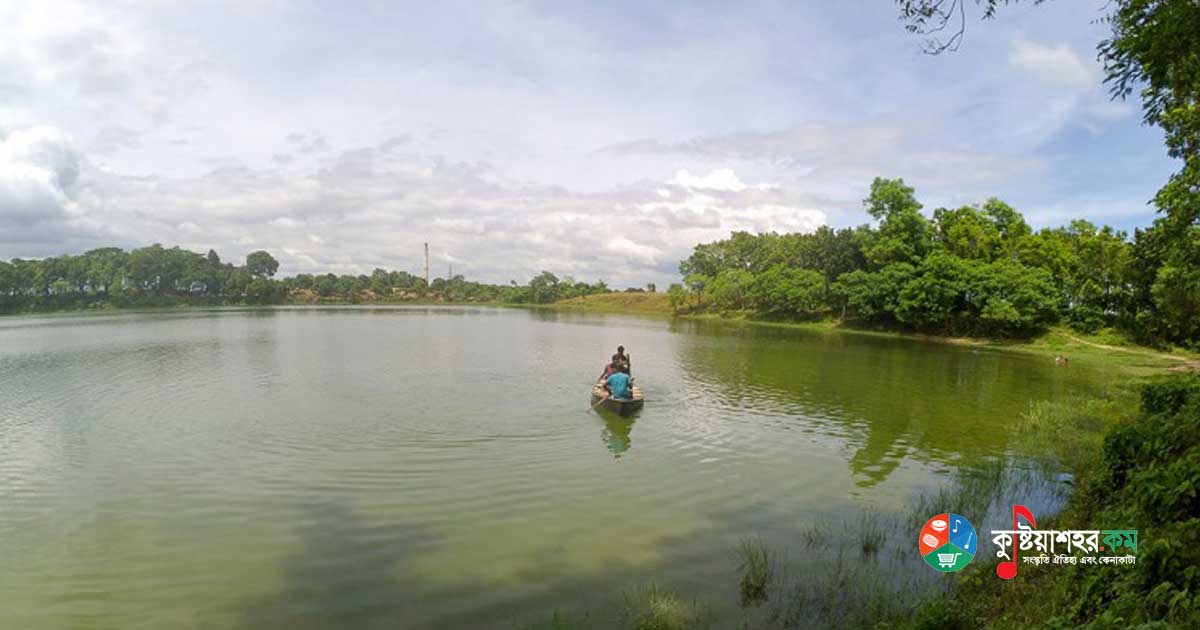
The golden days of the Padma's full youth remain today only in the manuscript of history, trembling with the mournful strain of unceasing weeping. Yet once, with abundance and heritage, the bustle of a vast settlement would roll down upon Nolini or the lap of Kaliji, not far from the river. Carrying its waters along beneath the green shade of trees, the river would flow to the unerring pulse of non-communal consciousness and fellow feeling.
The fishermen and boatmen hanging their wet nets on the branches of trees to dry in the sun, the birds flying off with small fish in their beaks, the sway of the wind over the fields of ripe paddy and the tall and low kash woods — these were a uniquely enchanting, mystical picture of the eastern region. The splendour that the riverine life and the old settlements along the Padma had in undivided Bengal has today largely merged into the womb of time. The flowing silty course of the mighty Padma, the enchanting aanchal of the village maiden, the kohl of the eye, the thorn of pain in the breast — in the mirage of the desolate sandbanks they are like a flood of decline.
Abu Ishaq's 'Padmar Palidwip' (The Alluvial Island of the Padma) is written with an incredible variety and a picture-laden brush of contemplation. For sixteen long years, bound in close intimacy with the riverine life of the Padma's banks, he gave it heart-stirring expression in his own profound stream of feeling and in a consummate literary style. Out of the unerring pull of the upper and lower reaches, the uprooted flood-stricken people and the emotion churned from the folk love that wells out of it, the dream-epic of the Kirtinasha Padma could be created in the form of a documentary film — where the riches of countless memories of undivided Bengal still float on the unique stream of time. This river-mothered eastern region of sujala-sufala, crop-laden, beautiful Bengal is brimming with tenderness regardless of caste and creed. Around this region, in the course of time like the current of the Padma, a host of eminent people has gathered. On 7 May 1925 the littérateur Mujibur Rahman Biswas, a vagabond by temperament, was born in the remote village of Laxmikunda, cradled by the Padma in Ishwardi upazila — a lifelong member of the Bangla Academy. In the adjoining village of Pakuria, Babu Sachindranath Saha was the founding teacher of an ancient school, and Sri Manindra Kumar Ghosh, the father of the poet Shankha Ghosh, was the head teacher of the Chandraprabha seat of learning at Pakshi, who at that time earned the status of the best teacher in West Bengal. The worship of patriotism, culture and equality that they carried at every step — the way they inspired their own hearts as teachers — will not be erased even at the moment of death. They forged, deep in their breasts, the wisdom of building an educated and healthy society. Of all the gifted people born along the silty course of this Padma in the journey of life's time and eternity, even a brief description will stand as witness to breadth and vastness. That will be found too in the life of Rabindranath Tagore, for on the breast of this mighty Padma the barge of his imagination floated for a long time. Even today the call of his appeal, bound in the melody of the heart's chamber, does not let go the strains of deep song. To find the strong radiance of its royal witness one must return to the tale of Saraghat, for Saraghat was the anchorage of the princely class.
Along the banks of the Kirtinasha Padma, the singer, the musician and the dancer were the sway of nature and the stirring breeze. All around rang the strains of birds, the gurgling sound of the river, the rustle of leaves, the swaying of the green crops. At ghat after ghat of the Padma — light and air, small settlements, riverine life, layer upon layer of the materials of folk literature scattered like an enchanting treasure — are sinking into the fathomless womb of oblivion. The revered Dr Dinesh Chandra Sen, by collecting the Mymensingh Gitika, showed what a priceless mine of literature lies hidden in the bosom of the village mother. In the same way, skirting the lap of the Padma, the self-narration of Saraghat is an abstract history in the intensity of its own being. Today modern civilisation is swallowing whole all our heritage, the lore of all the endeavours of our archaeology.
The search for identity and roots revolves around the past. And if that should perish, an ominous sign will be pressed into the belly of this Bengal — the unwanted, everlasting stamp of servitude's mesmerising seal. No store of literature, culture and national consciousness will avail our life's standing if its past stream perishes — that question is in crisis now. Yet our march continues in the unending current of history, and some part of the analysis of its form returns again and again in this tale of Saraghat.
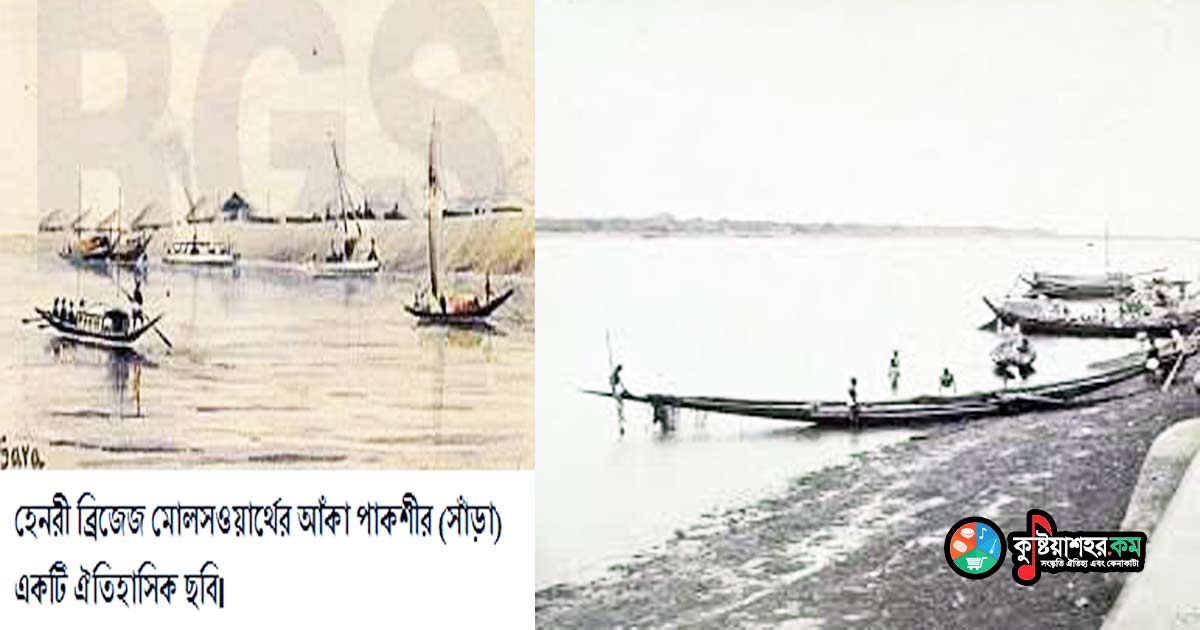
The tale of Saraghat remains flowing to this day with an extinct chapter of the Pabna district. In an earlier time, through the breast of that Padma in the full bloom of open youth, came floating sail-boats of many colours, the songs of the boatmen and the barges of the sahibs or the zamindars. Besides, there was the throng of many merchants and traders controlling the business of Saraghat. Whatever may be said about the naming of this Saraghat, the settlements here were then brimming with an array of heritage. For instance, the Bombayiyaras came with the trade of jute, turmeric, betel leaf and other goods. For in the British-ruled Indian subcontinent of that time, Saraghat was widely known as a port. Fewer railway trains crossed from Saraghat to Raytar Ghat by ferry, and there was an airport at Pakshi in the Sara region. Later it was shifted to Ishwardi, and alongside stood the Hardinge Bridge, which stirred such a great sensation — one of the notable structures of that time. One Marwari businessman named Agarwala, with his zeal for education, established the Sara Marwari High School. Even today, with its old heritage, it stands in a special dignity on the outskirts of Ishwardi's busiest town. This Saraghat was a special life-centre of the businessmen. Near Ruppur, adjacent to Pakshi in the Sara region, lay the Padma's fishermen's bend. At this fishermen's bend, from Asharh and Srabon and Bhadra up to Ashwin, the fair of hilsa fishing of the fishermen of the whole country went on. For from near Saraghat to Talbaria of Kushtia stretched a wide sanctuary of hilsa. In the Padma's full youth there raged a great festival of hilsa fishing in that sanctuary, and many kinds of nets were used, such as: the Bauli net, the Chekona net, the Kuna net, the Shaingli net, along with many other fishing gear. The hilsa of Shaingli had the greater fame — the kind caught in that net. The story of the hilsa of that Saraghat is heard from people's mouths even today: that no one returned home without a tray full of large hilsa, and in the weddings and festivals of Hindus and Muslims alike the hilsa of the fishermen's bend was as if indispensable. On the other hand, was it not the call of this Padma that was heard in the darkness of night from far and near, whose array of strange tales is still woven into the folk lore. With its vastness and the fierce rush of its strong current, how many towns, cities and settlements, together with the marks of human civilisation, the Padma has devoured age after age and pressed into the bowels of the earth — to find their exact history is hard, yet some silent witnesses perhaps remain even today. Like Laxmanabati, a great capital — the capital of Gaur, the port city — it devoured; to unroll the ledger of its accounts is hard. That is why this Padma came to be named Kirtinasha (the destroyer of fame). In this connection, a fact-based history is found in quite a few of the writings of Babu Radharaman Saha. Yet in the 190 years of British rule they established a great deal, including the Hardinge Bridge at Sara. What was lost is the folk and ancient grace of this Sara region — which was the unfettered, old-world splendour of the boys and girls of the sandy banks of the bela lands. In the early years of the nineteenth century, with Hindu-Muslim amity, a vast population cradled by the Padma grew up in this Sara region — where in harmony and amity a human bond of a river-mother's culture was created. In the folk songs, rhymes, pithas and festivals, weddings and invitations of the Sara region, everything seemed to carry the stamp of their own distinctiveness, regardless of religion and caste — whose sprinkled drops perhaps still weep silently, in seclusion, in the journey of time. For instance: the immersion of the Hindus' puja and the Bauli songs of the fishermen's quarter have largely become extinct. Yet in the entertainment of one or two games and the storytelling, one finds strains such as:
- The khaiti game is such a game — it throws ten boats afloat. A strike of ten, and in the kochu grove all topsy-turvy.
- I went to the north, and behold, I came back with seventy. The mor-mori of Dhaka, the quail's call — catching deer, they watch by the marsh.
- Mosquito of the kochu grove, you have a long beak; each bite you give, oh mosquito, is like the blow of a cutlass.
Even now many people lend their ears to the tale of Saraghat; sitting by the dead ghat, amid songs and salutations, they hear the mournful strains of the pauper's flute. Yet by geographical reason this land-fragment has, age after age, played its role as the sole connecting point of the settlements. Around this region — the Ruppur atomic project, the Pakshi Paper Mill, the steel mill and that old ice factory of Sara — all have today fallen into a decayed condition entangled with extinct fossil-like structures. Only the Pakshi EPZ has been built and awaits being set fully in motion. From this one can gauge how great is the measure of the geographical importance, and it is from that measure that the British built at Sara various infrastructures, including the chief office of the railway region. But in the course of time, through the tangle of state mismanagement and planning of various degrees, everything of today has moved away, centred on the trade-expansion of those who enjoyed political advantage. Yet out of the felt pulse of this Saraghat grew the strange bungalows of the English sahibs, and Pakshi and Ishwardi town grew into one vast town with its busiest settlements. Today, when after a long time one turns one's gaze to this settlement, here one finds little beyond the desolate sandbanks of the Padma, the ghostly skeletal bungalows left behind by the English sahibs with their desert-empty forgotten laments, and the long sighs of workless, unemployed people. Even in the decades after independence, the state structure and politics have only undervalued this region. But if, in geographic reckoning and analysis, a proper management is still created, then surely here a march of work can be set going with river dredging, embankment construction and the reform and expansion of river governance. Then around this region the export trade can be widely extended along with many kinds of mills and factories. For if this potent, Padma-cradled town gets the chance once again to attain its full form, then with all kinds of communications a new measure will be added to this land's GDP, and it can be said with certainty that a new door of further golden possibility will open for the people. Only then will the tale of Saraghat come to stand with a new store of words and sandalwood flowers.
Sources:- Gadyamangal, editors: Motiul Ahsan, Mijan Sarkar, Bilu Kabir, Sahitya Academy, Kushtia, 17.4.2013, pages 392-395. Hasan Ahmed Chishti: essayist, researcher.