বাংলা
 English
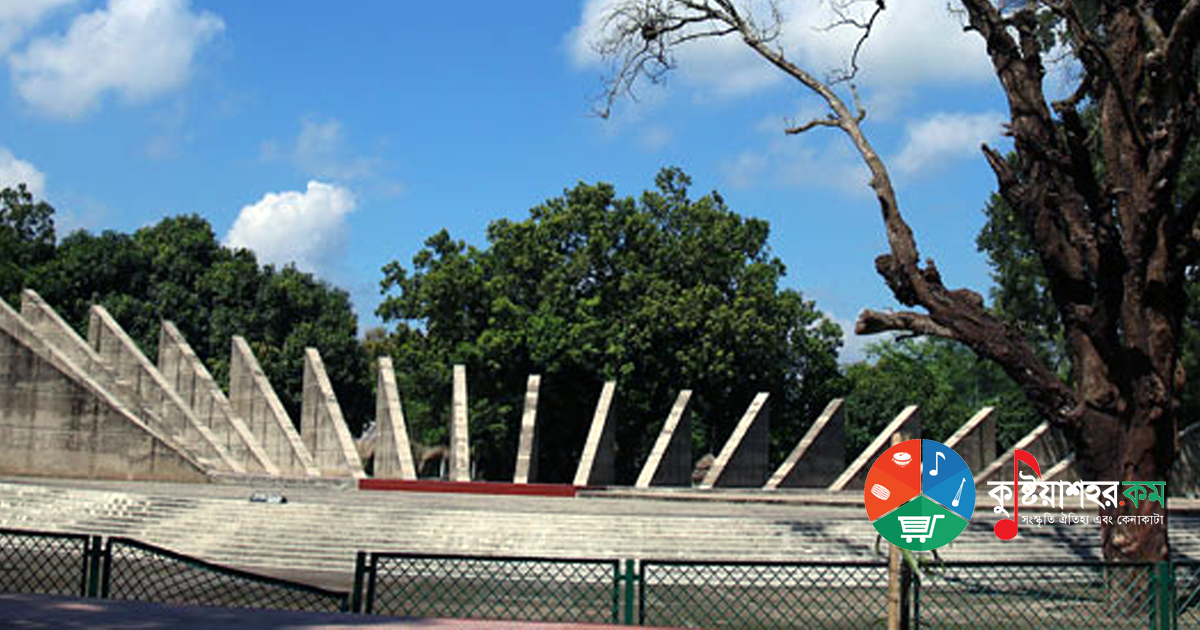
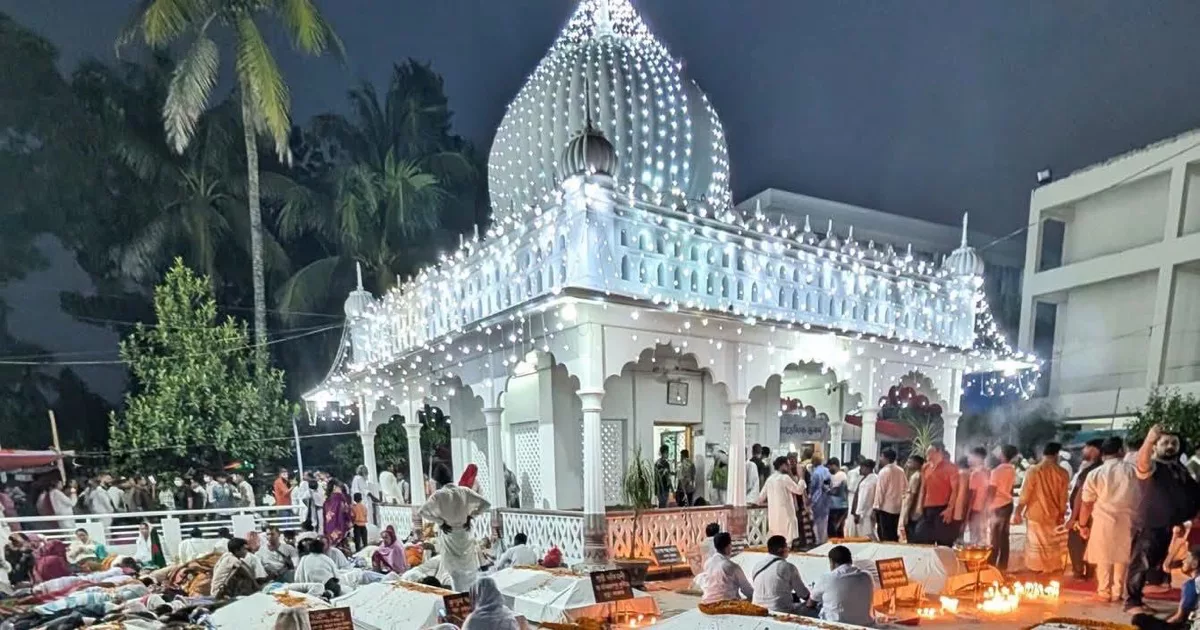
Mujibnagar is a historic place located in Meherpur district. Mujibnagar's greatest heritage is that it was Bangladesh's first capital. The first government of independent Bangladesh was sworn in at this provisional capital. At Baidyanathtala of that time, now the mango grove of Mujibnagar, the government's council of ministers took its oath on 17 April. The day is still observed with due solemnity. To preserve the heritage of Mujibnagar, the Liberation War Memorial Complex has been built here.
The reason Baidyanathtala of that time became the present-day Mujibnagar is that the Liberation War began in this land at the call of Sheikh Mujibur Rahman, and for that reason the government was named the Mujibnagar Government.
During the Liberation War, the provisional government of Bangladesh, or the Mujibnagar Government, was formed on 10 April 1971. On 17 April 1971 the members of the government's council of ministers took the oath of office. Although Bangladesh's independence was declared on 26 March 1971 and the people of the country began their resistance war against the Pakistani invading forces, this government's role was immense in organizing and coordinating the Mukti Bahini (liberation forces), winning the support of the international community, and maintaining organizational ties with the government and army of India, the state that provided direct assistance in this war. With the formation of this government, the resistance war against the Pakistani invading forces took the shape of a full-scale war, and the victory of Bangladesh as an independent and sovereign state was hastened.
On the night of 25 March 1971, when Operation Searchlight was carried out and Bangabandhu Sheikh Mujibur Rahman was on the point of being arrested by the Pakistani forces, in the moments just before his arrest — on the night following 25 March, that is, in the first hours of 26 March — Bangabandhu declared the independence of Bangladesh through a small transmitter of the EPR. Then, on 27 March, Major Ziaur Rahman formally announced Bangladesh's independence on behalf of Bangabandhu from the Kalurghat radio station in Chittagong. It was essentially from that day that Bangladesh became known to the outside world as an independent, sovereign state.
Meanwhile, during the horrific genocide of 25 March, Tajuddin Ahmad, one of the principal leaders of the Awami League, fled his residence. It was at this very time that he began planning the formation of a government of Bangladesh. Guided by the policy of first self-defence, then preparation, and finally counter-attack, he began thinking of forming a government to carry this policy forward along an organizational path. In the meantime, on the evening of 30 March he reached the border of West Bengal via the Faridpur–Kushtia route.
Taking Barrister Amir-ul Islam with him, he crossed the Meherpur border and set foot in India on 31 March. Toufik-e-Elahi Chowdhury, then the subdivisional administrator of Meherpur, extended them all-out assistance in crossing the border. After the border was crossed, Golok Majumdar, then Inspector General of the Indian Border Security Force, showed Tajuddin Ahmad and Barrister Amir-ul Islam due respect and arranged for their safe refuge. Having received the news from Golok Majumdar, K. F. Rustamji, Director General of the Indian Border Security Force, met them at their place of refuge and talked with Tajuddin Ahmad, becoming fully acquainted with the overall situation of East Bengal and the Bengalis' indomitable urge to win independence. At the border, Tajuddin found that, in support of the mutinous soldiers of the Bengal Regiment, the Indian army and the border guards could do nothing until they received instructions from the Government of India. When Tajuddin Ahmad sought the help of the BSF in forming a liberation army, the then BSF chief told him that the training and arming of the liberation fighters would be a matter of time.
He added that, since the Government of India had issued no instructions on training by then, he could not give the Mukti Bahini training or arms. When K. F. Rustamji contacted the senior officials in Delhi, he was told to take Tajuddin Ahmad and Barrister Amir-ul Islam with him to Delhi. The purpose was a meeting between Indian Prime Minister Indira Gandhi and Tajuddin Ahmad. After reaching Delhi, the Government of India confirmed from various sources that Tajuddin Ahmad was the closest colleague of Bangabandhu Sheikh Mujibur Rahman. Before his meeting with Indian Prime Minister Indira Gandhi, Tajuddin Ahmad held several rounds of talks with senior officials of the Government of India, explaining to them the assistance and cooperation needed to conduct the Bengalis' struggle for liberation. At that time he realized that if he met them merely as a leader of the Awami League, nothing much could be expected beyond a little sympathy and compassion.
Without the formation of a government and that government's firm support for the Liberation War, no country in the world would extend a helping hand to Bangladesh. Moreover, the day before the meeting with the Indian Prime Minister, a senior official asked Tajuddin Ahmad whether any government had been formed on behalf of independent Bangladesh. He then decided that at the meeting he would present himself as the representative of the Government of Bangladesh, because he believed that this could give effective shape to 'the resolution adopted in the Indian Parliament on 31 March to help the struggle of the people of East Bengal.' At the beginning of his meeting with Indira Gandhi, Tajuddin informed her that with the start of the Pakistani attack, Bangladesh had been declared independent and a government formed as early as 26 March. Bangabandhu Sheikh Mujib was the President of that independent Bangladesh government, and all the senior colleagues who had taken part in the Mujib–Yahya talks were members of the council of ministers. Since, apart from Sheikh Mujib's arrest, the whereabouts of the party's other senior leaders and activists were still unknown, Tajuddin, after consultation with the assembled party representatives, presented himself at the said meeting in Delhi as Prime Minister. At that meeting Tajuddin Ahmad requested Indira Gandhi to grant recognition to independent Bangladesh. Indira Gandhi assured him that formal recognition would be given at the appropriate time. Thus began the idea of a provisional government of Bangladesh.
After the meeting with Indira Gandhi ended and she promised Bangladesh every kind of cooperation, Tajuddin Ahmad called upon the MNAs (M.N.A) and MPAs (M.P.A) of the Awami League to convene a session on the border of Kushtia district.
At that session, a council of ministers was unanimously formed to conduct the Liberation War and run the government.
This council of ministers, along with the MNAs and MPAs, proclaimed on 10 April the sovereign Government of the People's Republic of Bangladesh with Bangabandhu Sheikh Mujibur Rahman as President. Syed Nazrul Islam was elected Vice-President and, in Bangabandhu's absence, acting President. Tajuddin Ahmad was appointed Prime Minister, and Captain M. Mansur Ali, Khondaker Mostaq Ahmad and A. H. M. Qamaruzzaman were appointed members of the council of ministers. On 11 April, M. A. G. Osmani was appointed Commander-in-Chief. Prime Minister Tajuddin delivered a speech over Bangladesh Radio on 11 April announcing the formation of the council of ministers.
Then, on 17 April 1971, as previously announced, the swearing-in ceremony of the council of ministers was held in a mango grove at Baidyanathtala in Meherpur of Kushtia district. From nine o'clock in the morning the leaders and invited guests began arriving there. About fifty journalists, domestic and foreign, were present at the event. The oath-taking began at eleven o'clock. The ceremony opened with the recitation from the Quran and the performance of Bangladesh's national anthem, and at the very outset Bangladesh was proclaimed as the 'People's Republic of Bangladesh.' The acting President then introduced, one by one, the Prime Minister and his three colleagues. He next announced the name of Colonel M. A. G. Osmani as chief of the armed forces of the new state, and Colonel Abdur Rab to the post of Chief of Staff of the army. Then the Declaration of Independence of Bangladesh was read out there. The declaration had already been broadcast on 10 April, and its effect was declared to date from 26 March 1971. From that day, the place was named Mujibnagar. At that ceremony both the President and the Prime Minister delivered speeches. In his speech, Prime Minister Tajuddin Ahmad described the background of Bangladesh's declaration of independence. At the end of his speech he said —
We have placed our case before the people of the world; no other nation on earth can lay claim to recognition more than we can. For no other nation has fought a harder struggle than we have, nor made greater sacrifices. Joy Bangla.
In other words, through this the Prime Minister called upon the international community, via the domestic and foreign journalists, to grant recognition to Bangladesh, and thus, during the Liberation War, the Government of the People's Republic of Bangladesh began its journey.