বাংলা
 English
The traces of some of those saints and dervishes who, away from the public eye, came to the obscure villages of East Bengal to preach Islam and left behind various trusts as tokens of civilisation and Islamic culture, are being found these days. These lost relics deserve a prominent place in our present history.
A long-lost chapter of history has been unearthed in Sajuria village of the present Hosendanga union. There the mazars of two saints lost in the abyss of oblivion have been discovered. One belongs to Shah Syed Abdullah Rumi, the other to Shah Zubayer Rumi.
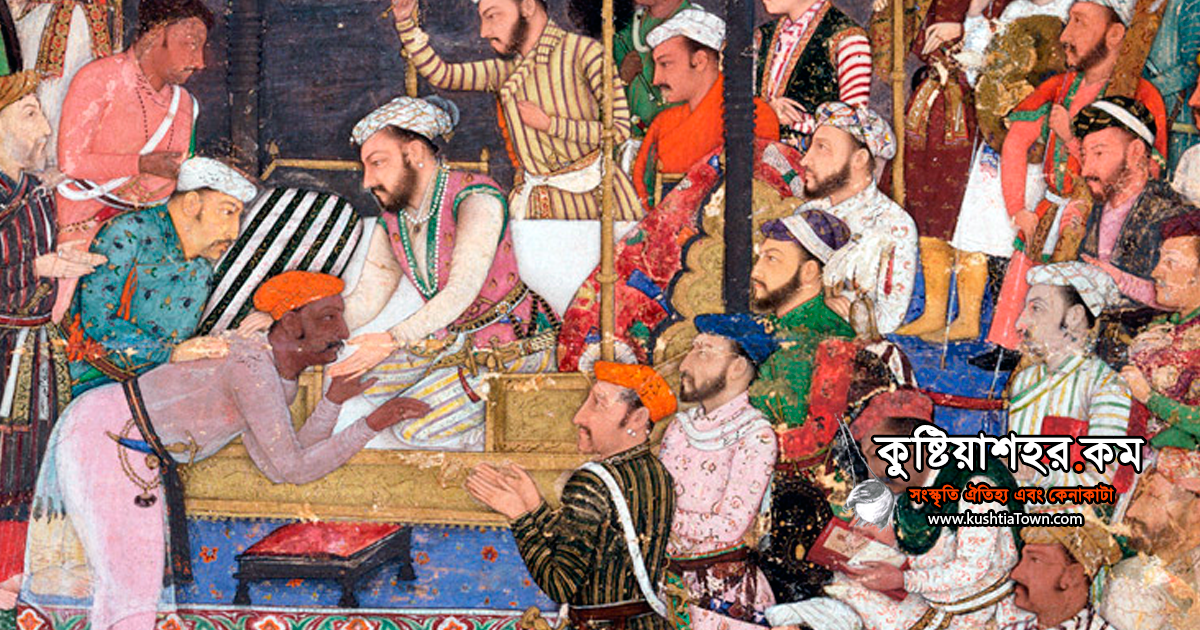
During the reign of Emperor Aurangzeb, many dervishes and saints came to Hindustan, that is to Bangladesh, to preach Islam. Hazrat Shah Syed Abdullah Rumi was one of them. The homeland of their ancestors was in Arabia. From there some of them came and settled in a place of Asia Minor called "Erzurumi". For this reason the word "Rumi" is written at the end of their names.
Hazrat Shah Abdullah Rumi came to Bangladesh via Delhi and, along with many other saints, set foot in present-day Chatga or somewhere near it. Then, travelling along the sea and river routes, as he was coming up along the Padma from the lower reaches, there was a sandbar at the present village of Sajudia where he took up residence. Gradually the place flourished. He decided to make that very place the centre of his Islamic preaching.
Through the efforts of Moulvi Akbar Hossain Sahib at Shailkupa of Jessore district [now under Jhenaidah district], an old and beautiful mosque has been discovered there underground, and thanks to his endeavours much of the Muslim heritage and many chapters of the history of Kushtia have been recovered. It is from the documents of that place that the name of Shahjiara village and the history of the preaching of Islam by the dervish-saints from there are known.
Coming into contact with the generosity, greatness and brotherhood of the religion of Islam, and with the refined character and towering personality of the dervish-saints, the lower-caste Hindus of this area - despised, condemned, neglected and trampled underfoot by the caste Hindus - sought refuge, group after group, under the cool shade of Islam.
With Shahjiara village as their centre, the men of this lineage preached Islam as far south as Shailkupa, as far east as the Padma river and as far west as Kumarkhali. Without taking recourse to state power, in a state of utter destitution, they preached Islam relying only on the name of Almighty Allah.
Little by little the wheel of time turned, and the terrible dark days of the Muslims of Hindustan arrived. Taking advantage of the ineptitude and indolence of the short-sighted Muslim emperors, the Baniya-English, the French and the Dutch infiltrated the land. Later the yardstick of the Baniya English merchants turned into the sceptre of rule. The Muslims were not willing to accept that rule. So the cunning English created a despised band of sycophants, and along with it tried to erase Muslim civilisation, culture and heritage. In this task they succeeded to a great extent.
Then came the era of the Sepoy Mutiny and the Wahhabi movement. The whole of India blazed with the fire of the Sepoy Mutiny, and its wave came lapping at Shahjiara village. Shah Syed Zubayer Rumi led the rebellion in this region. Facing the cannons of the mighty English, how long could one hold out armed with only a few bows, arrows and katari daggers? He was defeated in the battle. In that battle one of his sons embraced martyrdom. That son was buried in Bhatshala village of the present Kosba Mazail union. That place is still known as the Dargabari of Bhatshala village. Shah Syed Hussain Rumi of this lineage came to live in the present Hosendanga village. The village was not really named Hosendanga; it was called Hosenpur after his name. This is found in old documents.
Shahjiara and Hosenpur are two neighbouring villages. There were two neelkuthis (indigo factories) here. The sahibs of the neelkuthi were steeped in wanton murder, torture and debauchery. Unable to bear their unspeakable oppression, the simple, innocent local people took shelter under Hazrat Shah Hussain Rumi. So he protested. This made the sahibs aflame with fury, and they served him an ultimatum to leave the village and go elsewhere.
A skirmish took place here between Syed Hussain Rumi and the English kuthial sahibs. In this battle he dug a trench (khondok) and fought from within it, and attained martyrdom. "Khondok" in Bengali means a pit or ditch. From that pit or ditch the village was named Hosingara (Hussain-gara). Later, as the pit or ditch filled with silt and turned into high ground, the village was renamed Hosendanga many years afterwards.
Under the oppression of the neelkuthi sahibs, some members of the Rumi family migrated to Bhatshala village, while a few others migrated to Kamalapur village in Janipur union of Khoksa thana in the present Kushtia district. The descendants of Hazrat Shah Syed Abdullah Rumi still live in those two villages.
An event of 150 years ago can still be heard from people's lips. Hampered Sahib was the manager of the fourteen neelkuthis of this region. The local farmers had to grow indigo on their own land and deliver it free of cost to the sahibs' kuthi; otherwise their lives would be at stake. Moreover the sahib was a drunkard. Every night, as fuel for his debauchery, a beautiful young woman had to be delivered to the sahib's kuthi before him. The anguished weeping of the helpless, innocent, hapless women resounded through sky and air, spreading fear and terror among the simple, helpless people in the secluded recesses of the countryside.
One night the local people held a secret meeting, and on the following night they killed Hampered Sahib with all his retinue, tied his corpse to the back of his own horse and sent it to the big sahib's office.
The rest of the story is very brief. The sahibs and certain caste Hindus dependent on them came and burned the village to ashes. A Namashudra gentleman named Ramprasad Biswas led the killing of the sahib. This Ramprasad Biswas is the ancestor of the present-day Abhimanyu Biswas. Their house, pond and so on still exist. Over a long time the silt of the Padma made the spot excellent for crop production, so a settlement grew up again, and then the village was named Hosendanga.
For taking part in the Sepoy Mutiny of 1857, one member of this family was hanged. During the time of the Mughal emperors, one thousand bighas of land were granted to the ancestors of the Rumi family as tax-free (lakheraj) property. During the zamindari of Debendranath Tagore, the Khoksa-Kumarkhali part was under them.
If the rent was late, the zamindar's men would use elephants to break and demolish the tenants' houses. When the people could no longer endure the oppression of the zamindar's paiks, peons and naibs, they came to Syed Kamaluddin Rumi Sahib seeking redress.
Syed Kamaluddin Rumi Sahib rallied the entire population and started a movement. In the final stage of the movement, at the call of Kamaluddin Rumi Sahib, the tenants stopped paying rent to the zamindar.
When the news reached the Jorasanko zamindar Debendranath Tagore, he came to Khoksa in person to look into the matter. He sat in discussion, reduced the tenants' rent, increased various privileges and facilities, and named one mouza after Kamaluddin Rumi Sahib - the present Kamaluddin Mouza. At the demand of Kamaluddin Rumi Sahib, the zamindar's kachari (estate office) was established here.
About 100 years ago, an organisation named "Anjuman-e-Ittefaq-e-Islam" was formed across the whole of India for the anti-British movement and for the Muslim people. Its president was Syed Abdul Quddus Rumi, a cousin of the Rumi family, and Sir Azizul Haque was elected its secretary.
Syed Shah Abdullah Rumi's family tree and who they are:
Son of Syed Kamaluddin Rumi.
Syed Golam Hossain Rumi.
His son Syed Abdul Wahed Rumi (a Congress supporter who could speak five languages)
Descendants of Syed Abdul Wahed Rumi -
Son Syed Ahmad Rumi
Son Syed Mamun Rumi
Son Syed Masud Rumi
Son Syed Mahbub Rumi
Syed Ahmad Rumi - worked at the Dhaka High Court.
Syed Mamun Rumi - was active in Congress as a student; in his working life he served as a computer engineer at International Computers Limited in London, Bombay and Calcutta.
Syed Masud Rumi - a lawyer and politician, elected a member of the National Parliament from the Khoksa-Kumarkhali area.
Syed Mahbub Rumi worked as SDM (Revenue).