বাংলা
 English
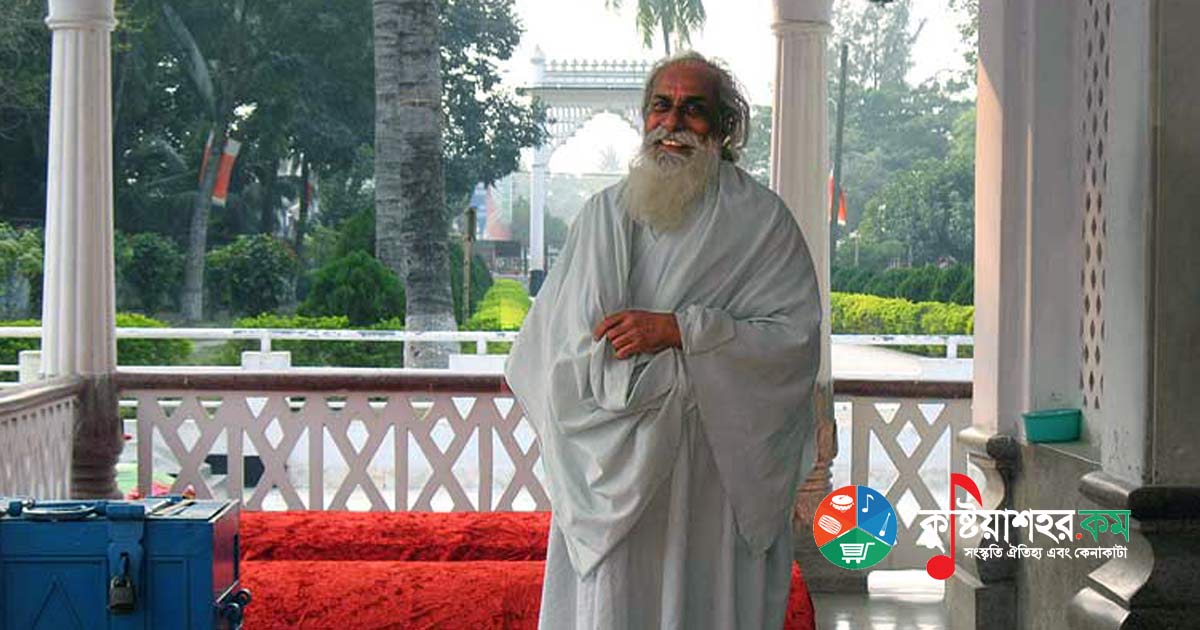
In Lalon's songs, man and his society came first. Lalon believed that one man of the heart dwells within all human beings. He placed humanism above all creatures. Many of his songs speak of this man of the heart. He believed the man of the heart has no religion, caste, class, gender or lineage.
The visible body of man and the invisible man of the heart are distinct from each other. God dwells in the heart of every human being. Lalon's philosophy cannot be placed within any religious doctrine. Lalon analysed the human soul as something mystical, unknown and invisible. In the song of the unknown bird within the cage he compared the inner being of the mind with such a bird — one that easily comes and goes within the cage-like body, and yet can never be confined.
In Lalon's time, contemporary oppression, man's protest, religious narrowness and superstition, love, self-centredness stood like a barrier before the society and social thinkers of the day. He questioned the various superstitions of society through his songs. For that very reason, in that struggle of Lalon's many noted personalities were attracted — historical figures, journalists, intellectuals, writers and even the ordinary, unnoticed men of the villages.
In a spiritual way he composed nearly two thousand songs. Their simple, flowing language revealed the mystery of human life, humanism and a non-communal vision. From some of Lalon's compositions we come to know that he was extremely sensitive about religion, lineage, caste and community. When communal discord and conflict between Hindus and Muslims were growing under British rule, Lalon was a protesting voice raised against it.
He did not believe in any distinction between man and man. The root of the humanist Lalon's philosophy is man. And to spread this philosophy he chose art. Many sought to introduce Lalon through his family identity. Someone tried to introduce him as a Hindu, someone as a Muslim. In every song of his, Lalon presented himself as a fakir (Arabic "sadhu").
About Lalon, Rabindranath Tagore said:
"Under the name of Lalon Fakir a Baul sadhak seems to blend Hindu, Muslim, Buddhist and Jain faiths into one — we should all turn our minds toward him."
Although he once called Lalon a 'fakir', he afterwards called him a 'Baul' — where the meanings of Baul and fakir are mutually complementary.
Baul Philosophy
The Baul is a particular folk community and creed. Lalon is considered a Baul and a pioneer of the songs. Though the Bauls were born in the fifteenth century, in the nineteenth century Baul song gained popularity through Lalon's songs. Baul song is a special treasury of melodies connected with man's philosophy of life. Bauls live a simple life, and it is their habit to roam from village to village singing songs to the accompaniment of instruments. It is a special part of Bengali folklore.
In 2005 UNESCO proclaimed Baul song one of the masterpieces of the oral and intangible heritage of humanity.
Bauls are liberal and non-communal religious sadhaks. They preach the doctrine of humanism. In Baul ideology the influence of Vaishnavism and Sufism can be seen. Bauls attach the greatest importance to the self. In their view only by knowing the self can the Supreme Soul or the Creator be known. Dwelling in the body, the soul makes them consider the body sacred. Though mostly unlettered, Bauls have spoken profoundly about the philosophy of life. Bauls proclaim their philosophy and views continually through Baul song.