বাংলা
 English
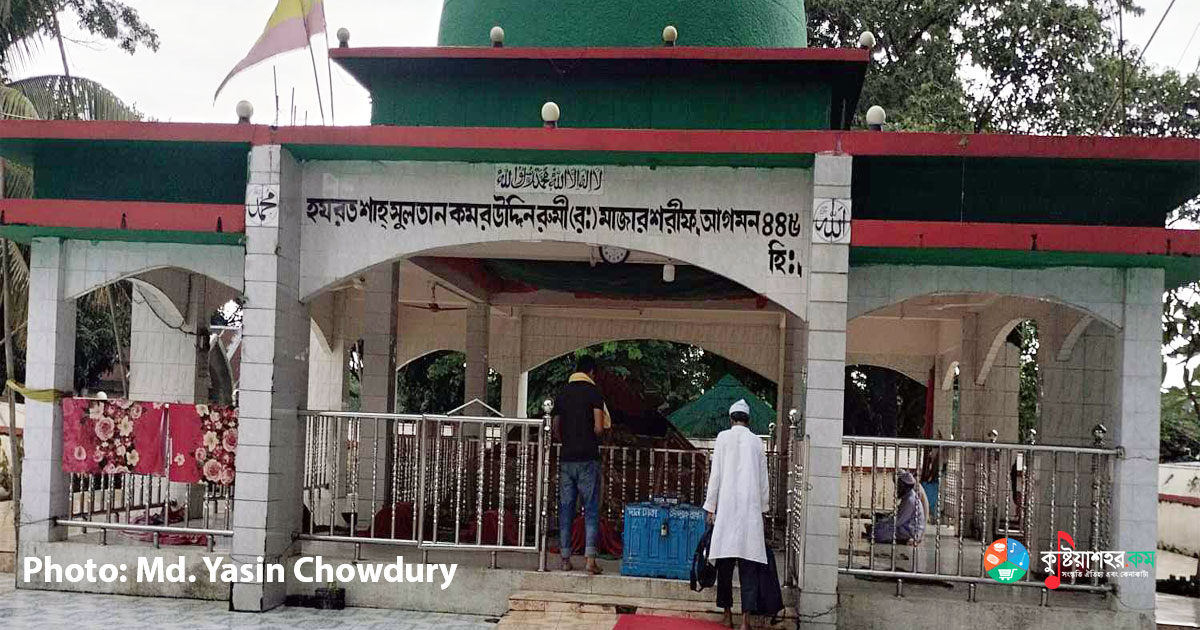
Hazrat Shah Sultan Qamar Uddin Rumi was a Sufi Muslim figure of the eleventh century. It is said that he was the first Sufi to travel to and settle in Bengal. His name is intertwined with the spread of Islam in Netrakona.
At a time when people, wrapped in the coils of various superstitions and forgetful of Almighty Allah, were steeped in all manner of wrongdoing, the Sufi ascetic Hazrat Shah Sultan Qamar Uddin Rumi, Rahmatullahi Alaihi, came to this subcontinent from the Seljuk province of Turkey for the purpose of preaching the religion of Islam.
This saint of Allah was born into a royal family. But when he came to feel the existence of the One Allah with all his heart and soul, he abandoned all luxuries and comforts and, solely to attain the pleasure of Allah and to preach Islam, left his home. Through rigorous spiritual discipline he acquired spiritual power, and facing trials and tribulations, obstacles and perils, and death at every step, crossing forests and jungles, hills and mountains, scorched by the burning sun, braving storms and rains, crossing deserts and seas, he travelled through various regions including Chittagong and Bogura, and 997 years ago, in 445 Hijri, this great ascetic arrived at Madanpur in Netrakona.
Together with his teacher Sayyid Shah Surkhul Antia and ten disciples he came to Bengal in 1053 CE (445 Hijri). That was a century before the arrival of the Muslim commander Bakhtiyar Khalji, and 250 years before Shah Jalal's conquest of Sylhet in 1303.
Hazrat Shah Sultan Qamar Uddin Rumi and his companions settled in modern Netrakona; there was no Muslim population there at the time, and it was ruled by a Koch king named Ganesh. When the message of Islam reached the local inhabitants, many of them accepted Islam. When news of the conversions reached the king, Rumi was summoned to the royal court. It is said that Rumi then claimed that God had granted him spiritual power. Upon saying this he was put to a test: he was made to drink poison. It is said that even after drinking the poison he remained safe and sound. At this, everyone present on the spot accepted Islam, and the king granted him Madanpur and some neighbouring villages free of revenue.
A party led by Shah Sultan Balkhi travelled by the Yamuna route to preach Islam in Bogura. The ruler of Bogura was the vassal king Parasuram, subordinate to the Pal Rajas. Shah Sultan Balkhi Mahisawar, with his retinue, took position at Mahasthangarh, the capital of king Parasuram. From there he sent an envoy to the court of king Parasuram with the invitation of Islam. Parasuram, on hearing the message of Islam, flew into a violent rage, arrested the envoy and launched a surprise attack on the party. In the surprise attack the party leader Hazrat Sayyid Shah Sultan Balkhi Mahisawar (RA), Hazrat Muhammad Faruk Shah (RA), Hazrat Shah Miah Gazi (RA), Hazrat Muhammad Kabil Shah (RA) and many others embraced death.
Receiving news of the Muslims' defeat in Bogura, Shah Sultan Rumi set out with his retinue for Bogura. Meanwhile, hearing of the approach of the Muslim force, king Parasuram advanced with his defence force and began the battle. With about a hundred companions, Hazrat Shah Sultan (RA) overpowered Parasuram's vast army. In the battle seven of the Muslim force were martyred, while king Parasuram and more than a hundred soldiers were killed. Through victory in this battle Bogura passed into the hands of the Muslims. After staying there for some days, he set out with some companions for eastern Bengal. At this time, after preaching Islam for some days in Madhupur of Tangail and in the Durgapur area of Jamalpur district, he entrusted the companions named Momen Shah and Kamal Shah with the responsibility for that region; later, with another companion, he took position on the eastern bank of the Brahmaputra river in the Bokainagar pargana. The local vassal ruler, Bokai Koch, accepted the invitation of Islam. After preaching Islam there for some days, in the middle of the eleventh century CE he came, with forty companions, to Madanpur pargana of the vassal king Madan Mohan Koch.
From the biography Hazrat Shah Sultan Qamar Uddin Rumi (RA) and various other sources it is known that in those days the vassal kings of Bokai Nagar of Gauripur in the Mymensingh region and of Madanpur pargana in Netrakona were Bokai Koch and Madan Mohan Koch.
While Hazrat Shah Sultan Qamar Uddin Rumi was staying at Namaz Khana, three kilometres west of Madan Raja's house, he sent one of his companions, Hazrat Ruposh Mallik, as an envoy to the royal court to convey the invitation of Islam. The vassal king Madan Koch had already learnt of the approach of the Muslim force and of its temporary exploits. When the envoy presented himself at his royal court and conveyed the invitation of Islam, he said nothing openly but secretly devised a plan to destroy the Muslim force. He consulted his council of advisers on inviting the Muslim force over and killing them by mixing poison in the food. Meanwhile the king's soldiers, having failed to attack the Muslim force, began to accept Islam. King Madan Koch, taking some soldiers with him, went near the fakir's tent and ordered that this place be abandoned and that they move beyond the bounds of his kingdom. When the fakir, looking towards the king, raised objection to vacating the place, the king refused to comply. Then, pointing to the prayer mat at his seat, he requested only as much space as that. At the fakir's resolute behaviour, the moment he hurled his prayer mat into the air, it expanded at great speed and covered the entire area. Witnessing this miraculous event and out of fear, making a pretence of accepting the faith, he invited the Muslim force to his house. The party of Hazrat Shah Sultan Qamar Uddin Rumi arrived near the royal house before the Fajr prayer and said their prayers. Pleased at their arrival, the king seated them in the royal court and, as pre-arranged, served the guests a poisoned drink. Hazrat Shah Sultan Qamar Uddin Rumi, learning of the king's conspiracy through meditation, forbade his companions to drink; he alone drank the poisoned liquid. It is said that fourteen tolas of poison had been mixed in the drink. Although a slight lassitude appeared in his body from drinking the poisoned beverage, by divine grace he returned to his normal state within a short while. Failing to kill him by poison, the king and his council of advisers sought forgiveness from the great saint and accepted the religion of Islam.
Death and Legacy
It is believed that Shah Sultan Rumi died in 1075 CE (475 Hijri). A mazar (shrine) was built in the village of Madanpur, and a mosque has been built beside the mazar.
During the colonial period in Bengal, the British East India Company attempted to seize the land of the mazar in 1829. Those who looked after the mazar opposed this, producing an old Persian document of the year 1082. Thereupon the British government abandoned the plan of seizure and granted ownership of the land to the holder of the document, Sayyid Jalaluddin.
To gather devotees to the sacred message of Islam preached in the feudal age in Madanpur, Netrakona, Hazrat Shah Sultan Qamar Uddin Rumi (RA) introduced the practice of beating the Donga (drum). The practice of beating the Donga, begun in that era, still continues.
Many things have been named after Hazrat Shah Sultan Qamar Uddin Rumi:
- Shah Sultan Jame Mosque, Madanpur
- Shah Sultan Degree College
- Shah Sultan High School, Madanpur
- Shah Sultan Digital Institute
- Shah Sultan Diagnostic Centre
- Shah Sultan Transport (bus service, Dhaka to Kendua)