বাংলা
 English
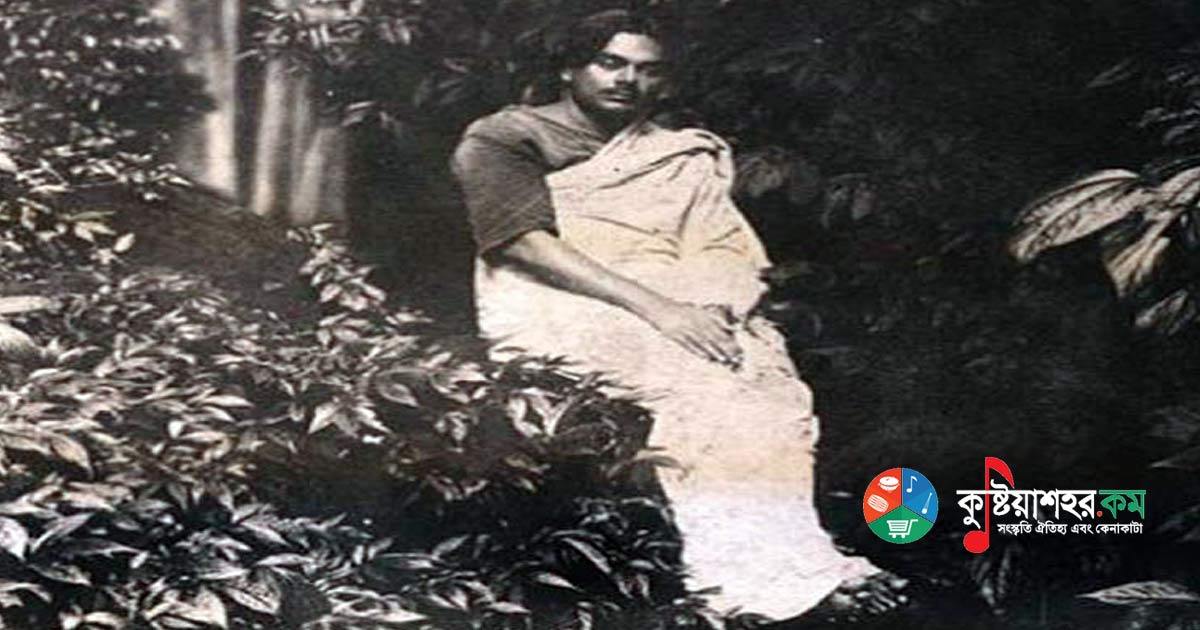
Kazi Nazrul Islam (born 25 May 1899, died 29 August 1976 CE) (born 11 Jaishthya 1306 - died 12 Bhadra 1383 Bangabda) was one of the most popular pioneering Bengali poets, novelists, playwrights, musicians and philosophers of the twentieth century, who, alongside playing a pioneering role in Bengali poetry, is best known for his progressive inspiration. He is notable as one of the greatest figures in the fields of Bengali literature, society and culture. Nazrul is a towering landmark of Bengali intellect. He is one of the literary figures of the Bengali language, a patriot, and the national poet of Bangladesh.
In West Bengal and Bangladesh - both Bengals - his poems and songs are equally cherished. Because of the rebellious outlook in his poetry he has been acclaimed as the Rebel Poet. The central themes of his poetry were man's oppression of man and outspoken protest against social injustice and exploitation. In the Bengali thought of the twentieth century, the stature and importance of Kazi Nazrul Islam are immense. At once poet, writer, musician, journalist, editor, politician and soldier, Nazrul was always outspoken against wrongdoing and injustice. This attitude is reflected in his poems and songs. He entered with a flaming lyre in hand and emerged like a comet. Rebellious in his writing as in his life - hence the "Rebel Poet"; his birth and death anniversaries are observed every year with special honour in both Bengals.
Nazrul was born into a poor Muslim family. His early education was religious. He also worked as an honoured muezzin in a local mosque. In adolescence, going to work with various theatre troupes, he gained thorough knowledge of poetry, drama and literature. After working for some time in the Indian army he chose journalism as his profession. He lived in Calcutta at that time. During this period he joined the direct struggle against the British Raj, publishing poems such as Bidrohi (The Rebel) and Bhangar Gan (The Song of Destruction) and the periodical Dhumketu (The Comet). After being imprisoned he wrote Rajbondir Jobanbondi (The Statement of a Political Prisoner); in these literary works the opposition to imperialism was explicit. He had a special relationship with the religious Muslim community and with the neglected people of India. Love, liberation and rebellion predominated in his literary work. He also wrote against religious gender discrimination. Although he wrote short stories, novels and plays, he is best known mainly as a poet. He gave birth to a new stream in Bengali poetry: Islamic song, that is, the ghazal - and alongside it he also composed many outstanding Shyama songs and Hindu devotional songs. Nazrul composed nearly 3,000 songs and set most of them to music; these are now known as Nazrul Sangeet or "Nazrul Geeti" and are especially popular. In middle age he was stricken with Pick's disease, as a result of which he had to remain cut off from literary work for the rest of his life; at the same time he lost his mental balance. At the invitation of the Government of Bangladesh he came to Dhaka with his family in 1972. He was granted Bangladeshi citizenship at that time. It was here that he passed away.
Birth and Early Life
Kazi Nazrul Islam was born on 25 May 1899 (11 Jaishthya 1306 Bangabda) in the village of Churulia in the Asansol subdivision of Burdwan district in West Bengal, India. The village of Churulia is situated in the Jamuria block of the Asansol subdivision. He was the sixth child of Zaheda Khatun, the second wife of Kazi Fakir Ahmed, son of his grandfather Kazi Aminullah. His father Fakir Ahmed was the imam of the local mosque and the caretaker of a mazar. Of Nazrul's three brothers, Kazi Ali Hossain was the youngest, and of his two sisters, Kazi Sahebzahan was the eldest and Umme Kulsum the youngest. Kazi Nazrul Islam's pet name was "Dukhu Mia". Nazrul worked as a muezzin in the village's local mosque. He began studying the Quran, the religion of Islam, philosophy and Islamic theology at the maktab (a religious school for Muslims run by a mosque). His father died in 1908, when he was only nine years old. After his father's death his education was disrupted by the family's poverty, and at only ten years of age he had to go to work to earn a living. At that time Nazrul passed the lower secondary examination from the maktab and began teaching at that very maktab. At the same time he began work as a caretaker at the grave of Hazi Palwan and as the mosque's muezzin (caller of the azan). Through these tasks he had the opportunity at an early age to become closely acquainted with the basic rituals of Islam, which later influenced his literary work enormously. It may be said that it was he who began the practice of Islamic consciousness in Bengali literature.
Nazrul did not stay long in the work of the maktab, the mosque and the mazar. Attracted to folk art in his boyhood, he joined a leto troupe (a travelling theatrical group practising a mixed genre of poetry, song and dance of the Rarh region of Bengal). His uncle Kazi Bazle Karim was a distinguished master of the leto troupes of the Churulia region and had command of Arabic, Persian and Urdu. Bazle Karim also composed songs in a mixed language. It is thought that it was under Bazle Karim's influence that Nazrul joined the leto troupe. Besides, Nazrul regularly took part in the leto and kavigan sessions of the region's popular leto poet Sheikh Chakor (Goda Kobi) and the kabiya Basudeb. His literary practice began in the leto troupe. With this troupe he went to various places, learned acting from them, and wrote songs and poems for their plays. In the light of his own work and experience he began studying Bengali and Sanskrit literature. At the same time he began studying the Hindu scriptures, that is, the Puranas. Even at that young age he composed quite a few folk songs for his theatrical troupe. These include Chasar Sang, Shakunibadh, Raja Jyadhishthirer Sang, Data Karna, Akbar Badshah, Kobi Kalidas, Bidyabhutum, Rajoputrer Gan, Buro Shaliker Ghare Ro and Meghnad Badh. On the one hand, the life of the mosque, the mazar and the maktab, and on the other, the varied experiences of the leto troupe, supplied many of the elements of Nazrul's literary life. Nazrul composed a great many Shyama songs about the goddess Kali. In his last address Nazrul noted: "Some say my word is that of a mlechchha, some say a kafir. I say I am neither of the two. I have only tried to take the Hindus and the Muslims together in one place and make them shake hands; I have tried to turn mutual abuse into mutual embrace."
In 1910 Nazrul left the leto troupe and returned to student life. That everyone was charmed by his talent in the leto troupe is evidenced by the songs composed about him by other disciples after Nazrul left the leto: "We are now subservient, having lost our master / I think of it day and night, with sorrow in my heart / Nazrul Islam by name - what proof of his talent shall we give". In this new student life his first school was the Siarsol Raj School of Raniganj; afterwards he was admitted to the Mathrun High English School, which later came to be known as the Nabinchandra Institution. The then headmaster of Mathrun School was Kumudranjan Mallick, who was also known as a famous poet of that era. His company was one of Nazrul's sources of inspiration. Recalling memories, Kumudranjan wrote about Nazrul,
"A small, pretty, cheerful boy; when I went to visit the classes he would bow to me beforehand. I would smile and caress him. He was very shy."
However, financial problems did not allow him to study here for long. After studying up to class six he had to return to work again. First he joined Basudeb's kavi troupe. Then he became a cook for a Christian railway guard, and finally took up the work of making bread at a tea-and-bread shop in Asansol. In this way his boyhood passed in considerable hardship. While working in this shop he came to know Rafijullah, the daroga (police inspector) of Asansol. Seeing the poems and rhymes Nazrul composed sitting alone in the shop, Rafijullah recognised his talent. It was he who admitted Nazrul to class seven at the Darirampur School in Trishal of Mymensingh district in 1914. In 1915 he went back again to the Siarsol Raj School of Raniganj and began studying there from class eight. He studied there until 1917. Towards the end of 1917, without sitting the pre-test examination of the secondary school, he joined the army as a soldier. During his studies at this school Nazrul was influenced by four of its teachers: Satishchandra Kanjilal of classical music, Nibaranchandra Ghatak with his revolutionary spirit, Nurunnabi, a Hafiz of Persian literature, and Nagendranath Bandyopadhyay of literary practice.
Nazrul in the Army
Towards the end of 1917 Nazrul joined the army. First at Fort William in Calcutta, and then for training he went to Nowshera in the Frontier Province. After his training he began soldier's life at the Karachi cantonment. He was in the army from the latter part of 1917 to March-April 1920, that is, about two and a half years. During this time, in the 49th Bengal Regiment, he rose from ordinary soldier and corporal to Quartermaster Havildar. From the regiment's Punjabi maulvi he learned the Persian language. He also continued the practice of music with indigenous and foreign musical instruments alongside his fellow soldiers, and the practice of prose and verse went on at the same time. The compositions Nazrul completed while sitting in the Karachi cantonment include Baundeler Atmokahini (The Autobiography of a Vagabond) (his first prose work) and Mukti (Liberation) (his first published poem); stories: Hena, Byathar Dan, Meher Negar, Ghumer Ghore, Kobita Samadhi and so on. Even while staying in the Karachi cantonment he was a subscriber to various literary periodicals of Calcutta. These include Probashi, Bharatbarsha, Bharati, Manasi, Marmabani, Sabujpatra, Saogat and the Bengali Muslim literary periodical. At this time he had some books of Rabindranath Tagore, Sarat Chandra Chattopadhyay and the Persian poet Hafiz. In this connection it may be said that Nazrul's literary apprenticeship began at this very Karachi cantonment. While a soldier he took part in the First World War. Nazrul's force was scheduled to go to Iraq at that time, but as the war came to a halt he did not go. When the war ended in 1920 the 49th Bengal Regiment was disbanded. He then gave up soldier's life and returned to Calcutta.
Journalistic Life and Marriage
After the war, coming to Calcutta, Nazrul began residing at the office of the Bangiya Mussalman Sahitya Samiti at 32 College Street. Staying with him was Muzaffar Ahmed, one of the officials of this society. It was from here that the main works of his literary and journalistic life began. Early on, some of his writings were published in periodicals such as Moslem Bharat, the Bengali Muslim literary periodical and Upasana. These include the novel Bandhan Hara and the poems Bodhan, Shat-il-Arab, Badal Prater Sharab, Agamani, Khaya Parer Toroni, Korbani, Mohorrom and Fatiha-i-Doyazdam; these writings were especially praised in the literary field. In this context the poet and critic Mohitlal Majumdar wrote a critical essay in the periodical Moslem Bharat praising his two poems Khaya Parer Toroni and Badal Prater Sharab. From this began Nazrul's close acquaintance with the country's prominent writers and critics. At the office of the Bangiya Mussalman Sahitya Samiti he came to know Kazi Motahar Hossain, Mojammel Haq, Kazi Abdul Odud, Muhammad Shahidullah, Afzalul Haq and others. Through participation in the two popular literary gatherings of the Calcutta of that time - the Gajendar Adda and the Bharatiya Adda - he came to know Atulprasad Sen, Abanindranath Tagore, Satyendranath Dutta, Premankur Atorthy, Sishir Bhaduri, Sarat Chandra Chattopadhyay, Nirmalendu Lahiri, Dhurjatiprasad Mukhopadhyay, Hemendrakumar Roy, Dinen Tagore, Charuchandra Bandyopadhyay, Ustad Karamatulla Khan and others. In October 1921 he went to Santiniketan and met Rabindranath. From then until Rabindranath's death good relations were maintained between them. A special friendship grew up between Nazrul and Kazi Motahar Hossain.
Young Nazrul
On 12 July 1920 an evening daily called Nabayug began publication. Published against the backdrop of the non-cooperation and Khilafat movements, its editor was Sher-e-Bangla A. K. Fazlul Haq. It was through this newspaper that Nazrul began journalism regularly. That very year he wrote in the paper an essay titled "Who is responsible for the killing of the Muhajirin?", for which the newspaper's security deposit was confiscated and police surveillance of Nazrul began. In any case, through journalism he had the opportunity to observe the political and social conditions of the time directly. At the same time, by joining various political meetings and associations with Muzaffar Ahmed, he had the opportunity to gain direct experience of politics. The practice of poetry and music was also going on simultaneously through various small occasions. He had not yet begun writing songs and setting them to music himself. But Mohini Sengupta, a musician of the Brahmo Samaj, had set several of his poems to music and was publishing them in periodicals with musical notation. These include Hoyoto Tomar Pabu Dekha and Ore E Kono Sneha-Suradhuni. In the Boishakh issue of 1327 Bangabda of the periodical Saogat his first song was published. The song was "Bajao Prabhu Bajao Ghan". Around April-June 1921, at the office of the Muslim Sahitya Samiti, Nazrul became acquainted with the book publisher Ali Akbar Khan. It was with him that he first came to the house of Birjasundari Devi of Comilla. And here he became acquainted with Pramila Devi, with whom he was first betrothed and later married.
But before this, Nazrul's marriage was arranged with Nargis Asar Khanam, the sister of Ali Akbar Khan. After the akd of the marriage was completed, a dispute arose over the condition in the marriage contract that Nazrul would live in his in-laws' house. Nazrul refused to live as a ghor jamai and, before the wedding night was completed, leaving Nargis behind, he went to the house of Birjasundari Devi in Comilla town. Nazrul was then very ill, and Pramila Devi nursed him. At one point they were joined in marriage.
Nazrul was a herald of egalitarianism. Although a Muslim, he gave his four children both Hindu and Muslim names, such as: Krishna Muhammad, Arindam Khalid (Bulbul), Kazi Sabyasachi and Kazi Aniruddha.
The Rebel Nazrul
At that time the non-cooperation movement created tremendous enthusiasm across the country. Nazrul stayed for some days at Ali Akbar Khan's house at Daulatpur, away from Comilla, and then returned to Comilla again on 19 June. For as long as he stayed there he became an active political worker. His main task was joining processions and meetings and singing songs. Among the songs he composed and set to music at that time are "E Kono Pagol Pathik Chute Elo Bondini Mar Anginay, Aji Rokto-Nishi Bhore / Eki E Shuni Ore / Mukti-Kolahol Bondi-Shrinkhole" and others. He stayed here 17 days and then changed his location. In November 1921 he returned again to Comilla. 21 November was a hartal across the whole of India - on this occasion Nazrul again took to the streets; he went round the town with the non-cooperation procession and sang, "Bhikkha Dao! Bhikkha Dao! Phire Chao Ogo Purabashi". In Nazrul's poems, songs and essays of this period the spirit of rebellion found expression. Its finest example is the poem titled Bidrohi (The Rebel). The poem Bidrohi was published in 1922 and won fame in the literary society of all India. In this poem Nazrul describes himself:
"I am the deprived, the sorrow of the wayfarers, forever homeless, all who walk the roads,
I am the heart's anguish of the humiliated, the venomous smart, the stirring of motion in the forever disgraced breast
I am the resentful lament of the forever seething heart, sorrow deeply nested,
I am the trembling throb of the first bloom of maidenhood!
I am the furtive glance of the secret beloved, a stolen glimpse,
I am the love of a playful girl, the jingle of her bangle-clad wrists.
...
Great rebel, weary of battle,
I shall be quiet that day
When the wailing roll of the oppressed shall sound no more in sky and air,
When the tyrant's scimitar and blade shall clash on earth no more -
Rebel, weary of battle,
I shall be quiet that day.
.......................
I am the eternal rebel hero -
Alone I have raised my head forever high above this world!
On 12 August 1922 Nazrul published the newspaper Dhumketu. It was published twice a week. In the 1920s the non-cooperation and Khilafat movements at one point ended in failure. The armed revolutionary movement that then arose for the building of Swaraj owed a special contribution to the Dhumketu. Blessing this newspaper, Rabindranath Tagore wrote:
"Kazi Nazrul Islam, blessed one - come, O comet, come.
Build a bridge of fire across the darkness; at this fortress-head of the evil day, raise aloft your banner of victory.
"
This message was written at the top of the paper's front page. In the 26 September 1922 issue of the paper, Nazrul's poem Anandamoyir Agoman was published. Because this political poem was published, on 8 November that issue of the paper was declared banned. On 23 November of the same year his book of essays Jugbani was confiscated, and on the same day he was arrested in Comilla. After the arrest he was brought from Comilla to Calcutta. On 7 January 1923 Nazrul, as an under-trial prisoner, gave a deposition in his own defence. This deposition was given in the court of Chief Presidency Magistrate Swinhoe. His deposition came to hold special literary status in Bengali literature under the name Rajbondir Jobanbondi. In this deposition Nazrul said:
"The charge against me is that I am a traitor to the Raj; that is why I am a prisoner in the King's jail today and accused at the King's gate... I am a poet; I have been sent by God to reveal the unrevealed truth, to give form to the formless creation. In the poet's voice God responds; my word is the revelation of truth, the word of God. That word may be treason in the Raj's judgement, but in the judgement of justice it is not treason against justice, not treason against truth. The revelation of truth shall not be stopped. The comet in my hand shall now become the fire-torch in God's hand and scorch injustice and tyranny...."
After the trial on 16 January Nazrul was sentenced to one year's rigorous imprisonment. Nazrul was taken to the Alipur central jail. While he was passing his prison life there (22 January 1923), the world poet Rabindranath dedicated to Nazrul his book of the musical drama Basanta. Nazrul was especially elated by this. In this joy, sitting in jail, he composed the poem Aaj Srishti Sukher Ullase.
Illness
Alongside journalism at Nabayug, Nazrul was working in radio. It was then - that is, in 1942 - that he fell ill. He lost his power of speech. His illness became clearly known in July 1942. Thereafter he was treated mainly with homoeopathy and Ayurvedic medicine. But there was no significant improvement in his condition. Had it been possible to send him to Europe at that time, neurosurgery could have been performed. But because of the Second World War that was not possible. Towards the end of 1942 he also lost his mental balance. Thereafter the Nazrul family lived in seclusion in India. They remained in seclusion until 1952. In 1952 the poet and his wife were sent to a mental hospital in Ranchi. A leading role in this initiative was played by an organisation formed for Nazrul's recovery named the Nazrul Treatment Committee; besides, the then famous Indian politician Shyama Prasad Mukherjee assisted. The poet was in Ranchi for four months.
Then in May 1953 Nazrul and Pramila Devi were sent to London for treatment. He left Howrah railway station on 10 May for London. After reaching London quite a few specialist physicians tried to diagnose his illness. Among them were Russell Brain, William Sargant and MacKeith - they met with Nazrul three times. In each session they took a fee of 250 pounds. According to Russell Brain, Nazrul's illness was incurable - to cure it was practically impossible. One group diagnosed that Nazrul was suffering from "involutional psychosis". Besides, the Indian physicians residing in Calcutta had also formed a separate group. Both groups agreed in this matter that the treatment of the early stage of the illness had been very inadequate and insufficient. At the London Clinic, where the poet was staying, an X-ray called air encephalography was performed on him. It showed that the frontal lobe of his brain had shrunk. Like Dr MacKeith, several physicians considered appropriate a procedure whose name was the MacKeith operation. Dr Brain, however, opposed it.
At this time Nazrul's medical report was sent to the famous physicians of Vienna. It was also sent to other important places in Europe. Roentgen, a neurosurgeon professor of the University of Bonn in Germany, opposed the MacKeith operation. The physicians of Vienna also raised objection to this operation. They all spoke of another examination in which a colour visible in X-ray is filled into the blood vessels of the brain and pictures of the blood vessels are taken (cerebral angiography). In accordance with the decision of the poet's well-wishers, he was admitted under the Viennese physician Dr Hans Hoff. This physician was one of the students of the Nobel laureate physician Julius Wagner-Jauregg. The poet was examined on 9 December 1953. From the result Dr Hoff said that the poet was certainly suffering from a neuronal problem called Pick's disease. In those afflicted with this disease the frontal and lateral lobes of the brain shrink. He further said that it was impossible to cure the poet from his present condition. On 27 December 1953 the Calcutta daily Yugantar printed an essay titled Nazrul in Vienna, whose author was Dr Ashok Bagchi - he was staying in Vienna for higher studies and had gained first-hand knowledge of Nazrul's treatment. However, the British physicians demanded a huge fee for Nazrul's treatment, whereas no physician of other parts of Europe took any fee. Soon Nazrul returned home from Europe. Immediately afterwards the Chief Minister of West Bengal, Dr Bidhan Chandra Roy, went to Vienna and heard the details from Dr Hans Hoff. All who had gone to Europe with Nazrul set out for home from Rome on 14 December 1953.
Arrival in Bangladesh and Passing Away
In 1971, with the victory of the Bengalis in Bangladesh's War of Independence, an independent state named Bangladesh was established. On 24 May 1972, with the permission of the Government of India, the poet Nazrul was brought to Bangladesh with his family. The then President of Bangladesh, Sheikh Mujibur Rahman, had taken special initiative in this regard. The rest of the poet's life was spent in Bangladesh. In recognition of his special contribution to Bengali literature and culture, on 9 December 1974 the University of Dhaka conferred on him an honorary D.Litt. He was given this degree at a convocation of the university. In January 1976 the Government of Bangladesh granted the poet Bangladeshi citizenship. On 21 February of the same year he was honoured with the Ekushey Padak. The Ekushey Padak is considered the most honourable award of Bangladesh.
Thereafter, despite considerable treatment, there was no significant improvement in Nazrul's health. In 1974 the poet's youngest son, the famous guitarist Kazi Aniruddha, passed away. In 1976 Nazrul's own health too began to decline. The last days of his life were spent at the PG Hospital in Dhaka. On 29 August 1976 he passed away. Nazrul wrote in one of his songs: "Bury me beside the mosque, brother / so that from the grave I may hear the muezzin's azan." Taking this wish of the poet into consideration, it was decided to bury the poet beside the central mosque of Dhaka University, and his tomb was built accordingly.
After his janaza prayer was performed, President Abu Sadat Mohammad Sayem, Major General Ziaur Rahman, Rear Admiral M H Khan, Air Vice Marshal A G Mahmud and Major General Dastagir, carrying Nazrul's body draped with the national flag, bore it from the Suhrawardy Udyan to the premises of the university mosque. On the occasion of his death in Bangladesh a two-day state day of mourning was observed. And in India's legislature one minute's silence was observed in the poet's honour.