বাংলা
 English

Kazi Aref Ahmed (born 8 April 1942, died 16 February 1999) was born in Jhaudiya village of Kushtia Sadar upazila. He was a member of the 1962 Nucleus and one of the organizers of the Mujib Bahini. Kazi Aref took part in the Liberation War as deputy chief of the Mujib Bahini in the western sector; he was a prominent organizer of the Liberation War and the designer of Bangladesh's national flag.
Kazi Aref Ahmed: he was an organizer of Bangladesh's Liberation War of 1971 and deputy chief of the Mujib Bahini in the western sector.
Kazi Aref was born on 8 April 1942 at his maternal grandfather's house in Jhaudiya village of Sadar upazila, and through his paternal line his address is Khoerpur village of Mirpur upazila.
- In 1966 he played a courageous role in popularizing the Six-Point Movement.
- In 1972 he was one of the initiators and founders of the Jatiya Samajtantrik Dal (JASAD).
- He was president of the National Krishak League.
- After independence he was chief executive of the national daily Gonokontho.
- Kazi Aref Ahmed rests in eternal sleep at the Mirpur Freedom Fighters' Cemetery.
"Declaring Islam the state religion has not raised the stature of Islam; rather, the greatness of Islam has been belittled. Islam is a religion of tolerance; in Islam, the faith of all human beings has been viewed with equal regard. Nowhere do the Quran and Sunnah disregard the Christian, Buddhist or Hindu faiths. In Islam the freedom of all religions has been guaranteed." (Weekly Ekhonai Shomoy)
----Kazi Aref Ahmed
The goal of today's movement of the National Coordination Committee is to establish an exploitation-free, non-communal, democratic state system, and to realize the spirit of the Liberation War by carrying out the death sentences of the war criminals and killers of '71 - Golam Azam, Abbas Ali, Nizami, Kamaruzzaman, Alim, Maulana Mannan and Anwar Zahid. To this end the second phase of the Liberation War has begun through the movement of the National Coordination Committee.
---- Kazi Aref Ahmed.
Comment: what Kazi Aref Ahmed thought about 22 years ago, on 16/02/1993, is now about to be realized.


Muhammad Ali Jinnat: journalist, central student organizer of the mass movement of the nineties and a colleague of Kazi Aref Ahmed, said:
Kazi Aref was not only one of Bangladesh's foremost dreamers, he also kept in touch with the soul of Bangladesh. That is why his political comrades knew him as the soul of Bangladesh. He was a leading figure of that dreaming youth who dreamed of giving full shape to the thousand-year history of the Bengali national identity. He was born on 8 April 1942 at his maternal grandfather's house in Jhaudiya union of Sadar upazila of Kushtia district. His paternal home was the famous Kazi house of Khoerpur village in Mirpur upazila of Kushtia. His father was Kazi Abdul Kuddus and his mother Khoodeja Khatun. He was the third of ten siblings. In 1948 he came to Dhaka with his father and the whole family. They settled in the historic Tikatuli area of old Dhaka. He passed matriculation from a reputed collegiate school of Dhaka in 1960, higher secondary from Jagannath College, and a BSc in 1966.
He was then admitted to the Department of Geography of the University of Dhaka. Because of his politics, on government orders the university authorities cancelled his admission in 1966. Bengali national consciousness awakened in Kazi Aref from his school days. He began his political life through the movement against Ayub's military rule in 1960. In 1962 he became a member of the central committee of the Chhatra League, and in 1963 he was elected president of the Dhaka Metropolitan Committee. At that time the president of the central committee was KM Obaidur Rahman and the general secretary was Sirajul Alam Khan (Dada Bhai). From 1962 he realized the need to build a revolutionary organization with the aim of the independence of Bengal, political and economic emancipation, and the establishment of the Bengali nation-state of Bangladesh. On this he began regular consultations with Sirajul Alam Khan and Abdur Razzak. In this continuity, in 1964 the three-member Nucleus of the Swadhin Bangla Biplobi Parishad (Independent Bengal Revolutionary Council) was formed.
The members of the Nucleus were Sirajul Alam Khan, Abdur Razzak and Kazi Aref Ahmed. This Nucleus held all the powers of the Swadhin Bangla Biplobi Parishad. By the Nucleus's decision, from 1964 declarations of independence written in Kazi Aref's own hand - 'Joy Bangla', 'Biplobi Bangla' - under various names were printed on a cyclostyle machine at his paternal home at 14/3 Abhay Das Lane in old Dhaka. Activists would read those papers and then, on the leaders' advice, burn them. Abdur Razzak's responsibility was constant liaison with Sheikh Mujibur Rahman and the Awami League. Kazi Aref's responsibility was building up the organization of the Swadhin Bangla Biplobi Parishad. Sheikh Mujib's direct and indirect support stood behind all the Parishad's activities. The students' movement of 1962, the Six Points of 1966, the mass uprising of 1969, the general election of 1970, the open declaration of independence by Bangabandhu on 7 March, the formal bestowal of the title Bangabandhu on Sheikh Mujibur Rahman, the making of the flag of independent Bangladesh, the formal hoisting of the flag, the reading of the declaration of independence - above all the Bengalis' war of independence - all of this was part of the Swadhin Bangla Biplobi Parishad's long planning. And it was the three-member Nucleus that planned all these things. The policy and strategy of the struggle for independence were formulated from the Nucleus itself.
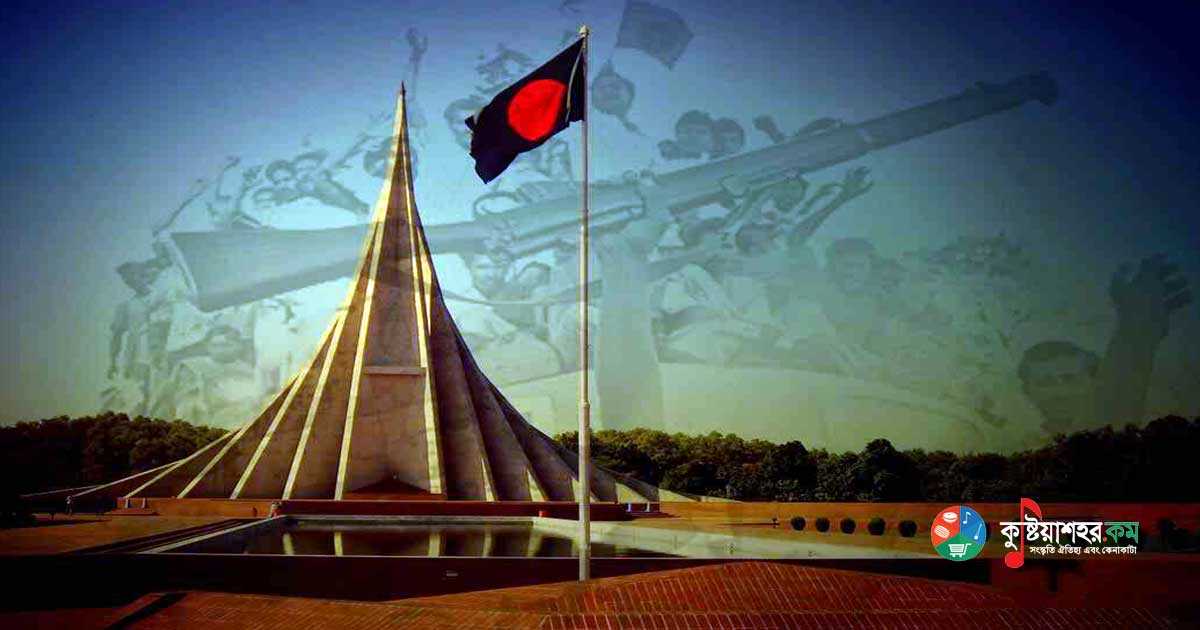
Kazi Aref was also one of the designers of the national flag, the symbol of Bangladesh's independence and sovereignty. In 1971, in room 118 of Iqbal Hall (now Zohurul Haq Hall) of the University of Dhaka, he finalized the design of Bangladesh's flag together with the members of the Revolutionary Council. As a member of the Nucleus he led the effort. That flag, once made, was hoisted on 2 March 1971 at Bat Tala of the University of Dhaka by DUCSU VP A. S. M. Abdur Rab. With the aim of giving meaning to the independence won through the Liberation War, a group of young people formed JASAD on 31 October 1972. Kazi Aref was one of the initiators of JASAD's founding. At that time he also took on the editorship of the party organ, the most widely circulated newspaper, the daily Gonokontho.
He was also a top-level organizer of the great Liberation War. During the war he served not only as deputy chief of the western sector of the Bangladesh Liberation Force (BLF), that is, the Mujib Bahini, but also as coordinator among the four regional chiefs of the Mujib Bahini - Sheikh Fazlul Haq Mani, Sirajul Alam Khan, Abdur Razzak and Tofael Ahmed. He was also the chief organizer of bringing all organizations and individuals who believed in the spirit of the Liberation War onto one platform in independent Bangladesh. Kazi Aref, one of the architects of the historic students'-people's uprising of 1990, was a rare example in Bangladesh's politics. An honest, fearless, resolute, principled politician like him is rare in today's era. He was free of ambition and unflinching.
As I saw him, Aref Bhai worked silently. He could be called something of a behind-the-scenes operator. I saw no change anywhere in his movements or way of life. He wore the same kind of pants and shirt. He walked and rode rickshaws. He commuted on ordinary buses. A very ordinary life. A colossus of a politician who passed the test of honesty.
This dreamer of the Bengali nation-state did not die a natural death, unlike many of the world's great national heroes. The national hero Kazi Aref Ahmed, the darling of the politics of our time, was killed by the brushfire of terrorist assassins while speaking at an anti-terrorist public rally on the field of Kalidaspur Primary School in Daulatpur upazila of Kushtia on 16 February 1999. His body was buried with full state honors at the Mirpur Martyred Intellectuals Cemetery in the capital. He left behind his one-time political colleague and wife Rowshan Jahan Sathi (member of the ninth National Parliament), his only son Arup and his only daughter Jyoti, along with hundreds of thousands of fellow fighters and colleagues.
As long as the red-and-green flag keeps flying, Kazi Aref too will live on in the hearts of the Bengalis. Finally, I want to say in Mao Zedong's words - Kazi Aref's death is heavier than Mount Tai.