বাংলা
 English
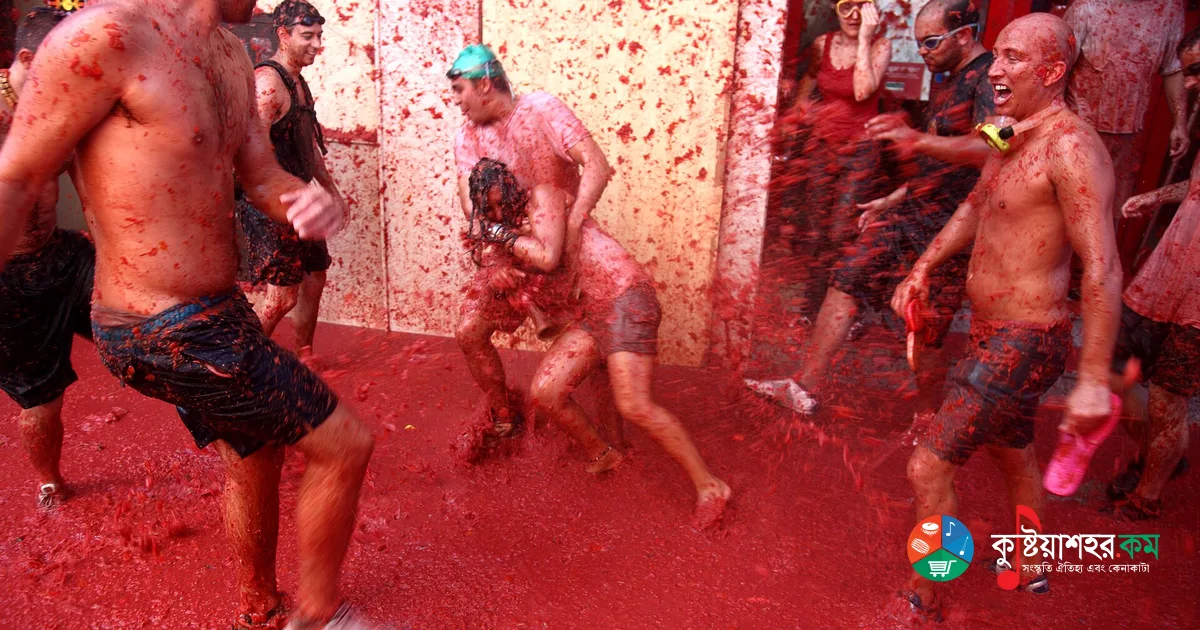
Every year on the last Wednesday of August, the small Spanish town of Buñol turns blood red — in just one hour, around 130 tonnes of ripe tomatoes are hurled in the world's biggest tomato fight, La Tomatina. Botanically a fruit but a vegetable in the kitchen, the tomato truly reigns at festivals. From the hill town of Sutamarchán in Colombia to Reynoldsburg, Ohio — the "Birthplace of the Tomato" — many countries celebrate the tomato at different times of the year, mixing tomato throwing, cooking contests and lively fairs into one giant burst of laughter.
La Tomatina: the world's biggest tomato fight
Buñol, a small town about 40 kilometres from Valencia, is famous for exactly one thing: La Tomatina, held every year on the last Wednesday of August (26 August in 2026). The story began in 1945, when a scuffle broke out during the town's Giants and Big-Heads parade — a participant's oversized head mask fell off, and in the ensuing rage people raided a vegetable stall and started pelting each other with tomatoes. The next year, 1946, young people deliberately brought tomatoes from home to repeat the fun — and the annual tradition was born.
The festival's path was not smooth. In the 1950s General Franco's government banned it as having no religious significance, and rule-breakers were arrested. In 1957 the townspeople answered with a brilliant protest: they carried a giant tomato inside a coffin through the streets, accompanied by a band playing funeral marches — the "tomato funeral". The protest worked, the festival returned with official rules, and later the Buñol town council took it over. A 1970s report by Spanish TV journalist Javier Basilio spread its fame across the country, and in 2002 La Tomatina was declared a Fiesta of International Tourist Interest.
How the day of the battle unfolds
Buñol fills up before Wednesday itself, with a paella cooking contest, fireworks, parades and music. On the morning of the fight comes the "Palo Jabón": a ham (jamón) is tied to the top of a greased pole, and crowds climb over one another trying to bring it down. When the ham falls — or at the appointed hour — a cannon blast opens the battle: huge trucks tip tomatoes onto the streets, roughly one hour of chaos follows, and the second cannon shot stops everything. Fire trucks then hose down the streets, residents offer their garden hoses to visitors, and the tomato's citric acid works as a natural cleaner — some surfaces end up shinier than before!

A participant drenched in tomato pulp (Photo: flydime / Wikimedia Commons, CC BY-SA 2.0)
Since 2013 the number of participants has been capped at 20,000 ticket holders — a town of only about 9,000 residents simply cannot absorb more. The 2020 and 2021 editions were cancelled for COVID-19; on the 80th anniversary in 2025 more than 22,000 people took part. Around 130 tonnes of tomatoes went flying in 2013, and roughly 145 tonnes in 2015. The rules are short: throw only tomatoes, squash them first; don't tear anyone's clothes; keep clear of the trucks; stop at the second cannon; obey the security staff.
Sutamarchán, Colombia: the June Tomatina
Spain's story proved so famous that it cast its shadow over South America too. Sutamarchán, a hill town in Colombia's Boyacá department, launched its own Tomatina on 15 June 2004, and the festival is now held around mid-June every year — with a tomato battle much like Buñol's. Famous for its longaniza sausages, the town adds grilled sausages, regional food and folk music to the tomato pulp. If you want a tomato festival in the first half of the year, this is the most popular address.
Tomato festivals in the United States
Reynoldsburg, Ohio carries the nickname "Birthplace of the Tomato" — in the 19th century Alexander W. Livingston bred the first commercial tomato varieties there, and his house still stands as a museum. Since 1965 the town has thrown a Tomato Festival every August, with tomato-themed food stalls, parades and a Tomato Festival Queen contest. Here nothing is thrown — tomatoes are cooked and honoured instead; this is the gentler face of tomato festivals.
What a tomato festival looks like
Wherever a tomato festival happens, three things almost always appear. First, food — paella, salsa, sauces, pizza toppings and straight-up tomato salads, usually with cooking contests. Second, music and parades — Buñol's festival week runs on bands, fireworks and street dancing. Third, of course, the tomato itself: somebody throws it, somebody cooks it, somebody rides it on a float. A tomato festival is really a strange kind of social gathering — once everyone is drenched in the same red pulp, boundaries of class, age and background simply melt away.
When and where
The calendar is easy to remember. La Tomatina — Buñol, Spain, on the last Wednesday of August (26 August in 2026). Sutamarchán — Colombia, around mid-June. Reynoldsburg — Ohio, USA, in August. So June belongs to Colombia and August to Europe and America: the tomato-festival season stretches across the second half of the year.
If you want to join
For La Tomatina, buy your ticket early from the official site — the 20,000 cap sells out fast. Wear white (turning red is the tradition), pack goggles or sunglasses and a change of clothes, and keep your phone in a waterproof pouch. Buñol has few hotels, so most visitors stay in Valencia, 40 kilometres away, taking a morning train in and an evening train back. For Sutamarchán, it is about a three-hour bus ride from Bogotá.
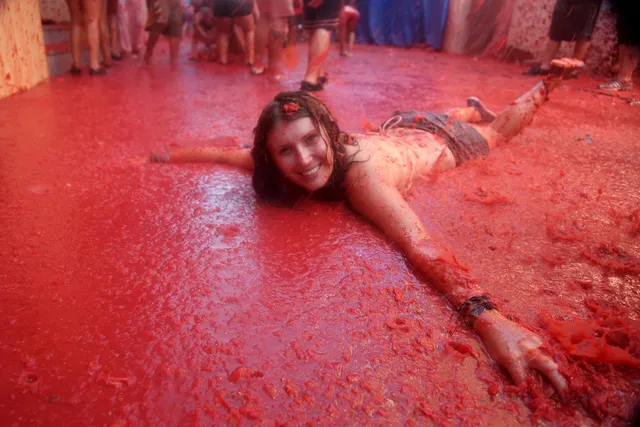
A participant floating in a pool of crushed tomatoes (Photo: flydime / Wikimedia Commons, CC BY-SA 2.0)
The place of tomatoes in Bangladesh
The tomato fight happens in Buñol, but tomatoes have an equally close bond with us. When winter arrives, the markets of Bangladesh fill with red tomatoes — winter is this fruit's season, and then the tomato becomes one of the favourite members of the Bengali table. Raw tomatoes with salt and chilli make the mouth water; the tangy tomato chutney that accompanies borhani at wedding feasts is indispensable; and tomato bhorta — a smoky mash pounded with mustard oil — is one of winter's most loved fiery companions of rice. In the kitchen the tomato is inseparable anyway: from biryani and korma to pasta and pizza sauce, everything rests on tomatoes. That is why the tomato is now a profitable crop for Bangladeshi farmers, with the northern districts growing it widely in winter.
How a tomato festival could be celebrated in Bangladesh
Buñol's tomato throwing is not for us — nobody in this food-conscious country wants to waste food. Instead, a Bangladeshi tomato festival would be a festival of cooking and farming. Schools and colleges can hold a tomato day in winter (December–January): cooking contests for the best chutney, salad and sauce, a biggest-tomato contest, and tomato art for the little ones. At home, a winter 'tomato platter' can be laid out one afternoon — bhorta, chutney, salad and jhol from the same tomato, with a game of telling the dishes apart by taste. A fair can go bigger with a giant-tomato display, prizes for the best grower and stalls of seedlings and seeds. So if a tomato festival is ever to start in Bangladesh, the rule is only one: in the place of throwing tomatoes, eating them is our way.
Closing words
It is remarkable how many towns have built so many different festivals around one humble fruit-vegetable. In Buñol the tomato became an explosion of release, in Sutamarchán a badge of pride, in Reynoldsburg a memory of heritage. When the hour-long tomato rain ends and people wash up and head home, they all carry back the same thing — the memory of laughing together with total strangers. The tomato festival, in the end, is a festival of people.