বাংলা
 English
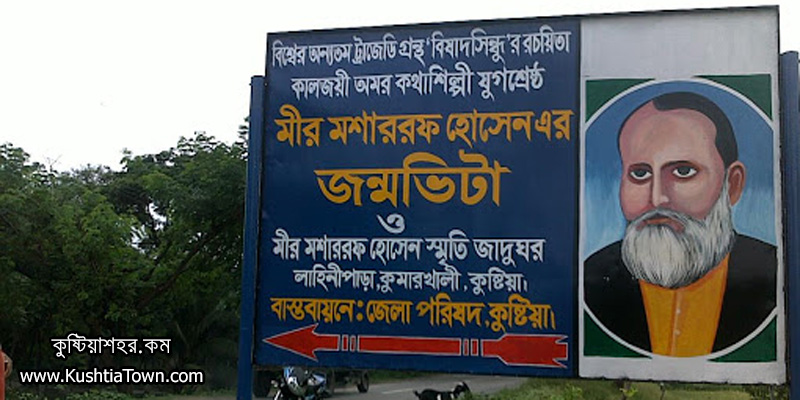
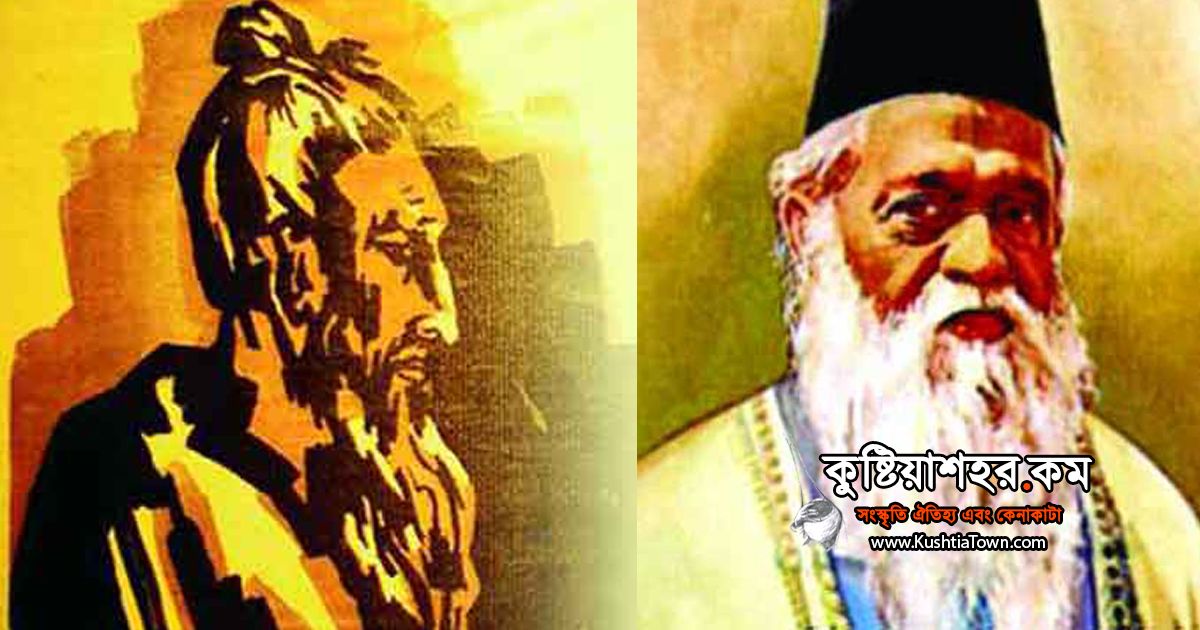
Mir Mosharraf Hossain, the immortal author of Bishad Sindhu, renowned as the greatest Muslim literary figure of the nineteenth century, was born on 13 November 1847. Mir Mosharraf Hossain's lineage: Syed Sadullah – Mir Umar Daraj – Mir Ibrahim Hossain – Mir Moazzem Hossain – Mir Mosharraf Hossain.
His forefather Syed Sadullah first came from Baghdad to Delhi and took service in the Mughal army. Later he came to Sakra village in Faridpur district, married a Hindu Brahmin daughter, and began living permanently in Padamdi village of present-day Rajbari district. According to the tradition of Bangladesh, women go to their parents' home during pregnancy. In keeping with that custom, while Mir Mosharraf Hossain was still in his mother's womb, his father Moazzem Hossain moved with his mother Daulatan Nessa from Kushtia town to Lahinipara village near the Gorai bridge, three miles to the east — that is, to Mir's maternal grandfather's house. Like Mir's paternal grandfather, his maternal grandfather too was a highly respectable and wealthy man. Mir was born at his maternal grandfather's house. After the death of Mir's maternal grandfather, his father Moazzem Hossain lived for some time in Lahinipara village of Kushtia district itself.
In his childhood Mir Mosharraf Hossain began his studies first at home and later at the village school of Jagmohan Nandi. He then studied for a short while at the Kumarkhali M. N. School and Kushtia High School. In 1860 Mir Mosharraf's mother Daulatunnesa died. After his mother's death, Mir returned to his own home in Padamdi village of Rajbari district and, enrolling at Padamdi High School, continued his studies. He was later admitted to Krishnanagar Collegiate School. At that time Mir was only thirteen years old. It was at this age that he began his literary career. He left his luminous signature in every field of literature, writing nearly thirty-seven books of stories, novels, plays, poetry, autobiography, essays and religious subjects. Among these, Ratnavati, Gauri Setu, Basanta Kumari, the play Jamidar Darpan, Sangit Lahari, Udasin Pathiker Moner Katha, Modinar Gourab and Bishad Sindhu are especially noteworthy. Alongside literary composition, he also did journalism for some time. He first worked for a while on Kangal Harinath Majumdar's weekly Grambarta Prakashika and on poet Ishwar Gupta's Sangbad Prabhakar. Then in 1880 he published a fortnightly periodical called 'Hitakari' from Lahinipara, the area of his maternal grandfather's home.
Probably on entering the eighth grade, he stayed for some time at the Kolkata home of his father's friend Nadir Hossain and studied there. During his stay at Nadir Hossain's house, a love affair first developed with Latifun, his beautiful eldest daughter, and later a marriage was arranged. But at the wedding, in place of the first daughter, Nadir Hossain married him off to the second, plain-looking and witless daughter Azizunnesa (19 May 1865). As a result of this episode Latifunnesa committed suicide, and Mir was deeply wounded. He could never forgive his wife Azizunnesa. Since his first marriage brought no happiness, eight years after it he married Kali, alias Kulsom Bibi, the daughter of a widow of Saonta village. This deepened his estrangement with Azizunnesa further. Unable to go on living in that area, Mir Mosharraf Hossain became manager of one branch of the Gaznavi estate in Tangail district and settled at 'Shantikunj' in Tangail with Bibi Kulsom. He then also worked at the Delduar estate of Tangail; he became manager at Delduar in 1884.
Meanwhile, after living a lonely life for years in neglect and disregard, Azizunnesa died at Lahinipara and was buried there. On the other hand, because of quarrels with the zamindars he gave up that job in 1892 and, after the death of his first wife Azizunnesa, returned to Lahinipara once more. Mir Saheb's book Bishad Sindhu was written during his stay at Delduar. Working in the zamindari estates, he saw the pettiness, selfishness, greed for property, intrigues, envy and malice, and manifold wrongdoings of the zamindars. Accounts of all that appear in the two books 'Gazi Miyar Bastani' and 'Udasin Pathiker Moner Katha'. The prose of these two books is likewise artistic and fluent.
After leaving the zamindari estate's service, Mosharraf Hossain lived in various places. He was also in Kolkata from 1903 to 1909.
His first wife Azizunnesa bore no children. Mir Mosharraf Hossain's five sons and six daughters were all born of Bibi Kulsom. The names of Mir Mosharraf Hossain's children: Roushan Ara, one daughter (whose name is not known), Ibrahim Hossain, Amina, Saleha, Salema, Ashraf Hossain, Omar Daraj, Mahbub Hossain, Rahela and Mostaq Hossain. When Mir Mosharraf Hossain passed away at his own home in Padamdi village of Rajbari district on 19 December 1911, he was buried beside Bibi Kulsom's grave.
Mir Mosharraf Hossain was one of the greatest literary figures of the nineteenth century. His first biographer Brajendranath Bandopadhyay compared him with Ishwar Chandra Vidyasagar in Bengali literature. It would not be incongruous to compare Mir Mosharraf Hossain with Bankim Chandra Chattopadhyay either. In prose, verse, drama and the novel, Mir Mosharraf Hossain wrote nearly thirty-seven books. His prose style was pure Bengali, which many a famous Hindu writer of the time could not manage. But since his verse was almost entirely imitation and forced composition, it did not gain much favor. By writing the play 'Jamidar Darpan' he attained the rank of one of the foremost playwrights of the age. In plot, dialogue, characterization and dramatic quality, that play claims superiority in many respects over Dinabandhu Mitra's 'Nil Darpan'. Fearing it might incite a peasant uprising, Bankim Chandra recommended in the periodical 'Bangadarshan' that the play's publication and performance be stopped.
The books written by Mir Mosharraf Hossain are as follows:
| # | Name of the book | Category of the book | Year |
|---|---|---|---|
| 1 | Ratnavati | Novel | 1873 |
| 2 | Basanta Kumari | Play | 1873 |
| 3 | Jamidar Darpan | Play | 1869 |
| 4 | Gorai Bridge or Gauri Setu | Book of poetry | 1873 |
| 5 | Er Upay Ki | Farce | 1876 |
| 6 | Bishad Sindhu | Historical novel | 1885-91 |
| 7 | Sangit Lahari | Music | 1887 |
| 8 | Go-Jibon | Essay | 1889 |
| 9 | Behula Gitabhinay | Musical drama | 1889 |
| 10 | Udasin Pathiker Moner Katha | Biography | 1899 |
| 11 | Gazi Miyar Bastani | Satirical writing | 1899 |
| 12 | Maulud Sharif | Religious book in prose and verse | 1900 |
| 13 | Musalmaner Bangala Shiksha | Student textbook, first and second parts | 1903 - 1908 |
| 14 | Bibi Khodejar Bibaha | Poetry | 1905 |
| 15 | Hazrat Omarer Dharma Jiban Labh | Poetry | 1905 |
| 16 | Hazrat Belaler Jiboni | Essay | 1905 |
| 17 | Hazrat Amir Hamzar Dharma Jiban Labh | Poetry | 1905 |
| 18 | Modinar Gourab | Poetry | 1906 |
| 19 | Moslem Biratwa | Poetry | 1907 |
| 20 | Islamer Joy | Essay book | 1908 |
| 21 | Amar Jiboni | Autobiography | 1908-10 |
| 22 | Baji Mat | Poetry | 1908 |
| 23 | Hazrat Yusuf | Essay book | 1908 |
| 24 | Khotba or Eidul Fitr | Poetry | 1908 |
| 25 | Bibi Kulsom | Biography | 1910 |
| 26 | Bhai Bhai Eit Chai | Farce | 1899 |
| 27 | Fans Kagoj | Farce | 1899 |
| 28 | E Ki! | Farce | 1899 |
| 29 | Tala Obinoy | Farce | 1899 |
| 30 | Panchanari | Poetry | --- |
| 31 | Prem Parijat | Poetry | --- |
| 32 | Bandha Khata | Novel | 1899 |
| 33 | Niyoti Ki Obonoti | Novel | 1899 |
| 34 | Rajia Khatun | Novel | 1899 |
| 35 | Tahmina | Novel | 1899 |
| 36 | Gazi Miyar Guli | Satirical writing | --- |
| 37 | Brihat Hirak Khoni | Children's reader | --- |
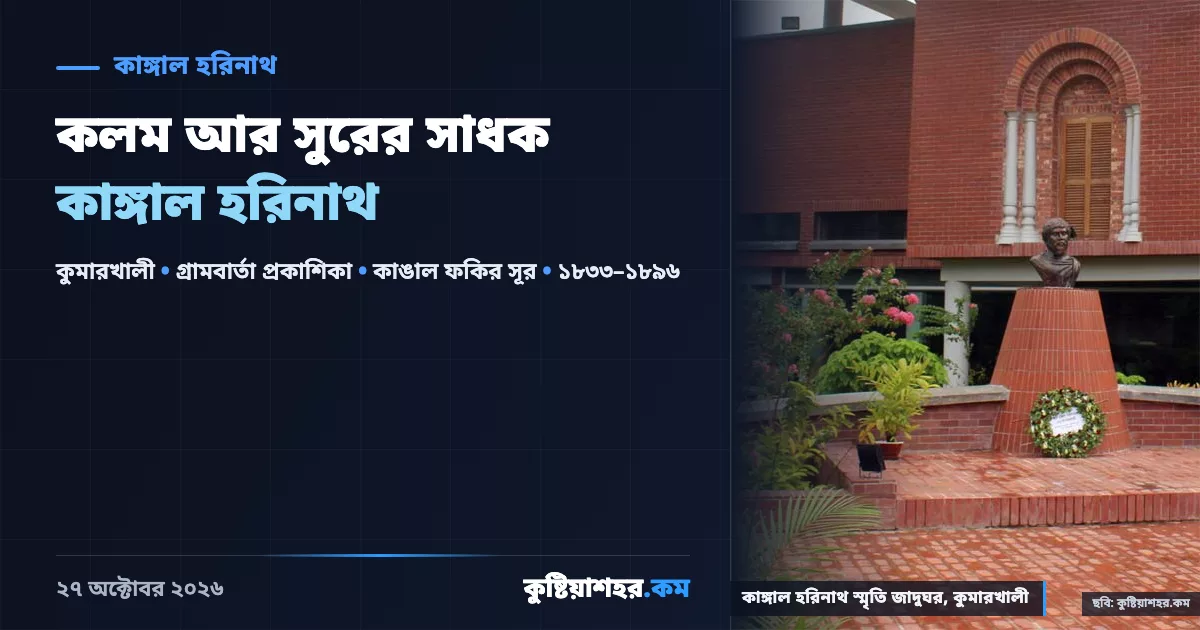
In his early life Mir Mosharraf Hossain used to send occasional news items to Kangal Harinath Majumdar's 'Grambarta Prakashika' (1863) and poet Ishwar Gupta's 'Sangbad Prabhakar' (1831). Through this connection an intimacy grew between him and Kangal Harinath that lasted to the end of his life. It is for this reason that Mir Mosharraf Hossain has been called Kangal Harinath's literary disciple. In reality, it was Kangal Harinath Majumdar who tried to emulate Mir Mosharraf Hossain.
After his marriage, Mir Mosharraf Hossain published in 1874 a periodical named 'Ajijan Nehar' after his first wife, from his maternal grandfather's home in Lahinipara. The paper closed down after only a few months. In 1890 he again published from Lahinipara a fortnightly periodical named 'Hitakari'. The editor's name appeared nowhere in this paper. A few issues of 'Hitakari' were also published from Tangail. The assistant editor of this paper was Raicharan Das, a famous lawyer of Kushtia.
Mir composed a Baul song ('Robe na sudin kudin koidin gele') and became a member of Kangal Harinath Majumdar's 'Fkirchand Fakir's' Baul troupe. Under the pen-name 'Masha Baul' he composed several excellent Baul songs. Mir had a fairly good knowledge of music. His 'Sangit Lahari' contains many excellent songs in various rhythms.
Mir Mosharraf Hossain, the pioneer of Muslim literary figures, wrote numerous books in pure Bengali and abandoned the so-called Mussalmani Bengali language mixed with Arabic and Persian. Mir Mosharraf Hossain's greatest book 'Bishad Sindhu' is still read with reverence, like a scripture, in the Muslim society of Bengal.
Based on the tragic history of Karbala, this novel is a priceless treasure of Bengali literature. Even setting aside Mir Mosharraf Hossain's other books, for the composition of this one book alone he can be acclaimed as the greatest writer of Bengali literature. Although nearly half of his literary output is poetry, he never earned fame as a poet. Mir Mosharraf Hossain could not meet the demands of his age.
That effort and that cast of mind were not his. Yet it cannot be denied that he was the first to write fruitful literature for the Muslims. It is as true that the name of Mir Mosharraf Hossain stands unfaded at the summit among the Muslim poets and writers of Bengali literature as it is undeniable that he was a great literary figure of the whole of Bengali literature. His death: Padamdi, Rajbari — 19 December 1911.