বাংলা
 English
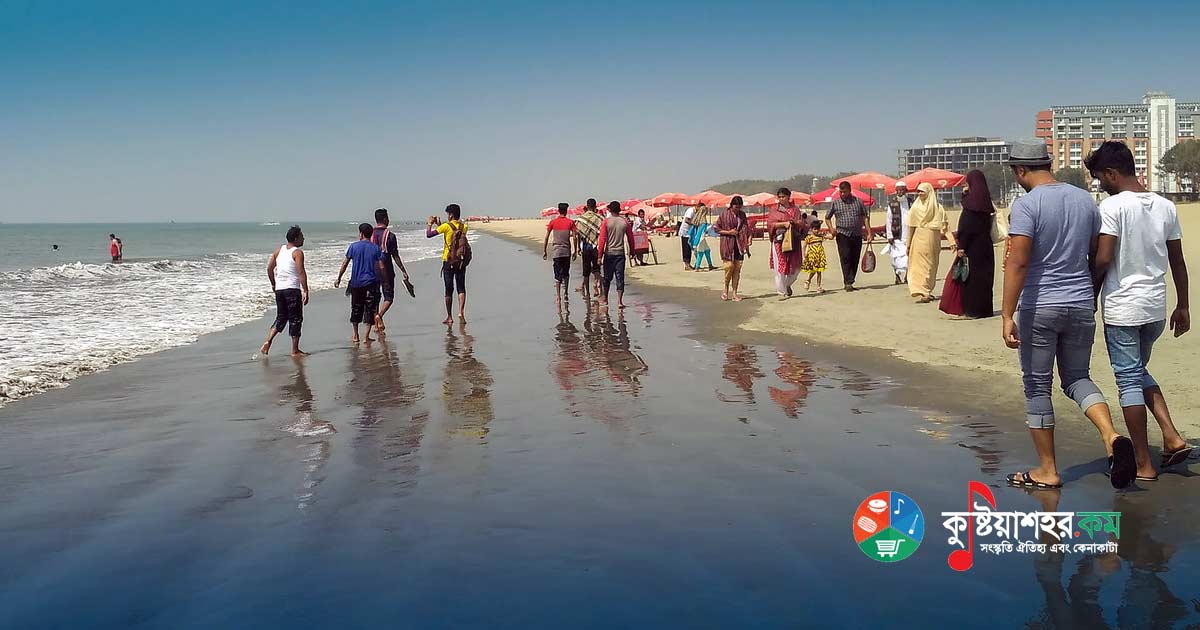
Cox's Bazar is a tourist town in the south-eastern region of Bangladesh, falling within Cox's Bazar district of Chittagong Division. Cox's Bazar is famous for its natural beauty. Here stands the world's longest uninterrupted natural sandy sea beach, stretching 155 kilometres (96 miles) unbroken from Cox's Bazar town to Badarmokam. It is home to Bangladesh's largest marine fishery port and a submarine cable landing station. Cox's Bazar was once also known as Panowa, literally meaning 'yellow flower'. Another of its ancient names is Palongki.
History
From around the beginning of the ninth century until the Mughal conquest of 1616, a large part of Chittagong, including Cox's Bazar, belonged to the kingdom of Arakan. Mughal prince Shah Shuja, travelling to Arakan along the hill routes, was captivated by the natural beauty of Cox's Bazar and ordered a camp to be set up there. About a thousand palanquins of his travelling retinue took position at a place in Chakaria of Cox's Bazar called Dulahazara - Dulahazara meaning 'a thousand palanquins'. After the Mughals came Tripura and the Arakanese, and then the Portuguese and the British took control of the area.
The name Cox's Bazar comes from Captain Hiram Cox, an officer of the British East India Company. Before Cox's Bazar the place was known as Palongki. After the British East India Company Act of 1773 was enacted, Warren Hastings was appointed Governor of Bengal, and Hiram Cox was then appointed Superintendent of Palongki. Captain Cox strove to resolve the thousand-year-old conflict between the Arakanese refugees and the local Rakhines, and made important progress in rehabilitating the refugees - but he died (1799) before the work was finished. To keep his rehabilitation efforts in memory, a market was established and named Cox Saheber Bazar - 'Cox Saheb's Bazaar'. Cox's Bazar thana was first established in 1854, and a pourashava (municipality) was formed in 1869.
Location
Cox's Bazar lies 152 kilometres south of Chittagong city. Its distance from Dhaka is 414 kilometres, and from Kushtia to Cox's Bazar it is 691 kilometres. It is the largest tourist centre of Bangladesh. One can reach Cox's Bazar from the capital Dhaka by road and by bus. A project has been undertaken to lay a railway line from Chittagong to Cox's Bazar.
Tourist Attractions
Many establishments have grown up around the tourism industry here. Besides many privately built hotels and the motels built by the Bangladesh Parjatan Corporation, twenty five-star hotels stand close to the beach. A shell market has also grown up for tourists. The Burmese Market has sprung up with fancy goods brought from countries across the border such as Myanmar (formerly Burma), Thailand and China. Here stands the country's only fish aquarium. There are also parasailing, water biking, beach biking, the Cox Carnival circus show, the Doria Nagar Eco Park, numerous structures built by the Cox's Bazar Development Authority, a future park, a children's park and countless photo spots. Here is the country's largest safari park, the Bangabandhu Safari Park; there is also the Teknaf Geological Park. For enjoyment there are night beach concerts; with the beach lit up, the sea can be enjoyed at night too. Here the Cox's Bazar Development Authority is building the world's largest sea aquarium, a cable car and a Disneyland.
Various tribes or ethnic communities live in Cox's Bazar, making the town all the more diverse. Among these tribes the Chakma community is the principal one. In Cox's Bazar town and in nearby Ramu stand Buddhist temples, sacred places of pilgrimage for the followers of Buddhism. The temple in Cox's Bazar town houses quite a few rare Buddhist statues. This temple and these statues are among the chief attractions for tourists. Cox's Bazar has not only the sea; it also has a river called Bakkhali, which is quite important for the town's fishing industry. Cox's Bazar is famous as the healthiest place in Bangladesh.
Laboni Point
Because of its closeness to Cox's Bazar town, Laboni Point is considered the main sea beach of Cox's Bazar. Big and small shops line the area along the beach, displaying all manner of goods - an added attraction for tourists.
Himchari
Himchari lies 18 kilometres south of Cox's Bazar. Broken hills and waterfalls are its main attractions. On the way from Cox's Bazar to Himchari, green-clad hills on the left and the blue expanse of the sea on the right create a mesmerizing scene. During the monsoon, Himchari's waterfall seems far more lively and vibrant. Atop the hill at Himchari stands a resort from which the view of the sea feels out of this world - that is, the entire sea can be taken in at a glance. Himchari's chief attraction is its Christmas tree. Several tourist centres and picnic spots have recently grown up at Himchari.
Inani Beach
Besides the long sea beach, Cox's Bazar has many more scenic areas along the coast that are principal attractions for tourists. Among these attractive coastal areas is Inani Beach, lying about 35 kilometres south of Cox's Bazar town. This sea beach, full of indescribable beauty, is barely half an hour by road from Cox's Bazar. For its clear water, the place is considered by tourists the finest spot for sea bathing.
How to go from Kushtia:
There is no direct vehicle from Kushtia to Cox's Bazar, though one can go by a reserved vehicle. Otherwise, one can come to Dhaka by train or bus from Kushtia; from Dhaka there are various means of reaching Cox's Bazar, chief among them air, train and bus.