বাংলা
 English
A Few Words on Behalf of the Nobopran Movement
The Nobopran movement strives to build an intimate bond with the bhab-andolon of Bengal. In this day the use of the word "sadhana" is risky. Simply put, we are trying to weave, together with Bengal's bhab-andolon, a relation of joy, of knowledge or wisdom, and at the same time of practice or work.
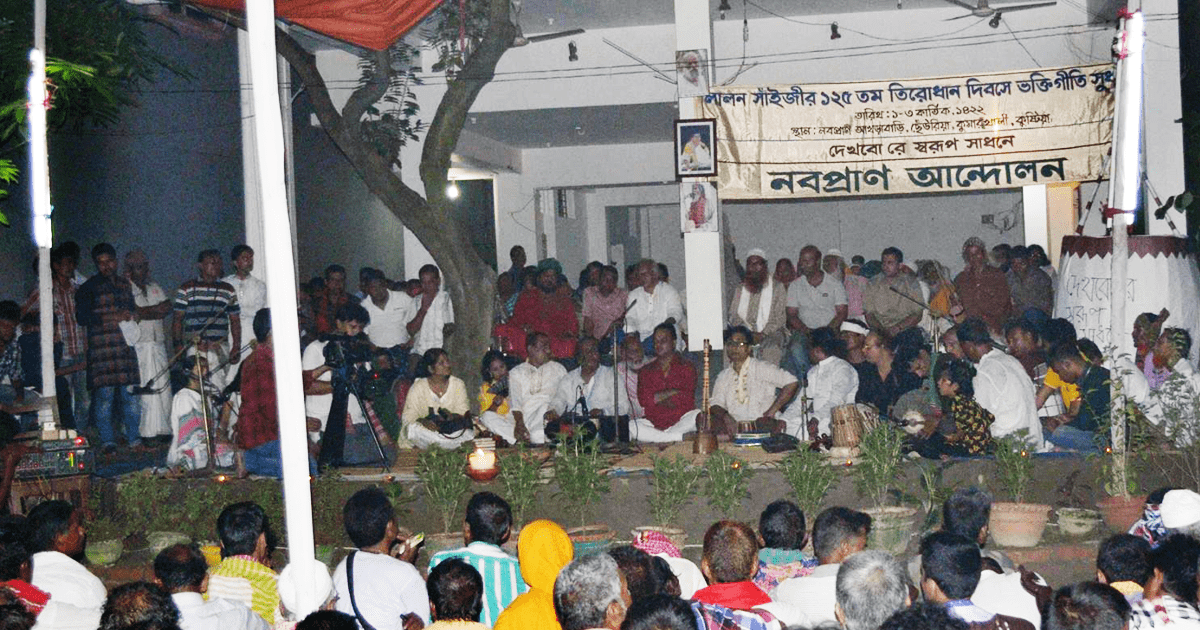
Building a relation of practice or work is easy from one angle, but bhab-charcha - the cultivation of bhava - is, needless to say, comparatively a path of difficult devotion and perseverance. The tradition of practice we are trying to build through the regular activities of the sages of the Nobopran Akhra house in Cheuria - above all the practice of Fakir Lalon Shah's songs, absorbing the songs' message into the heart, research into their meaning and melody, group songs at dawn and regular sessions of the songs of destitution in the evening, regular sadhu-sanga, the celebration of the Dol Utsab on Dol Purnima, and the srishti-sabha and performances of the songs of destitution on Fakir Lalon Shah's Tirodhan Dibas - is now more or less known to many. Here it is necessary to mention with gratitude the love and cooperation the Nobopran sadhu-gurus and Shaheeji's devotees and followers have given us. Besides, the Nobopran music house is active in Dhaka. On behalf of the Nobopran movement, every Sunday it has been arranging regular sessions of song and philosophical discourse at "Adda" - in particular, the songs of Bengal's sages that are hard for Dhaka's listeners to hear we present them, and we carry on discussions of the songs' bhava.
But bhava is present through all systems of signs, and it is not only spoken or written language. Conduct of life, service and practice, the arrangements of food, the organization and conduct of rituals, the inner environment of the Akhra house, even the planting of trees and the gathering of medicinal plants - all of this is language; through all things we remain present, carrying outward the form of what lies within our hearts. At the same time we are also aware of where the limits of argument, knowledge or theory lie.
In a holistic sense we are interested in the many struggles of Bengal's bhab-andolon - its motion, its turns, its expression and the many folds of its practice. There is no reason to think that Bengal's bhab-andolon has moved along an unbroken straight line without any rupture, or that its unfolding in bhava has been continuous. Within it there have certainly been many ruptures, leaps and declines, with streams and rivers small and great flowing through. Yet, needless to say, Fakir Lalon Shah remains a principal figure. For that very reason his songs and sayings have become the most central concern of our practice. Shaheeji is not a subject of our research; he is a subject of practice. "Ananda" is a most important and significant concept from the standpoint of Bengal's bhava practice. It is our wish to worship Shaheeji as the embodiment of Ananda.
Since by "bhava" we still understand idealism, it must be said in caution that in the language of Bengal's bhab-andolon, bhab-charcha and idealism are not the same thing. In the sense in which we understand idealism, Bengal's bhab-andolon is not "idealist". This must be understood with great care. Who is to be called "matter" and who "bhava" - that philosophical judgment is extremely obscure in the world of our knowledge and action. Our pursuit of knowledge has travelled only this far: that bhava is a thing opposed to matter. To be "progressive" means to take the side of matter against bhava. Yet in reality there is no such thing as "matter". What is this "universal" or "abstract" notion called "matter", if not bhava? For that reason Friedrich Engels had to coin the phrase "dialectical materialism" to make plain the distance between his and Marx's philosophy and politics and the materialists. Without the mediation of language, or without recourse to some conceptual notion, it is impossible to speak of any particular or universal, seen or unseen, matter. These doubts have not even reached us as information. There is no scope here to discuss all those fundamental questions. It will suffice to say this much: the principal tendency of Bengal's bhab-andolon is toward this-worldliness, not toward the other-worldly. Talk about the so-called "other-worldly" or "supernatural" can certainly go on in this world - but it is conducted by this-worldly "human beings". As for belief in institutional religion or in a hereafter, it may well be said that such belief is impossible to find here. The thinkers of Bengal's bhab-andolon trade briskly in the "present". Their saying is: "If I do not see him here, how shall I know him?" For that reason it is exceedingly foolish to describe the chief thinkers of Bengal's bhab-andolon with such self-contradictory adjectives as spiritual, mystic and the like. Yet we do it habitually, and that is why the caution had to be given at the very start.
Besides, the wisdom that nails a question into the very assumption or notion that matter and bhava are separate from each other - taking it to be ignorance, maya or illusion - for such a mind the question of idealism or materialism inside its pursuit of knowledge is beside the point. What I name "matter" is after all my own bhava, for matter itself has not given itself that name. What I call bhava is again a matter of my own bodily self. There is no body, yet there is "bhava" - and within this very duality of "bhava" and "matter" lies the impurity of thought. A muddle. One enormous difficulty. So when we in Nobopran use the words "bhava" or "bhab-charcha", they must be understood with care.
In singing Lalon's songs we fall into great difficulty. One song has many different readings. The compilations of those who have collected and edited Lalon's songs contain many problems too. Out of practical necessity, then, we in Nobopran have been compelled to prepare a workable, followable reading of Lalon's songs. Determining some "pure" and "authoritative" text is not the purpose here. In a culture rooted in shruti and smriti, bound into the grain and given form in the spoken tongue, both the limitations and the difficulties of determining an "authoritative" and "pure" text of utterance are present. We have discussed that elsewhere. Besides, that our reading is the final word - we have no such arrogance at all.
In preparing a reading of Lalon's sayings we have come face to face with certain questions. Here we shall throw some general light on those matters. In preparing this reading we shall make some relevant remarks about the three notebooks at Lalon's Akhra and about the collections of the various other collectors and editors we have used. The reader also needs a clear idea of the purpose of the Nobopran movement's collection and reading. We shall attempt that here as well.
At the outset we need an explanation of why we are using the word "reading". Whoever gathers the bhava and language of a culture rooted in shruti and memory sends them to the printing press after one round of sifting and sorting, and they come out edited. Through this whole process the song the editor presents is also a reading of his own - for the very reason that it is, from his side, an interpretation of the song. Certainly so. It is in the light of how the collector or editor understood the song, and of the meaning he accepted, that he sifts and sorts. And through that an interpretation of the song takes shape of its own accord. Our effort too is no exception to this general rule.
Many have collected Lalon's songs. Among them are researchers, sages of Lalon's own household, devotees, and many others who have collected Shaheeji's songs out of their own enthusiasm, even out of sheer business interest. We must acknowledge the contribution of all of them with a grateful mind. Whose collection is wrong and whose authoritative - that dispute and its settlement may be necessary; but the quest for a "pure" and "authoritative" text of collections Nobopran regards with a somewhat sceptical eye. If the words of a collected song can be recovered unchanged and its melody intact, that is indeed a very good thing. We are certainly not against it; we ourselves have made that effort too. But to "correct" the sentences, to fix the words, or to edit them at one's own sweet will - without knowing or understanding the life and the practices of life so intricately bound up with these songs, all in the name of evidence and purity - proves both the arrogance and the ignorance of the educated.
But the point of utmost importance is this: Fakir Lalon Shah's songs are the songs of the poor and the oppressed, the songs of the illiterate - not of the so-called "educated". The process of determining an authoritative or pure text is entirely the affair of the educated circle. Within this process, from the very beginning, a covert endeavour has been at work to strike off, in the end, the very people whose songs these are - an endeavour over which Lalon's followers and devotees may one day no longer have any control. That Shaheeji's followers and devotees sing his songs in their own regional pronunciations, sometimes even swapping words and lines and turning things about a little - this is true. To the eyes of the educated purists it looks like "distortion". They wish to take some measure against it - the aim being to set up a kind of stratification over bhab-charcha itself, over the lives of the sages, to establish a rule over thoughtfulness. Setting language "in standard form" and "purifying" songs - once this aim is set aside, the real task is to recover the song-maker's own original reading. That we accept. If that be so, then it is those who sing - that is, those very poor, illiterate and oppressed people who have kept Shaheeji immortal, those devotees and lovers - who must do it. The judgment of right and wrong must take place from the ground of their own living practice. These songs are not modern literature, and so there is a fear that raking them over with the yardsticks of literature would only destroy them.
When we prepare a workable reading of Lalon's songs, it is for our own singing, for the need of keeping it in harmony with the day-to-day life of practice at the Akhra house of Nobopran - not merely as songs. We want to make it clear that we have no competence to purify anyone's songs. Compared with anyone else's, our reading is neither purer nor more authoritative. We have made this reading for our own special purpose, out of our own need. Only in the days to come shall we slowly understand whether this work has been rightful at all. If we have grasped even a little of Fakir Lalon Shah's significance, we have also realized this truth: no song can be truer, purer or more authoritative than the one sung by a devotee sunk in absolute devotion to Shaheeji and lost in the state of bhava. And so when any devotee of Shaheeji sings his song, the chief question to be weighed is whether that singing is born of devotion. An error can be corrected; but one devoid of devotion cannot be brought onto the high road of the sadhana of knowledge or onto the path of wisdom.
Yet it is well to warn: let that devotion not again become like the sadhu of Madhuban village in Bardhaman - in whose grave, in keeping with the testament of Jahiruddin Shah, a disciple of Bolai Shah, an old notebook of Lalon Shahi was buried [Montu Shah, 93].
Collection: Shaheeji's Songs of Destitution - Farhad Mazhar