বাংলা
 English
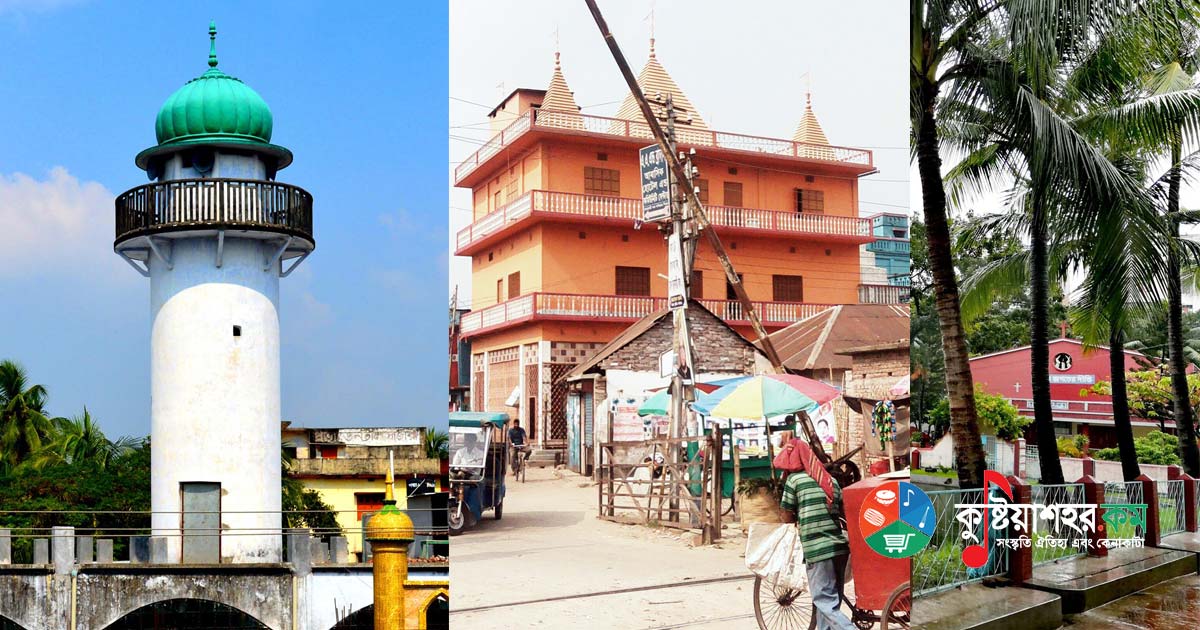
Due to its geographical location, the people of Greater Kushtia possess a rich spiritual consciousness. That is why people of all faiths — Muslims, Hindus and Christians — have been able to practise their religion freely in this region. Kushtia district was born in 1947 after the partition of the country. Before the partition, the present Greater Kushtia district — Kushtia Sadar, Chuadanga and Meherpur sub-divisions — was part of Nadia district. Nabadwip of Nadia was a major centre of Hindu religion and scripture-based scholarship. In the early twelfth century, the Bakhtiyar Khalji invasion of the Nadia river island opened the way to Muslim rule in Bengal. The emergence of Sri Chaitanya and the spread of the Vaishnavite faith on Nabadwip, or the profound influence exerted on the Muslims of Bengal, cannot be denied. Besides, the Nadia-Nabadwip-Kushtia region was the birthplace and arena of several quasi-religious sects such as Aul-Baul and Shahajiya Hayati-Gobarat.
In the fifteenth century, the famous Auliya Hazrat Khan Jahan Ali came to Jessore, north of Kushtia. He preached Islam widely across this district.
Determining the chronology of the spread of Islam in Greater Kushtia district is difficult. Beside the mazar of Hazrat Khairul Bashar Umez in the village of Ghuladari in Alamdanga upazila of Chuadanga stands an ancient mosque. About this mosque it is said: in Bangla 723, Pir Khairul Bashar Umez founded it.
The mosque located in the village of Ghuladari is considered the first mosque of Greater Kushtia district.
The dervish Meher Ali Shah and Shah Bhalai (original name: Shaikh Sayyid Muhammad Jahir Uddin, born in 1405 in Yemen) were the first to settle (establish residence) in the whole region of Meherpur.
He also preached Islam in Chuadanga and in the Ranaghat, Karimpur, Murshidabad and Nadia regions of West Bengal.
Around 1630, the padre Reverend M. Hossain began preaching Christianity in the Karpasdanga area of Damukhuda thana in Chuadanga. When famine struck around 1634, Christian missionaries were able to baptize many poor Hindus in exchange for food alone.
When the Kushtia sub-division was established in 1860, a small mosque was set up near the Chhota Faujdari Kot (police station) of a Hindu munsef in Bangla 1305. Mir Musharraf Hossain published this news under the headline “Sat Prasanga” in the “Kohinoor” paper (1305), edited by Yakub Ali Chowdhury and published from Pabna.
This mosque was formerly known as the Court Mosque and is now known as the Bara (Great) Mosque. However, as far as is known, the mosque at Kuthipara is the first mosque of Kushtia town. Around Bangla 1299, a Muslim named Nazir, a resident of the Pabna Nawabi Kot, built the first mosque in a tin-shed house.
Kushtia town was originally an island region; its ancient name was Kakadwip. That king Ballal Sen built his capital on the island of Nadia and reformed the Hindu religion. The capital built by the Pala kings was Subarnabihar, adjacent to Nabadwip.
Among the Hindus of this district, Shakta, Shaiva, Vaishnava, Kartabhaja, Ballam-bhaja and others are more numerous. Worship of Durga, Saraswati, Kali and others is celebrated with pomp.
Besides, among the Hindus of recent construction, worship of local deities such as Gazan, Mansa and Sheetala is performed. In all the temples of Kushtia, the idols of Radha-Krishna are worshipped. Before the partition of the country, Vaishnava-Vaishnavis had akhras (monasteries) in almost every village.
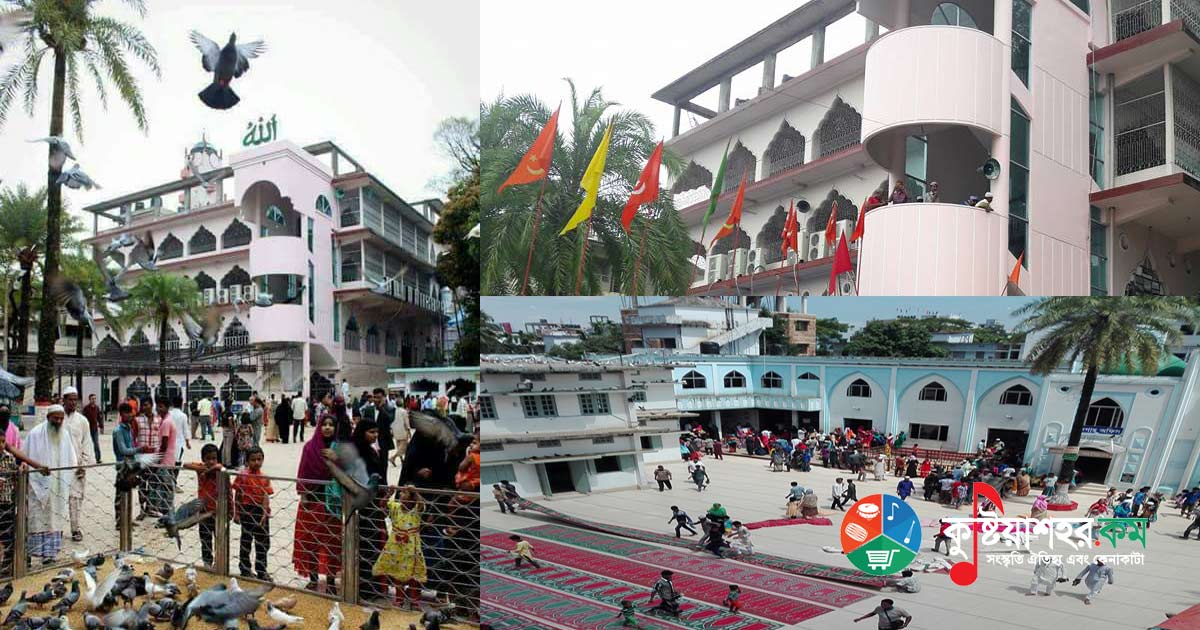
Mosques, temples and churches of Greater Kushtia - Abdullah Saeed