বাংলা
 English
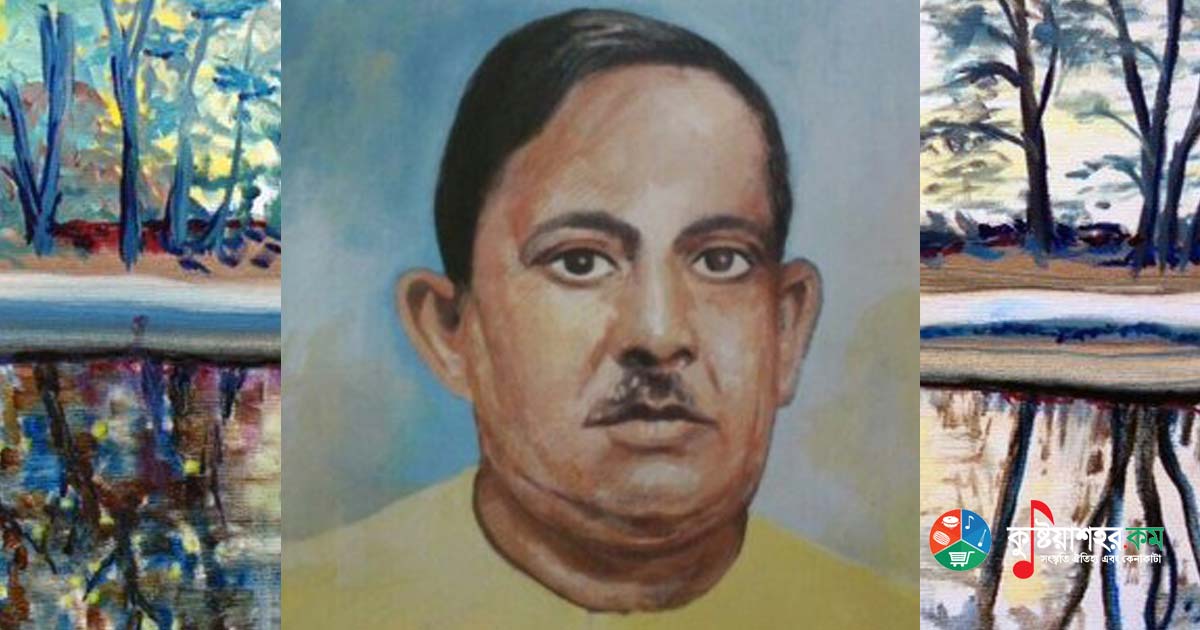
Jalal Uddin Khan (1894-1972) was a prominent Baul poet and singer of eastern Mymensingh. He was born in Asadhati village of Kendua upazila in Netrokona district. His father's name was Sadruddin Khan.
In the 1920s, 1930s, 1940s, 1950s and 1960s of the twentieth century, this poet of the common Bengali people was active in his devotional pursuit. The region where he was born and lived has a folk tradition of great richness. Jalaluddin Khan was a man of that part of Mymensingh - the largest district of the undivided Bengal of the time - marked as 'eastern Mymensingh'. At one time Netrokona and Kishoreganj of eastern Mymensingh, along with parts of the neighbouring Sunamganj and Habiganj and areas such as Brahmanbaria and Narsingdi, together formed a distinguished cultural region. Many folk poets and composers of folk lyrical songs were born in that region - such folk poets and folk singers as Hason Raja, Abdul Karim and Radha Raman of Sunamganj, Dvijadas and Haricharan Acharya of Narsingdi, Monomohan Datta of Brahmanbaria, Lal Masud, Sula Gain, Bijoy Narayan Acharya and Din Sarat (Sarat Chandra Nath) of Netrokona, and Ramu Mali, Ramgati Shil and Ramkanai Nath of Kishoreganj. Jalaluddin Khan of the twentieth century was the direct successor in pursuit of these poets.
Although Vaishnava padavali, Shakta padavali, Sahajiya padavali and various songs in Baul tunes influenced his musical practice, he is noted for composing music entirely exceptional in the originality of its ragas and raginis, in his own line of thought. His composed music - the arrangement of words, the mastery of simile and ornamentation - undoubtedly claims the highest excellence. It cannot be denied that Jalal Uddin Khan is the principal bearer of the tradition of song-devotion now flowing in the greater Mymensingh region. Jalal Uddin Khan's Jalal Gitika has been published in five volumes. He also published a book rich in esoteric information titled 'Bishwa Rahasya'. He classified his songs within the Baul tradition under the categories of marfati, murshidi, bhatiali, paramatattva, nigurha, dehatattva, srishtitattva, sangsaratattva, sadhanatattva, prematattva, birahatattva, matritattva, lokatattva and deshatattva.
Professor Jatin Sarkar has discussed Jalal Uddin Khan in detail in the complete Jalal Gitika. Jalal Uddin Khan was at once a poet, a Baul singer, a composer, a lyricist and an essayist, leaving his own imprint in every field. This seeker of the inner meaning of the folk religion kept himself connected with everything of folk life. There was no discord or contradiction between the life Jalal Khan lived and his philosophy of life; his practice of poetry, equally his devotion to music, was woven with his lived life and philosophy of life by the same thread. Intertwined and mixed with all this was the heritage of the folk tradition. He was not merely a bearer of that heritage, nor did he pass his life simply consuming, indiscriminately, the resources received through inheritance. Conscious of his times and surroundings, this man knew that tradition and heritage needed to be made fit for one's own time and surroundings. It is precisely that awareness that shows through, layer upon layer, in his compositions.
Like a truly modern man, he observed that the traders of religion had kept obstacles in the common people's path to self-realization, and that by misinterpreting religion they sought to keep people deprived even of language education. That is why he sang: 'Heaven is not found in the alien English education; hearing the mullahs' sermons, man learned nothing - grasp that all languages are equal, now hold firm - when will the good days dawn again? Jalal says: march, with courage.' At a time when the people of the countryside regarded birth control as sin, Jalal said, 'Without checking birth one shall not find happiness in this world.' Not only in the voices of unknown, unheralded singers of the villages - renowned vocalists such as Abbas Uddin and Abdul Alim also recorded Jalal's songs. Some such songs are: 'O Amar Dordi Age Janle Tor Bhanga Noukay Chartam Na', 'Are-o Bhaityal Ganger Naiya', 'Dayal Murshider Bazare', 'Sei Pare Tor Bosto Bari'. Though these songs won extraordinary popularity, the fact that their composer was Jalal Uddin Khan is unknown to many. Not only self-tattva or supreme tattva - Jalal's songs also give expression to love for the homeland: 'Blessed is my life - O mother, even if heaven stays on your lap / Bengal, mother, at the root of your feet', 'Here I took my birth with the kusum flower at crimson dawn / lying on the carpet of grass, may death be blissful. After death, waking from oblivion, keep me merged in your mind age after age - Jalal says, surrendering his soul.' In the last part of the past century several gifted people began research on the life and music of Jalal Uddin Khan. In 1990 Azizul Haque Chowdhury's biographical work 'Jalal Uddin Khan' was published by the Bangla Academy.
On the other hand, Sudhir Chakraborty, the eminent researcher of West Bengal, published two anthologies - 'Bangla Dehatattver Gan' in 1990 and 'Jonpadabali' in 2001. Ten of Jalal's songs were anthologized in the first book and thirteen in the second, and in the introductions to both books he discussed Jalal's music. Sudhir Chakraborty's long essay "Jalal-giti: 'Kato Ranger Nokshi Kantha'" was published in the sixth issue of the little magazine 'Nirontor', edited by Naim Hasan, in Poush 1412. Besides these, the 'Jalalgitika Samagra' edited by Jatin Sarkar is a rare publication. In 1972 this mystic artist of the folk people, from the self-tattva of his devotional pursuit, touched the supreme tattva.
Beneath such designations as self-tattva, supreme tattva, esoteric tattva, folk tattva, country tattva and separation tattva, Jalal Uddin composed more than a thousand songs. This eminent folk poet was unrivalled too in the assemblies of malzora song. Jalal Uddin Khan composed many songs. During his lifetime 630 songs were published in the four-volume 'Jalal Gitika'; after his death appeared the fifth volume of the 'Jalal Gitika', containing 72 songs. With this total of 702 songs, the 'Jalal Gitika Samagra' was published in March 2005. Jalal published his songs arranged under various 'tattvas'; the names of those tattvas are self-tattva, supreme tattva, esoteric tattva, folk tattva, country tattva and separation tattva. Though most of the songs of the 'Jalalgitika' bear such tattva designations, Jalal Khan did not assign many songs to any tattva. For example, of the 202 songs collected in the first volume of the 'Jalal Gitika', 20 songs are designated 'bhatiali'; of the 228 songs in the second volume, 60 are 'bhatiali'; of the 78 songs in the third volume, seven concern 'tattva' subjects, while 14 are designated 'murshidi' and 11 'marfati'; and in the fourth volume of the 'Jalal Gitika', a total of 101 songs were collected with no tattva indicated, under the names Baul tune, jhaptal, choupadi, prosad tune, mukund tune and khemta. The fifth volume of the 'Jalal Gitika', published after his death by his successors, carries no classification or designation of the songs; in that new publication, 72 songs of various kinds, unpublished in Jalal's lifetime, were collected. He also published an essay volume titled "Bishwa Rahasya". On 31 July 1972 - 16 Shravan 1379 of the Bengali calendar - he passed away, leaving behind two sons, three daughters and his wife Shamsunnahar Begum. His mazar lies in the courtyard of his own village home. In memory of the late mystic Baul saint Jalal Uddin Khan, the Jalal Mela is held every year, spanning two days.