বাংলা
 English
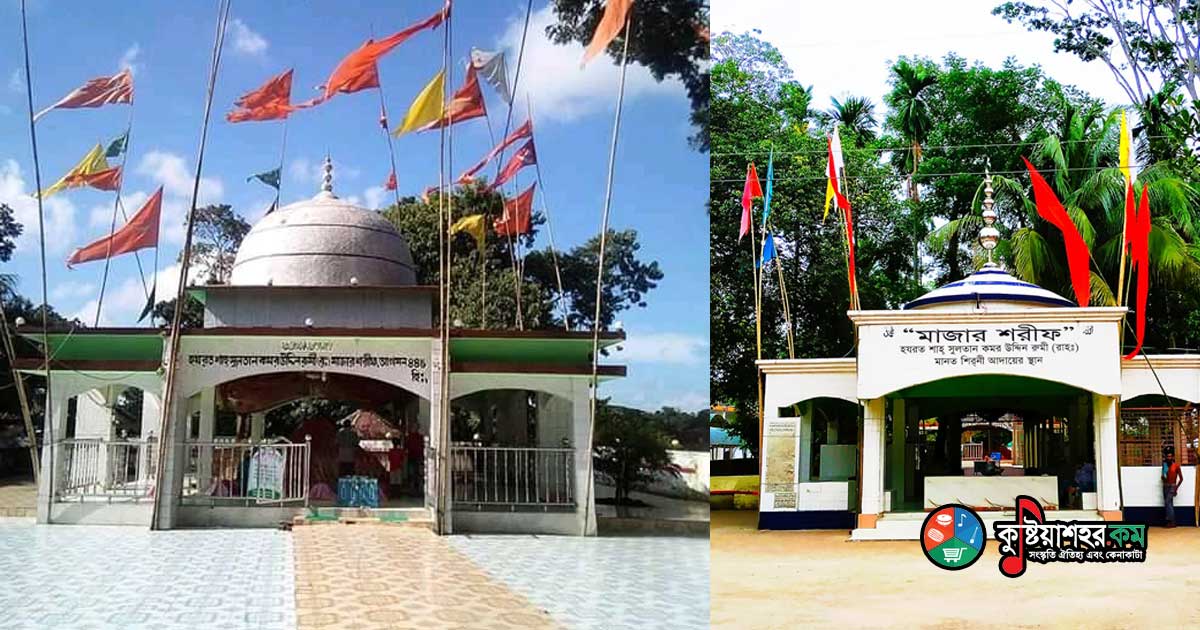
Shah Sultan Kamar Uddin Rumi (birth: unknown - died 1059 CE) was a Sufi dervish. The tomb of Shah Sultan Kamar Uddin Rumi lies at a place called Madanpur in Netrokona Sadar Upazila. It is said that the Sufi saint Shah Sultan Kamar Uddin Rumi (RA) came to Bengal from the Seljuk state of Turkey in West Asia some time before 1059 CE.
It is also said that because it conquered the Roman Empire, the state of Turkey itself came to be called the Roman Empire. Its ruler was called Rumi, and as the younger brother of the Sultan of that state, Shah Sultan too was honoured with the title Rumi.
He first arrived, with a group of 120 Sufi saints, in the present-day coastal Chittagong region of Bangladesh. From there he set out to preach the faith towards Mahasthangarh (Bogra), the capital of Pundravardhana. Even before this, Shah Sultan Sayyid Mahmud Mahisawar Balkhi had reached Mahasthangarh with a part of the 120-strong band of Sufis and invited the local ruler, Parshuram, to Islam. Enraged by this, Parshuram attacked the band of Shah Sultan Sayyid Mahmud Mahisawar Balkhi. In that attack, 7 (seven) members of the band of Shah Sultan Sayyid Mahmud Mahisawar Balkhi were martyred. On receiving the news of the martyrdom of Shah Sultan Sayyid Mahmud Mahisawar Balkhi, Shah Sultan Kamar Uddin Rumi set out for Mahasthangarh with the organised band of Sufis known as Kaiqawar. Without engaging directly in battle with Parshuram, he offered him the proposal to accept the faith of Islam, acknowledging the oneness of Allah and His sent Prophet Hazrat Muhammad (SAW). When Parshuram became enraged again at this proposal, Shah Sultan Kamar Uddin Rumi attacked him. Thereupon Parshuram was killed.
Having defeated Parshuram, Shah Sultan Kamar Uddin Rumi took possession of the Varendra region and began preaching Islam. From there he crossed the Yamuna river eastward and went to a place called Durmut (now under Jamalpur district), where he established his khanqah. From there he crossed the Brahmaputra river and went to Boikai Nagar, the kingdom of the Boikai Koch. There he initiated the Boikai Koch into the faith of Islam. Later he went east of Boikai Nagar to Madanpur, the kingdom of the Madan Koch. There he defeated the Madan Koch through wisdom and began the work of preaching Islam at Madanpur.
Shah Sultan Kamar Uddin Rumi (11th century CE) is one of the Sufi dervishes who came to Bengal. His holy mazar is located in Madanpur, the upa-shahar of Madanpur Union in Netrokona district. This Sufi dervish, endowed with miraculous powers, came to Bengal in 559 AH, corresponding to 1059 CE. 120 companions and disciples came with him. Shah Sultan Rumi went to the durbar of the then Koch king of the Madanpur area, and when the king offered him a deadly poison, hard to endure, he drank it saying Bismillah, with a smile on his face. Seeing this superhuman power of his, the king was astonished, and in his name he gifted him, with a duly written lease deed, the greater area of that region including Madanpur. As a result, the king and the tribal people of the place came in groups and took shelter under the shade of Islam.
Recognition of the tax-free property kept for the maintenance of Shah Sultan's mazar was granted by way of a sanad in Persian in 1042 AH (1631 CE) by Shah Shuja (1616-1660 CE), son of Emperor Shah Jahan (1592-1666 CE) and Subahdar of Bengal. This royal sanad records the historic account of his arrival at Madanpur in 559 AH (1059 CE) together with his murshid, his unhindered swallowing of the poison given by the Koch king of the place, and the dedication of the entire village granted by the king. According to Shashibhushan Dasgupta (1917-1969 CE), he was also the first Sufi mystic preacher in the whole of the Indian subcontinent. The dervish Shah Sultan Rumi set up his khanqah in Madanpur village and preached Islam in that region. The then Koch king accepted Islam at his hands and granted him the ownership of Madanpur village.
Around Shah Sultan Rumi's mazar, that is, at various places in the Madanpur area, there are also the mazars of his companions. 120 saints accompanied him as fellow travellers. Through a lifetime of inviting people to Islam, this Sufi dervish has become immortal in this region. Every year in the month of Falgun a week-long Urs is observed at his mazar, drawing crowds of hundreds of thousands of people from different parts of the country.
According to historians, this was the first mission to arrive for the propagation of Islam. Crossing many regions of the subcontinent, he came via Kushtia, Jhenaidah and Bogura of Bangladesh and finally reached Madanpur of Netrokona thana. At that time Bengal was witnessing clashes between the Buddhists and the sanatan Hindus. Again, local society was riddled with wounds from the caste system among the Hindus. At this complex moment, the message of Sufism in Islam was able to attract the whole of society. That is why, identifying himself with the unique natural beauty of a generous and open-hearted nature, he was able to spread rapidly the message of Islam and the consciousness of peace. The essence of that consciousness was the humane, refined social and human values rooted in love for mankind. Today hundreds of thousands of people gather at the tomb of this man of timeless greatness. As a result, this mazar has become one of the most important landmarks of Bangladesh and of the world. The mazar is located in a village named Madanpur, at a midway point on the Netrokona-Kendua road.
How to Get There:
From Netrokona Sadar bus terminal, one can reach this historic site located in Madanpur Union by bus, Honda, autorickshaw or rickshaw.