বাংলা
 English
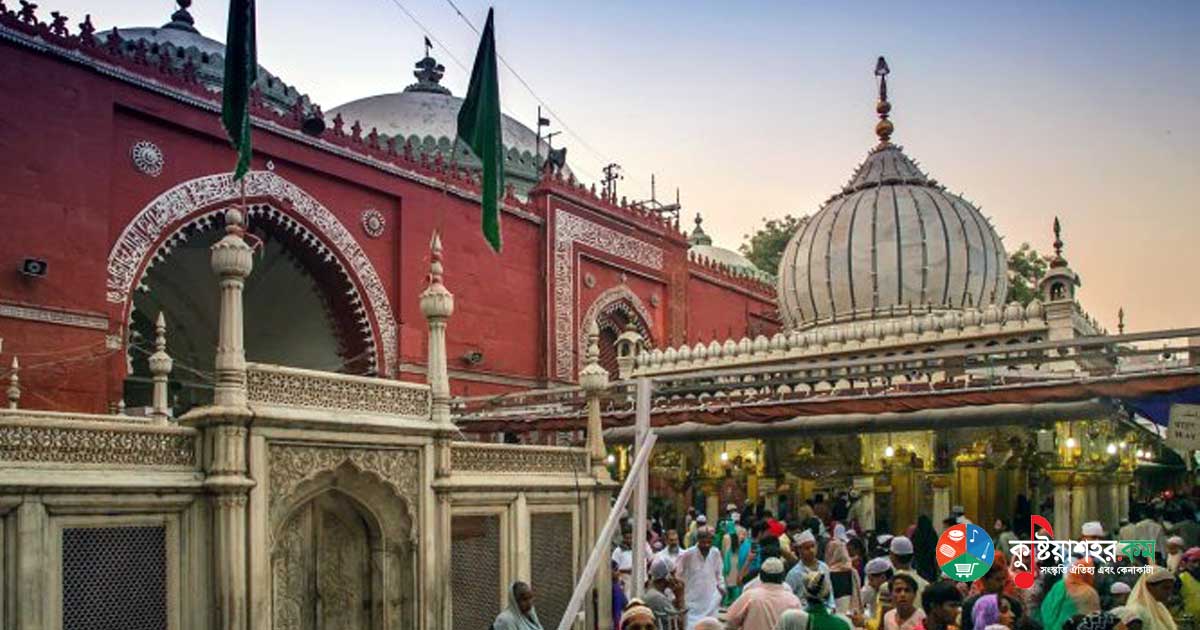
Sultan-ul-Mashaikh, Mehboob-e-Ilahi, Sheikh Khwaja Sayyid Muhammad Nizamuddin Auliya (1234 - 3 April 1325), Hazrat Nizamuddin - by these names he is also known - is a renowned Sufi saint of the Chishti order in the Indian subcontinent. He is one of the greatest Sufi saints of the Chishti order in India.
His spiritual lineage began with Fariduddin Ganjshakar and, through Qutbuddin Bakhtiar Kaki, joined with Khwaja Moinuddin Chishti. Accordingly, they established the fundamental spiritual lineage, or silsila, of the Chishti order, which became widespread throughout the Indian subcontinent. Nizamuddin Auliya, like his predecessors, described love, or ishq, as the way or path to attaining the Creator, or Allah. According to him, love for the Creator gives birth to love for humanity. Ziauddin Barani, a historian of the fourteenth century, claimed that his influence upon the Muslims of Delhi was such that their outlook on worldly affairs changed remarkably. People became devoted to spirituality and worship and detached themselves from worldly thoughts.
Nizamuddin Auliya was born in Badayun, in Uttar Pradesh (east of Delhi). When he was five years old, his father, Ahmad Badayuni, died, and he moved to Delhi with his mother (Bibi Zulekha). The Ain-i-Akbari, written by Abul Fazl Mubarak, the minister of the Mughal emperor Akbar in the sixteenth century, contains an account of Nizamuddin's life. At the age of twenty, Nizamuddin went to Ajodhan in Pakistan (present-day Pakpattan) and became a disciple of the Sufi saint Fariduddin Ganjshakar, better known as Baba Farid. While Baba Farid was alive, he went to Ajodhan every year to spend the month of Ramadan. On his third visit to Ajodhan, Baba Farid appointed him as his khalifa. A few days later, when Nizamuddin returned to Delhi, he heard the news of Baba Farid's passing.
Before settling permanently in Giaspur, Nizamuddin lived in various parts of Delhi. There he established his khanqah, a spiritual place where people of every level of society were served, and there he gave spiritual instruction to others. Here he had his own residence. Within a very short time the khanqah was thronged with people of every kind, rich and poor alike. Many of his disciples attained high stations of spirituality. Among them were Sheikh Nasiruddin Muhammad Chiragh-e-Dilli, and the renowned Sufi musician and court poet of the Delhi Sultanate, Amir Khusrau. He passed away on the morning of 3 April 1325. His mazar, the dargah of Nizamuddin, is located in Delhi, and the present structure was built in 1562.
When Nizamuddin heard the name of Fariduddin Ganjshakar for the first time, he was only twelve or thirteen years old, and from that time on respect and love for Fariduddin began to grow in his heart. Describing it to his disciples, he said that the state created in his mind upon hearing the name of Baba Farid was something he had never experienced upon hearing the name of any other Sufi saint, not even after meeting them. His love kept growing like a spark of fire. If his fellow students tried to get him to do any work for them, they would invoke the name of Baba Farid, and he would never refuse a task invoked in the name of Baba Farid. He never felt such feelings for anyone else in his life. At the age of twenty, after finishing his studies, he became a disciple of Baba Farid. During Baba Farid's lifetime he visited his darbar three times.
He had more than 600 khalifas (a khalifa is a disciple who is granted permission to take bai'at and is given the responsibility of extending the lineage of his murshid or Pir) who preserved his spiritual lineage throughout the world. Among them his famous disciples were: Nasiruddin Chiragh Dehlavi, Amir Khusrau, Akhi Siraj Aynae Hind, Borhanuddin Garib, Jalaluddin Bhandari, Sayyid Mahmud Kashkinakar, Ayan Fakir.
Amir Khusrau was the most beloved disciple of his Pir or murshid. He was so dear to his murshid that Nizamuddin Auliya once said, "If the Shariah permitted me, I would have asked Khusrau to be buried with me in the same grave." He also said: whoever comes to pay respects at my rauza (tomb), let him first visit the rauza of Amir Khusrau before visiting my own. A few months after his Pir passed away, he too passed away. He was buried at the feet of his Pir. His mazar is at the Nizamuddin Dargah in New Delhi, Delhi.
Titles
- Mehboob-e-Ilahi (worthy of the love of Ilahi, or Allah).
- Sultan-ul-Mashaikh (king of the Mashaikh).
- Imam-ul-Mehbubin (leader of the Mehbubin).
- Malik-ul-Fuqara wal Masakin.
- Taj-ul-Mukarrabin.
- Mehfil-e-Sukhan (attraction of the mehfil).
- Jari'jar Bakhsh (distributor of gold and silver).
- Nizamuddin Ba'hat
- Mehfil-e-Shikhar.
- Tabib-e-Dil
- Gaon-ul-Alam (Ghaus of the world)
- Jag Ujare (light of the world)
Urs
Every year on 17 Rabi Sani the Urs (death anniversary) of Nizamuddin Auliya is observed at the Nizamuddin Dargah, and the Urs of Amir Khusrau is observed on 18 Shawwal.
In Popular Media
- Arziyan, a qawwali song tuned by A. R. Rahman and used in Delhi 6, released in 2009, is dedicated to Nizamuddin Auliya.
- Kun Faya Kun, a song used in the film Rockstar released in 2017, was picturised at the Nizamuddin Dargah and dedicated to him.
- There is a popular Bengali Sufi song titled "Nizamuddin Auliya" that evokes his historic return to Delhi.