বাংলা
 English
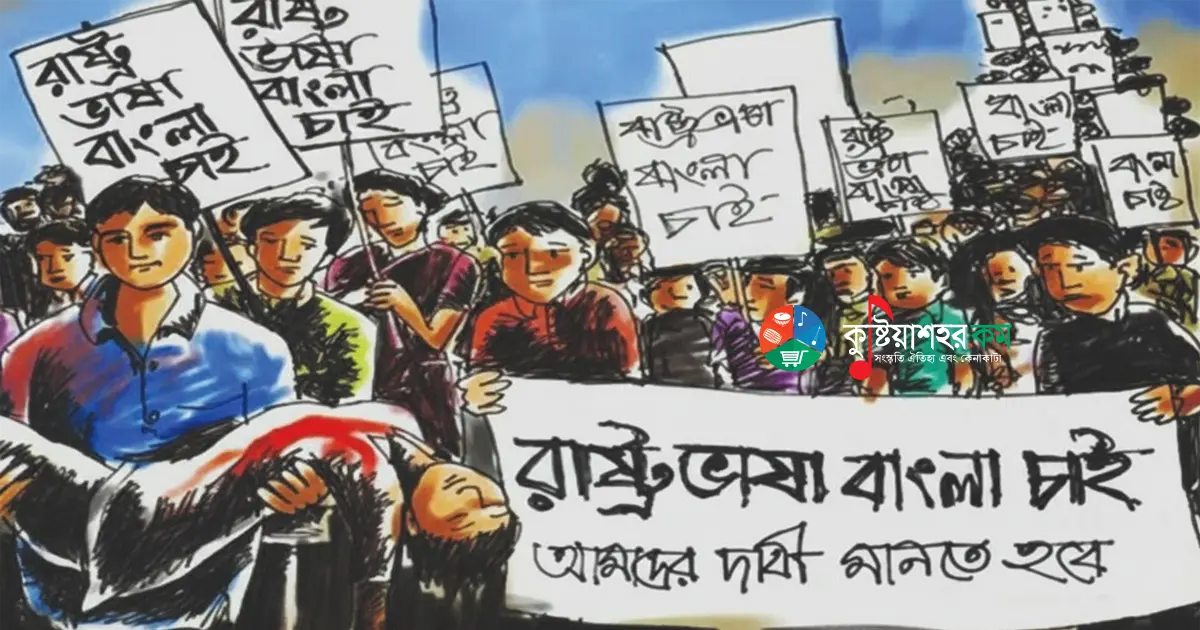
Background: On 14 August 1947 Pakistan gained independence, and on 15 August India. From then on the need arose to determine the state language of the two countries. Multilingual India then had no all-India language. For this reason the Brahmanical state leaders decided to make Hindi, a regional language of India, the state language, with the aim of building a unified national consciousness through a single language. The Bengali-speaking Hindus of India also accepted this declaration of India's state language.
The Pakistani state was formed essentially on the basis of Muslim nationalism. Bypassing the fundamental thread of unity, the Pakistani rulers' aim in forming a nation through the bond of linguistic unity was to make Urdu the state language.
Apart from the one religion, Islam, the inhabitants of the two parts, East and West, had nothing else in common. The language of the majority people of East Pakistan was Bengali. The people of East Pakistan were vocal from the very beginning about making it the state language. West Pakistan was a mixture of languages such as Sindhi, Balochi, Punjabi, Pashto and so on. Urdu was the regional language of the Muslims of the Lucknow region of India. Under the cover of religion, the rulers of West Pakistan wanted to silence the Bengali language. To that end they made the strange attempt of writing Bengali in the Urdu script, but it could not influence the Bengali language in any way. To thwart the conspiracy of making Urdu the state language, the people of Bangladesh went on organising in various ways. Massive popular support grew everywhere for the organised movement under their leadership.
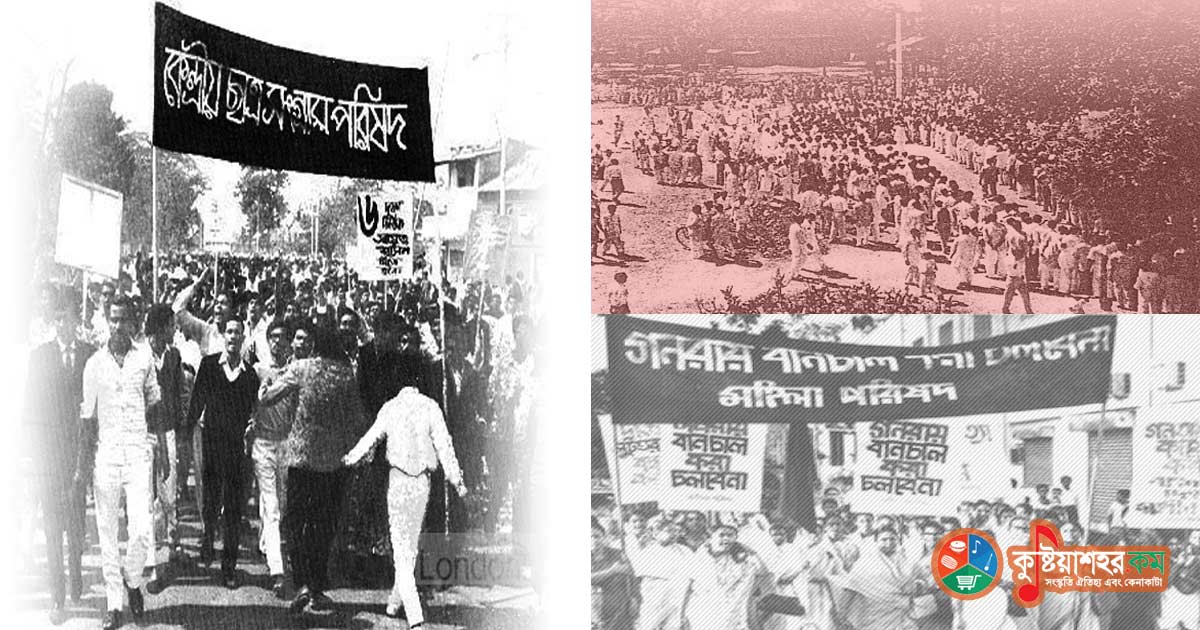
Organisations such as the Tamaddun Majlis and the All-Party Struggle Council then infused great inspiration among the people. Because of that, even after hundreds of oppressions, the Bengalis did not withdraw from the demand for the state language. The wave of the spreading state language movement reached Kushtia too.
The state language movement in Kushtia: In 1950 Zulfikar Haider (now a retired teacher of Kushtia High School), realising the need of the state language movement, made contact with the central committee of the Tamaddun Majlis. On the centre's advice he gradually became the convener himself and, taking Nazmuddin Ahmed, Shamsuzzoha, Jalal Uddin Khan and others, formed the district branch of the Tamaddun Majlis. In 1951 the full committee of the Tamaddun Majlis was formed. Professor Abdus Sattar was elected president and Nazmuddin Ahmed secretary. Later Muhammad Siraj Uddin, Advocate Chowdhury Jalal Uddin Ahmad, Khondkar Taleb Ali, E.T. Obaidullah and Abdul Haq joined this organisation.
The subjects discussed in their regular weekly meetings included, among others, the suitability of Bengali as the state language, and its necessity as the language of Pakistan's majority people.
They held the annual conference of the Pakistan Tamaddun Majlis in Kushtia. Held at the Parimal Theatre, this conference was attended by leaders including Abul Kashem, the architect of the state language movement, Professor Abdul Gaffar, editor of the Sainik paper, the writer Professor Shahed Ali, Farid Ahmed, the philosopher Dewan Mohammad Azraf, Advocate Farman Ullah Khan, and the labour leader Solaiman Khan. The renowned music artist Khalid Hossain performed music.
On 21 February 1952, at the news that Section 144 had been broken on the streets of Dhaka, that police had fired on the processions, and of the self-sacrifice of Salam, Barkat, Shafiq and Jabbar who were killed by police bullets, there was massive protest in Kushtia. To keep this struggle moving, an all-party struggle committee was formed under the leadership of the Tamaddun Majlis. The list of the persons of this committee is given below:
President: Abdul Haq (Barrister). Secretary: Zulfikar Haider. The members were: Nazmuddin Ahmed, Khalequzzaman, Dewan Ahmed.
Responding to the call of the All-Party Struggle Council, schools and colleges in Kushtia closed down that day. Mohini Mills, the Yajneshwar factory and others came to a standstill. The whole town overflowed with processions and meetings. Shamsuddin Ahmed, a worthy son of Kushtia, a former minister of undivided Bengal and a member of the Provincial Legislative Assembly, reprimanded Pakistan's Prime Minister Khwaja Nazimuddin and the provincial Chief Minister Nurul Amin in harsh terms, addressing the assembly.
Through the activities of the All-Party Struggle Council, the influence of the state language movement spread in Kushtia so far that, fearful of the possibility of a black-flag reception for Chief Minister Nurul Amin during his visit to Kushtia, the then District Magistrate of Kushtia, Mr. Ehia Khan Chowdhury, externed the president of the Struggle Council, Mr. Abdul Haq, to Meherpur, and confined the then Muslim League leader of Kushtia, Advocate Sa'ad Ahmed, to his own home.
Later the members of the Tamaddun Majlis became caught up in various professional responsibilities. As a result the activities of the state language movement and of the Tamaddun Majlis fell largely dormant. Today many of the language soldiers are no more, and many are living out their retirement; they are remembered no more at government or private levels. But they bear no grievance about it. With a sense of duty to the country they had led the state language movement.
In the 18th year, 37th issue of the weekly Deshbrati paper, an interview of the language soldier Nazm Uddin Ahmed was published. In this interview he said, it is regrettable that the goal and purpose in front of which the state language movement took place was not fully realised. Today an aggression of pseudo-culture is under way in the country. The country's own culture is being lost bit by bit. To save our culture, the language must be further enriched. For this he stressed expanding cultural practice and promotion further.
Special thanks: the language soldier Mr. Nazmuddin Ahmed and Kushtia Pourashava Blogspot.