বাংলা
 English
The Arab Nation (الشعب العربى وأقوامها)
The original inhabitants of the Middle East are the Arab race. For this reason it is called the Arabian Peninsula (جزيرة العرب). The Arabs are divided mainly into three communities. 1. The Perished Arabs (العربُ البائدةُ): those of the early lineages — Ad, Thamud, Amaleqa and the like — whose extensive history cannot be found. 2. The Qahtani Arabs (العربُ العارِبَةُ), the inhabitants of Yemen, descendants of Ya'rab ibn Yashjab ibn Qahtan. 3. The 'Adnani Arabs (العربُ الْمُسْتَعْرِبَةُ), descendants of 'Adnan, descended from Ismail (AS), son of Ibrahim, who came from Iraq. It was in their lineage that the Messenger of Allah (SAW) was born.
The Location of Arabia (موقع العرب)
The world's finest Arabian Peninsula, about 1.3 million square miles in area and surrounded by the sea on three sides, is situated not only at the very centre of the earth, but was at that time also the easy meeting-ground of the four quarters and the hub of trade and commerce. Most of this vast land — nearly twice the size of present-day France — is desert. Yet beneath this grey desert, by Allah's mercy, flows the cascade of His mercy: the world's highest reserve of precious liquid gold. To its west lies the Red Sea, to its east the Arabian Gulf, famed among the Greeks as the Persian Gulf. To the south lies the Arabian Sea (a broad stretch of the Indian Ocean), and to the north the lands of Syria and Iraq. By waterways and land routes the Arabian Peninsula is connected with the three great continents of Asia, Africa and Europe.
The Centre of Prophethood (مركز النبوة)
The advent and workplace of all the prophets and messengers — the first father Adam, Nuh, Idris, Hud, Salih, Ibrahim, Lut, Ismail, Ishaq, Ya'qub, Shu'ayb, Musa, Dawud, Sulayman, Ilyas, Zakariya, Yahya and Isa ('Alaihimus Salam), together with the last prophet Muhammad (Sallallahu 'Alaihi wa Sallam) — was this holy land of the Middle East.
There may be various reasons for this. But in our view the first reason was that, being an infertile area, its inhabitants were accustomed to trade. As a result the Arabs had regular commercial contact with the other areas of the world. For that reason the da'wah of prophethood would spread quickly across the whole world from here with great ease.
The second reason was the presence in this land of two holy places. The first was in Makkah: Baitullah or the Ka'bah House, first built by Hazrat Adam (AS), and later rebuilt at the hands of Ibrahim and his son Ismail. The second was Baitul Muqaddas, first built forty years after the Ka'bah House by one of the sons of Adam, which was annihilated. Then it was built by Ya'qub ibn Ishaq (AS), Ibrahim's (AS) grandson. Then it was rebuilt by Dawud and Sulayman (AS). The descendants of Ibrahim's son Ismail populated the Makkah area. They alone discharged, generation after generation, the responsibilities of maintaining Baitullah, of guarding the lives and property of the pilgrims, and of supplying them with water, entertaining and supervising them. On the other hand, the descendants of Ibrahim's (AS) younger son Ishaq (AS) lived in Baitul Muqaddas, that is, in the area of today's Palestine. Ishaq's son Ya'qub (AS) had another name, 'Israel' (إسرائيل — 'the servant of Allah'). For that reason his descendants are known as 'Bani Israel'. In this way, throughout almost the whole world, including the two principal areas of the Arabian Peninsula, the da'wah of tawheed spread through Ibrahim's (AS) descendants, Bani Ismail and Bani Israel. At the same time their honour and authority extended everywhere. Allah says, إِنَّ اللهَ اصْطَفَى آدَمَ وَنُوْحاً وَآلَ إِبْرَاهِيْمَ وَآلَ عِمْرَانَ عَلَى الْعَالَمِيْنَ- ذُرِّيَّةً بَعْضُهَا مِنْ بَعْضٍ وَاللهُ سَمِيْعٌ عَلِيْمٌ — 'Surely Allah has chosen Adam and Nuh and the family of Ibrahim and the family of Imran above all the worlds'. 'They are the offspring one of the other, and Allah is All-Hearing, All-Knowing' (Al-e-Imran 3:33-34; Al-Ankabut 29:27). Imran was the father of Musa (AS) or the father of Maryam. The root father of all is Abu al-Anbiya, Ibrahim (AS). By mentioning 'Al-e Imran' separately, the vast ummahs of Musa and Isa (AS) are meant. And in the lineage of Ibrahim's (AS) eldest son Ismail (AS) came the final and greatest prophet Muhammad (SAW), whose ummah is the most numerous in this world and the Hereafter.
The Political Situation (الحالة السياسية)
Since the land of Arabia was surrounded by desert, it was always safe from external attack. Consequently they were free-born. At that time the empire of Abyssinia lay in the south of Arabia, the Persian empire in the east, and the lands of the north were under the sway of the Roman empire. The inhabitants of all these emperor-ruled regions were Christians in religion, although there was nothing there that could be called true religion. The people of the rest of Arabia's lands, including Makkah and Yathrib (Madinah), were free. They had no central system of government; rather they were ruled by tribal chiefs.
The Religious Situation (الحالة الدينية)
For knowing about this the Quran is the greatest source. According to that account, the Arabs of the Jahili age fixed man-made deities for attaining nearness to Allah (Yunus 10:18). They acknowledged Allah and at the same time accepted others as deities as intercessors (Al-An'am 6:19). According to historical accounts they considered the idols to be 'the places of descent of the souls' (مَنَازِلُ الْأَرْوَاحِ) of the persons they worshipped. Idol worship had mingled with their creed and socio-culture. Generation after generation they became believers in this creed and habituated to its rites (Az-Zukhruf 43:22). They had placed idols in the Ka'bah House and altered the rites of Hajj. For tawaf they introduced the custom of wearing new garments called 'the garments of the Haram' (ثِيَابُ الْحَرَمِ); otherwise people had to make tawaf naked. The Quraysh practised idol worship and at the same time called themselves 'Hanif' (حَنِيْف) — 'sincere monotheists' — strict followers of Ibrahim (AS). Moreover they claimed to be 'Hums' (حُمْس), 'Qatinullah' (قَطِيْنُ اللهِ), 'Ahlullah' (أَهْلُ اللهِ) and 'the dwellers of Allah's House' (أَهْلُ بَيْتِ اللهِ)'.[1] For that reason they performed Hajj at Muzdalifah, not in the plain of Arafat. For Muzdalifah was part of the Haram, whereas Arafat was outside the Haram area, where the incoming pilgrims stayed. After the advent of Islam this custom was forbidden, and all were asked to stand in the plain of Arafat (Al-Baqarah 2:199).
They considered performing umrah in the months of Hajj to be 'the most wicked of deeds' (أَفْجَرُ الْفُجُوْر). While worshipping at the Ka'bah House they would whistle and clap their hands (Al-Anfal 8:35). They had altered Allah's names and attributes (Al-A'raf 7:180). They had fixed the jinn as Allah's partners (Al-An'am 6:100) and called the angels Allah's daughters (An-Nahl 16:57). They denied taqdir and the Resurrection (Al-An'am 6:148; An-Nahl 16:38). They worshipped, sacrificed or made vows not for attaining salvation in the Hereafter, but for gaining worldly interests. They attributed death and other calamities not to Allah but to nature (Al-Jathiyah 45:23). They had instituted sacrifice in honour of idols (Al-Ma'idah 5:3). They swore by the names of Lat and 'Uzza and prayed for rain through the stars' (Bukhari Hadith 3850).
The Arabs' belief was that every 13 days a star set in the west and at the same time a star rose in the east. According to their belief, at the time of that star's setting there would surely be rain or a flow of cold wind. For that reason, when it rained they would attribute it to that star, saying, مُطِرْنَا بِنَوْءٍ كَذَا — 'We have received rain because of such a star'.[2] They did not believe that rain falls by Allah's command. In this way they had gone far from the belief in tawheed, which was in fact their father Ibrahim's principal da'wah.
There were many things in their character and customs that would pull Islam down — such as boasting of one's lineage and disdaining other lineages. The Messenger of Allah (SAW) says, أَرْبَعٌ فِى أُمَّتِى مِنْ أَمْرِ الْجَاهِلِيَّةِ لاَ يَتْرُكُوْنَهُنَّ الْفَخْرُ فِى الأَحْسَابِ وَالطَّعْنُ فِى الأَنْسَابِ وَالاِسْتِسْقَاءُ بِالنُّجُوْمِ وَالنِّيَاحَةُ — 'Four things of the Jahiliyyah remain in my ummah, which they do not abandon: boasting of nobility of descent, taunting on account of lineage, praying for rain through the stars, and wailing (mourning)'.[3] Among the customs of the Jahili age were extolling the deeds of one's parents, taking pride in the responsibility of supervising Masjidul Haram (At-Tawbah 9:19, 55), honouring the wealthy (Az-Zukhruf 43:31), holding the poor and the weak in contempt (Al-An'am 6:52), and divining good and bad omens and calculating fortune in any undertaking (Al-Jinn 72:6), and so on.
On the other hand, the creed of tawheed existed among many Jahili poets — such as the famed Mu'allaqa poet Zuhayr ibn Abi Sulma and the poet Labid ibn Rabi'ah, among others.[4] Hajj at the Ka'bah House was in vogue. The sanctity of the sacred months was maintained. Although fatalism predominated, the creed of qaza and qadar existed among them. Some samples of the teaching and worship of the Ibrahimi deen were alive in Makkah and its vicinity. Among them such unique virtues as honesty, trustworthiness, courage, hospitality and keeping promises remained unimpaired.
The Social Situation (الحالة الاجةماعية)
(a) The tribal social system (المجتمع القبائلى): The Arabs' social system was tribal. For this reason ties of lineage and kinship were considered most important. In that society, battered by fighting and feuding, they could survive only by relying on the firm bond of tribal unity. Right and wrong alike were determined by the measure of tribal interest. The intense partisanship we observe in today's so-called democratic political social system is largely comparable to the Jahili Arabs' tribal social system; rather, in many respects it has fallen to a state lower than theirs. Wars often raged among the tribes. For that reason they desired sons in greater numbers. Whoever owned more brothers and sons was held in awe by all. When defeated in war, out of the fear that the women would be looted away along with the other possessions, or because of poverty, many would kill their daughters in infancy. They had no tribal financial reserve. When war broke out, all deposited the necessary funds with the tribal chief, and the costs of war were met with it. However, because religious custom ran from of old, they kept warfare suspended during the four honoured months of the year (Dhu al-Qa'dah, Dhu al-Hijjah, Muharram and Rajab). This was for them an exceedingly important religious shield. The tribal chiefs would sit together and settle by discussion such matters as maintaining social peace and order, starting or ending a war with any tribe, or concluding treaties of peace. Makkah's 'Darun Nadwah' (دار الندوة) was famous for this.[1] Among them drinking was widespread. War and physical might alone were the standard of victory. In a word, Arabia's social condition was governed by the principle of Might is Right — 'might is right'. Today's world system is by no means better than that. The five 'veto'-wielding states, so to speak, rule the world.
(b) The economic situation (الاقتصاد): Trade was their mainstay. Apart from fertile and developed areas such as Taif, Syria and Yemen, animal husbandry everywhere was one of the people's chief means of livelihood. The camel was especially the only land transport for long journeys. The ass and the mule were used mainly for local transport. The horse was the mount of war. Makkah's traders made long trading journeys to Yemen in winter and to Syria in summer. Interest (riba) prevailed in financial transactions. They lent one another interest-based loans at compound rates. Merchant caravans were often looted on the roads; for that reason they set out with armed bands of warriors. However, by virtue of being the khadims (custodians) of the Ka'bah House, Makkah's merchant caravans were especially honoured and remained safe everywhere. For eight months of the year they lived under the fear of plunder, but during the four sacred months they traded without worry. At this time, in the great markets of Ukaz, Dhul-Majaz and Dhul-Majannah, and at many other great fairs in various parts of Arabia, trade fairs were held. Through abundant buying and selling at these trade fairs the traders prospered. Among them the textile, leather and metal industries were in vogue. Yemen, Hira, Syria and other regions were rich in these industries. But most Arab women were engaged in spinning yarn, sitting in the courtyard of the home. Farming was done in some areas: chickpeas, maize, barley and grapes were cultivated. Wheat was not grown in Makkah-Madinah; in the khilafat of Mu'awiyah (RA) wheat was first imported to Madinah from Syria. Date orchards were seen on a wide scale, and dates were one of their principal means of subsistence.
They had no tribal economic fund. Consequently they had no coordinated programme or plan for removing the poverty and diseases of the people of society and for health care. For that reason they had to depend on mutual charity and benevolence. A thoroughgoing capitalist economy was in vogue. As a result, although one class of the rich existed in society, most people were without means. The general state was that the Arabs' resources were not spent on improving their standard of living; the lion's share was spent behind warfare. Consequently hunger and poverty were their constant companions. Wine and gambling were widespread among the well-to-do of Arabian society. There the destitute were sold as male and female slaves and forced to live inhuman lives.
The Quraysh were engaged in trade with one another. Hashim ibn 'Abd Manaf established this mutual trading relationship among the tribal chiefs, which continued until the time of the Messenger of Allah's (SAW) advent. It was called 'Ilaf' (إيلاف) — those who made trading journeys to Yemen in winter and to Sham in summer. This very thing has come in the Quran in Surah Quraysh. They traded by sea with China and Hindustan too.
Hashim ibn 'Abd Manaf, under treaties with the emperors of the two world powers of the time, Rome and Persia, carried on trade in their countries as well. In this way the foundation of Makkah's economy was laid upon trade. Apart from the arms industry and the furniture industry, there was not much other industry among them. Another basis of the economy was animal husbandry, which was within the reach of the common people. The trading leaders lent on the basis of interest. As a result, mountainous disparity arose there between rich and poor. Although a handful of the wealthy class lived in luxury, most of Makkah's inhabitants were of the lower class or without means. Makkah's leaders and traders were honoured throughout Arabia. Because of the Ka'bah House their standing was firmly established everywhere. At the same time Makkah was always protected from external attack.
(c) The condition of women (حالة النساء): People of various classes lived in the Arabia of that time. The condition of the aristocratic class there was comparatively very advanced. The mutual relations of men and women in the family were founded upon dignity and a just system. Constant vigilance was kept in preserving the honour of the women of aristocratic families untarnished. If any situation arose harmful to their dignity, the sword would instantly leap from its sheath. The women's dignity stood so high that they were capable of uniting warring tribes and concluding peace treaties. On the contrary, at their excited speeches and poetical songs war could at any time break out between two tribes. In the battle of Uhud, Abu Sufyan's wife Hindah, with her companion women, did precisely this against the Muslim force. Among them the system of marriage was of a very high standard. After the consent of the guardians of both sides and the bride's acceptance, the groom could marry the bride in exchange for the fixed mahr. Holding ceremonies with fanfare, inviting the leaders of society at weddings and at the aqiqah of a child, was their social practice.
Four kinds of marriage were current among the common and poor classes of the Arabs. One kind was the marriage system by mutual consent and mahr, like the aristocratic class. But the remaining three methods should be called not marriage but outright adultery. It is known that these are current even in the modern age in Indian Hindu society under the names of Rakshasa marriage, Gandharva marriage and the like. In Arabian society there were two kinds of women: free women and slave women. The free women were honoured; but the slave women were sold in the markets. Serving the master as slave women was their principal occupation.
(d) The moral situation (الأخلاق): Among the liberal desert-roaming Arabs two streams were observed together in the sphere of morality. On the one hand, drinking, adultery, fighting and feuding persisted among them; on the other, an assemblage of such virtues as kindness, generosity, honesty, manliness, moral courage, a sense of individuality, simplicity and freedom from ostentation, charitableness, trustworthiness, hospitality and steadfastness to promises was seen. Their daring and reckless spirit was comparatively greater. As they had countless faults, so they had extraordinary virtues rarely found elsewhere. Their moral courage, trustworthiness, truthfulness, poetic talent, memory and hospitality were legendary. Before their love of poetry and refined poetic ornament, the Arab poets and littérateurs of the modern age are as good as nothing. Their memory was so sharp that, hearing once, they could recite it verbatim from memory. The great qasidas or long poems circulated from their very mouths. For this reason they considered writing beneath themselves. Today's world, because of weak memory, gives more importance to writing, although errors in writing are natural. But errors in the memory of the Arabs of that time were rare. Probably it is because of these virtues that Allah sent the Prophet of the Worlds to Makkah — people of whose sharp memory kept the Quran and Hadith safe unaltered, and later they were circulated throughout the world in written form. Although the Quran and Hadith were then compiled in writing as well.
In the above discussion it appears that although the desert-roaming people of Arabia, the centre of the world, were possessed of various weaknesses, the development of refined human virtues among them was seen in an enviable measure. Because it was the place of descent of the first parents, Adam and Hawwa, from this very land human civilisation gradually spread to the other lands of the world. In this land, in the valley of Na'man of Arafat, at the beginning of creation Allah Pak took from all mankind the affirmation of His lordship and the oath of obedience to Him, famed as the 'Ahd-e-Alast'. At the same time He took from all the prophets the covenant of believing in the final prophet Muhammad (SAW) and helping him in every way (Al-e-Imran 3:81).
In this very land came thousands upon thousands of prophets and messengers. In this very land are situated Allah's House, the Ka'bah, and Baitul Muqaddas. For commercial reasons this land was the centre-point of the whole world. The language of Paradise, Arabic, was the spoken and current language of this land. Against the background of a simple and unostentatious way of life, sharp memory, and the incomparable virtues of honesty and trustworthiness, to Muhammad ibn Abdullah (Sallallahu 'Alaihi wa Sallam) — the best son of the noble lineage of the land of Makkah, the centre-point of the land of Arabia, the custodians and keepers of the Ka'bah House — Allah entrusted the holy trust of the Quran and Sunnah, the last and greatest blessing sent for the welfare of mankind. Falillahil hamd wal minnah.
Points to Learn - 1 (العبر-1)
(1) It is because of being the prophet of the world and the final prophet that Muhammad (SAW) was sent to Makkah, the centre of the world.
(2) To spread the da'wah of tawheed quickly across the whole world, the final prophet was sent to the land of Arabia, then the world's finest centre of trade and communication.
(3) Arabic is the language of Paradise, and it is in that language that the Quran was revealed. Therefore the final prophet came in the lineage of the pure-speaking Arabs, the custodians of Allah's House — the Quraysh — so that he might call mankind, in the language of Paradise, to the path of Paradise, man's original home.
(4) The modern printing press did not exist in that age. Therefore the priceless blessing of the Quran and Sunnah was entrusted for preservation to the Arabs of sharp memory.
(5) The Arabs were a free-born and heroic race. Therefore it may be said that the land of Arabia was chosen as the place of the final prophet's advent and work for the successful implementation of the Islamic khilafah against the Roman and Persian superpowers of the time.
Makkah and the Lineage of Ismail (مكة وذرية اسماعيل)
The first inhabitants of Makkah were mother Hajarah (Hagar) and her son Ismail. Later there came the merchant caravan Banu Jurhum from Yemen. With Hajarah's permission they settled beside the well of Zamzam. Later Ismail married into their lineage. Then the Ka'bah House was built at the hands of Ibrahim and Ismail. Then it was Ismail's descendants who populated the land of Makkah and the adjoining areas. Through them the da'wah of tawheed spread everywhere.
Ismail (AS) was all his life the prophet and ruler of his own lineage. After him his sons and descendants ruled Makkah and the adjoining areas and discharged the holy responsibility of the supervision of the Ka'bah House.
The descendants of Ismail's son Nabit (نَابِت) ruled northern Hijaz. Their descendants were the Aws and Khazraj tribes of Yathrib. The descendants of Ismail's other son Qaydar (قيدار) lived in Makkah, and later one of their most famous leaders was 'Adnan (عَدنان), who was the Messenger of Allah's (SAW) 21st ancestor.
The Position of Makkah (موضع مكة)
Makkah is called the navel of the earth (وَسَطُ الْأَرْضِ). In the Quran it is called 'Ummul Qura' (أُمُّ الْقُرَى) or 'the mother of towns' (Al-An'am 6:92; Ash-Shura 42:7). مَكَّة means 'the destroyer'. مَكَّ يَمُكُّ مَكًّا means 'to destroy'. There are two reasons for Makkah being called Makkah. One: in the Jahili age no oppression and injustice could survive here; whoever committed oppression was himself destroyed. For this reason one of its other names was 'Na-ssah' (النَّاسَّةَ), meaning 'the expeller, the purifier'. Whenever any king or emperor went to destroy it, he himself was destroyed. Another of its names is Bakkah (بَكَّةٌ), which has two meanings. One: بَكَّ يَبُكُّ بَكًّا means 'to break'. For this reason it is said, لِأَنَّهَا تَبُكُّ أَعْنَاقَ الْجَبَابِرَةِ إذَا أَحْدَثُوا فِيْهَا شَيْئًا — 'It breaks the necks of the mighty tyrants when they intend to perpetrate some outrage here'. Two: it means اِزْدَحَمَ — to crowd together, and to weep. For people gather here in crowds and weep before Allah' (Ibn Hisham 1/114).
In the Jahili age Allah instantly destroyed the attacking disbelieving leader Abraha, the Christian governor of Yemen. But in the Islamic age Allah did not instantly destroy the Muslim wrongdoers, because of their faith. Their severe punishment will be in the Hereafter, unless they die without making tawbah. Even today if any disbelieving power wishes to destroy the Ka'bah, it will be instantly destroyed in Allah's wrath, Insha Allah. As Allah says, أَوَلَمْ يَرَوْا أَنَّا جَعَلْنَا حَرَمًا آمِنًا وَيُتَخَطَّفُ النَّاسُ مِنْ حَوْلِهِمْ — 'Do they not see that We have made the Haram secure, while people are snatched away from all around them' (Al-Ankabut 29:67). He further says, وَمَنْ يُرِدْ فِيْهِ بِإِلْحَادٍ بِظُلْمٍ نُذِقْهُ مِنْ عَذَابٍ أَلِيْمٍ — 'Whoever intends therein (in the Haram) an act of wrongdoing through transgression, We shall make him taste a painful punishment' (Al-Hajj 22:25).
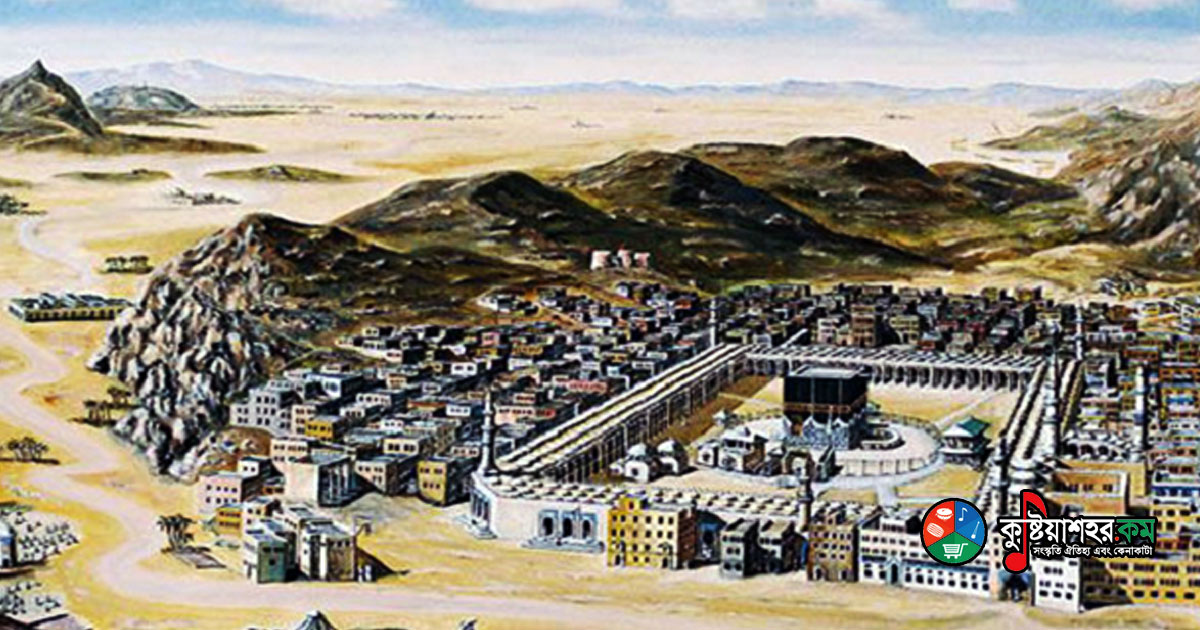
The city of Makkah lies in a valley surrounded by hills on all sides. To the east the mountain of Abu Qubays (أبو قُبَيس) and to the west the mountain of Qu'aiqa'an (قُعَيْقَعان), like a new moon, surround Makkah. In its lowland stands the Ka'bah House, around which is the habitation of the Quraysh. On the two horns of the new moon lies the dwelling of the poor Bedouins, who were skilled in warfare.
The Quraysh lineage is related on the side of Kinanah, who lived not far from Makkah. Thus, being bound in the bond of mutual harmony, the inhabitants here turned Makkah into the town of a secure fortress. For that reason the caravans arriving in Makkah always remained safe.
The Social Situation of Makkah (مجتمع مكة)
In the first half of the fifth century AD, Qusai ibn Kilab gathered the leaders of the Quraysh tribe and gave a foundation for the management of society. Then he began cutting down the trees around the Haram and building houses of stone there, which gave Makkah the form of a city. Before this the trees here were considered most sacred and were never cut. Qusai was the first leader who began the felling of trees here. Then he assigned his sons various responsibilities in the city's management. Hijabah (الْحِجَابَةُ) means the supervision of the Ka'bah House. Siqayah (السِّقَايَةُ) means discharging the responsibility of managing water for the pilgrims. Rifadah (الرِّفَادَةُ) means the entertainment and hospitality of the pilgrims. For this, subscriptions were taken at fixed rates from all the tribes, with which the needy pilgrims were entertained. Liwa (اللِّوَاءُ) means carrying the banner of war. Nadwah (النَّدْوَةُ) means the advisory council, sitting in which the problems of society were properly solved by mutual consultation and social unity was maintained. Qusai himself was in charge of it, and he turned its door towards the Ka'bah. In truth, Darun Nadwah was the parliament of the city-state of Makkah, of which Qusai ibn Kilab was the president and every tribal chief a member of its cabinet. Qusai fixed a subscription at the rate of ten per cent upon the outside traders who came to Makkah for business, which became one of the chief sources of the prosperity of the city of Makkah. In this way Qusai turned the city of Makkah into a well-organised, socially and economically prosperous city, which continued thereafter too. At the time of the Messenger of Allah's (SAW) advent, the leader of Makkah was his grandfather Abdul Muttalib ibn Hashim, and after his death, his uncle Abu Talib.
Source and acknowledgement: Dr. Muhammad Asadullah Al-Galib