বাংলা
 English
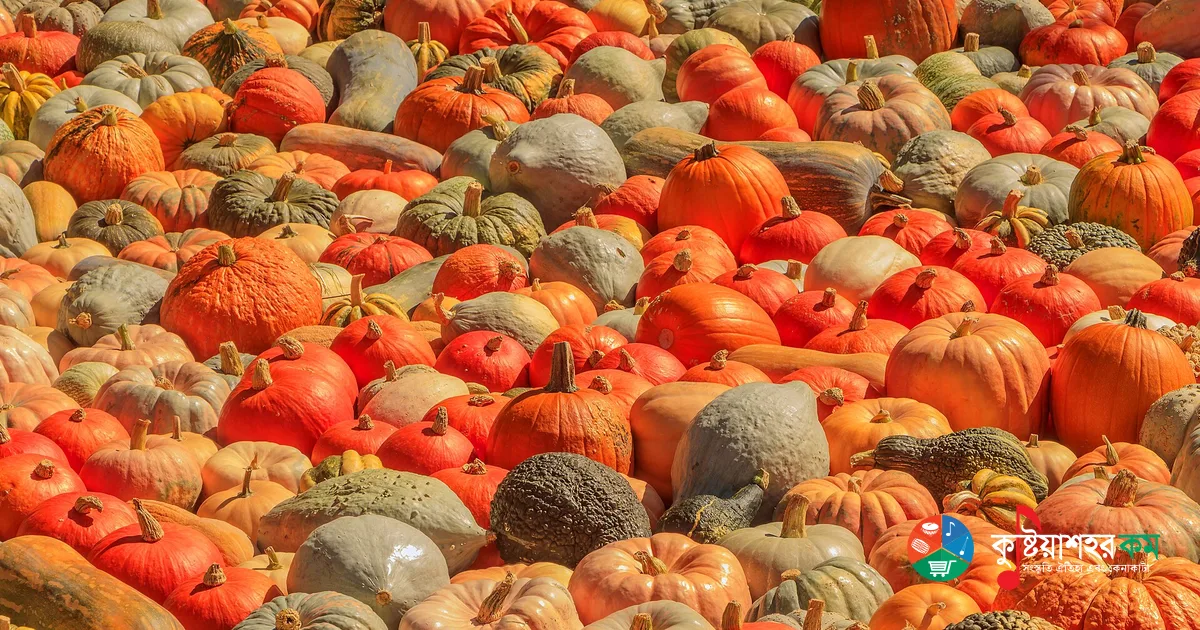
When the first chill of autumn arrives, pumpkins begin to rule the towns of the West — a grinning jack-o'-lantern on someone's porch, a rainbow display of thousands of pumpkins in a German palace garden, and a contest in America where giant pumpkins tip the scales at a thousand pounds. From October to November, the sweet pumpkin is the hero of harvest festivals around the world — art, food, sport and legend all rolled into one orange bundle.
Why the pumpkin rules autumn
Sweet pumpkins are planted in spring and ripen at the end of summer — in October, exactly when the harvest comes home. So wherever autumn means bringing in the harvest, the pumpkin climbs to the top of the celebration. In America the pumpkin is a native crop, and its bond with Halloween on the last night of October is so deep that a pumpkin-less Halloween is hard to imagine. But here is a surprise: the roots of the Halloween jack-o'-lantern lie not in pumpkins but in turnips.
The story of the jack-o'-lantern
An Irish legend from the mid-eighteenth century tells of a shrewd blacksmith, "Stingy Jack", who once even trapped the Devil. The result: Jack earned a place neither in Heaven nor in Hell. To light his endless wandering, the Devil gave him a burning coal, which Jack placed inside a hollowed-out turnip — "Jack of the Lantern". In the nineteenth century, people in Ireland, Scotland, England and Wales carved grotesque faces into turnips to ward off evil spirits. When immigrants carried the custom to America, they found pumpkins — native, plentiful and far easier to carve — and the pumpkin simply took the turnip's seat: the word "jack-o'-lantern" for a carved pumpkin first appears in American English in 1837, and a Canadian newspaper reported a jack-o'-lantern at Halloween as early as 1866.
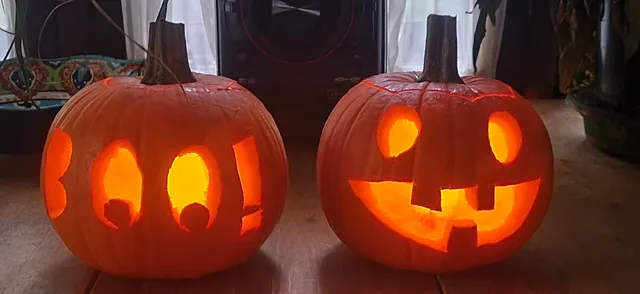
Jack-o'-lanterns carved for Halloween (Photo: Tim Evanson / Wikimedia Commons, CC BY-SA 2.0)
The Circleville Pumpkin Show: 'the greatest free show on earth'
Circleville, a town in Ohio about 30 miles south of Columbus, has run its Pumpkin Show since 1903. It began small — that autumn, Mayor George R. Haswell set out a modest display of pumpkins and corn in front of his store to share the joy of the harvest. Today the show opens on the third Wednesday of October and runs through Saturday, four full days, and the ticket price is — zero! Claiming to be the greatest free show on earth, it sells roughly 23,000 pumpkin pies and more than 100,000 pumpkin doughnuts each season, and Lindsey's Bakery bakes a "world's largest pumpkin pie" every year. With seven parades and children's pageants, visitors top 400,000; except for war years and 2020's COVID pause, the show has run every year since 1903 — even through the great flu of 1918–1919. Each show opens with the giant pumpkin weigh-in; the recent record stands at 2,388.5 pounds (1,083 kg), grown by Bob and Jo Liggett in 2023.
From Keene to Laconia: the Guinness record for lit pumpkins
In 1991 another kind of pumpkin festival began in Keene, New Hampshire, with a single obsession: light as many jack-o'-lanterns at once as possible. The first event counted 600 pumpkins; in 2003 Keene set a Guinness World Record with 28,952 lit jack-o'-lanterns, Boston took the record in 2006 with 30,128, and Keene reclaimed it in 2013 with 30,581 — by nightfall the whole town had turned into a sea of grinning lights. After student riots near the 2014 festival the city denied the following year's permit, and since 2015 the festival has been held in the neighbouring town of Laconia — still one of the most talked-about pumpkin gatherings of late October.
Ludwigsburg, Germany: the world's largest pumpkin exhibition
The world champion of pumpkin festivals, though, is German. In the Blühendes Barock gardens of the Ludwigsburg Residential Palace near Stuttgart, the Ludwigsburg Pumpkin Festival has run since 2000 and is billed every year as the largest pumpkin exhibition in the world. The Swiss Jucker brothers started the show at their farm in 1997 and brought it to the palace gardens just three years later. The festival runs from late August to early November (22 August to 1 November in 2026). Among colourful mounds of pumpkins stand enormous pumpkin sculptures built to each year's theme — storybook characters, animals, anything. The European and German pumpkin-weighing championships are held here, and the food stalls serve pumpkin soup, pumpkin fries, pumpkin Spätzle and even pumpkin ice cream.
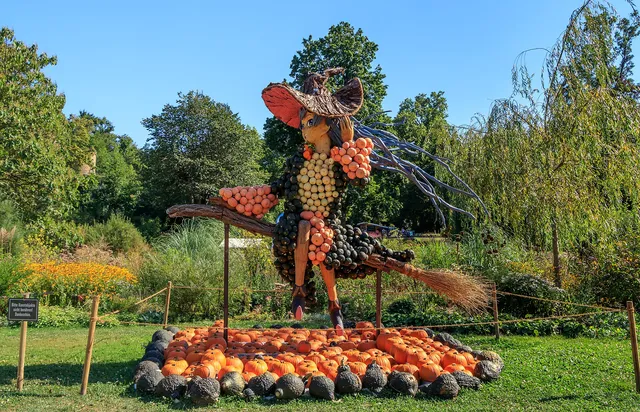
A witch sculpted from pumpkins at the Ludwigsburg festival (Photo: Llez / Wikimedia Commons, CC BY-SA 3.0)
Giant pumpkin weigh-offs: the race past 3,000 pounds
Autumn's other big contest is the giant pumpkin weigh-off — who can grow the heaviest pumpkin on earth. Most of today's giants descend from 'Dill's Atlantic Giant', a variety selected by Howard Dill of Nova Scotia; winning seeds sell at auction for up to 850 dollars, and growers track seed pedigrees like racehorses. The record's journey is remarkable: at the 1893 Chicago World's Fair William Warnock's pumpkin weighed 365 pounds; in 2023 Travis Gienger set a record of 2,749 pounds (1,247 kg) at the famous Half Moon Bay weigh-off in California; and in October 2026 the record fell twice in a single week — Britain's Ian Paton reached 2,856.8 pounds on 3 October, and just seven days later, on 10 October, America's Ron Wallace took it past the 3,000-pound barrier for the first time with 3,156 pounds (1,431 kg) in Rhode Island. It is said a giant pumpkin can gain up to 50 pounds in a single day — and 94 percent of that weight is water!
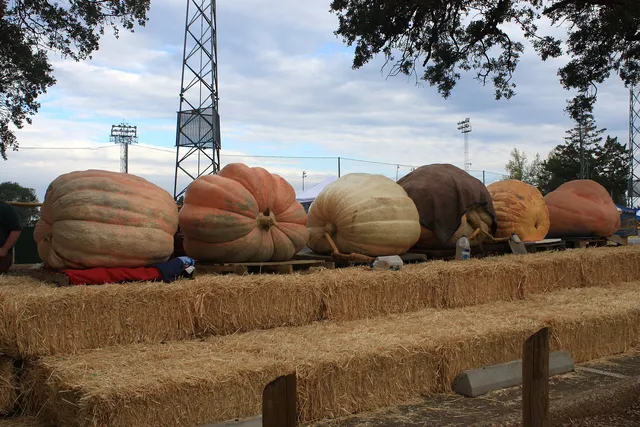
Giant pumpkins at the weigh-off of Auburn Community Festival, USA (Photo: Nick Ares / Wikimedia Commons, CC BY-SA 2.0)
More pumpkin festivals
The list does not end there. Morton, Illinois calls itself the Pumpkin Capital of the World — the town's claim is that 99 percent of the world's canned pumpkin is produced at its Libby's plant — and every September it throws a four-day Morton Pumpkin Festival. Some people build pumpkin cannons: in "pumpkin chunking" contests, contraptions fling pumpkins hundreds of metres. Elsewhere, giant pumpkin shells are hollowed out and paddled as boats — races between floating pumpkin boats are among autumn's funniest sights.
Why Bangladeshis love the sweet pumpkin
In the West the pumpkin is a guest of one season; in Bangladesh the sweet pumpkin is a companion of almost the whole year. In village courtyards, on the raised ridges of fields and beside ponds, pumpkin vines climb bamboo-and-jute trellises, and when the season arrives the trellises fill with golden pumpkins. Pumpkins are cheap, easy to digest and within reach in the bazaar for most of the year — which is why the sweet pumpkin holds a permanent seat on the common people's plate. It is no weakling in nutrition either: pumpkins carry beta-carotene, which the body turns into vitamin A, along with fibre. For many, a winter morning begins on a different note altogether when hot pumpkin ghonta is served with rice.
Pumpkins in the Bengali kitchen
The sweet pumpkin plays many roles in Bengali cooking. Everyday homes make pumpkin chanchki and jhol, pumpkin bhorta with rice, and a wedding feast feels incomplete without pumpkin ghonta — that sweet-salty, thick curry pounded to a pulp is Bangladesh's own culinary treasure. Winter mornings bring stir-fried tender pumpkin shoots and greens, and roasted pumpkin seeds are eaten like nuts. At winter fairs and roadside tea stalls, stalls of sweet-pumpkin bora still pull crowds — deep-fried in a gram-flour batter and served with coriander chutney, hot pumpkin bora is one of winter's most loved snacks. Thick pumpkins turn into halwa, ash gourd (chal kumra) brings a different taste, and at the Nabanna new-rice feast the pumpkin claims its golden seat too.
How a pumpkin festival could be celebrated in Bangladesh
Bangladesh has no fixed pumpkin festival yet, but the land and its people are both ready for one — hung on Nabanna or a winter fair, a pumpkin festival of its own can stand up overnight. In the family, the easiest way is a pumpkin gathering on a winter afternoon: carve a face into a pumpkin, light a candle, sit on the floor with stories, and in the evening cook that same pumpkin into ghonta or bhorta. In America's Halloween the carved pumpkin stays only a sculpture for display; a Bengali pumpkin festival ends with food in hand.
For a school, college or neighbourhood, three contests are enough: a heaviest-pumpkin weigh-in (village markets have always weighed prize mangoes and jackfruits), a best-carved-face contest or sculptures in Bengali motifs, and a cooking contest of pumpkin dishes — ghonta, chanchki, bora and halwa all qualify. A fair can go bigger with a giant-pumpkin display, pumpkin-bora stalls and prizes for the best grower; a growers' conversation on trellis farming turns the festival into a school of agriculture too. The best window is Nabanna through early winter (October to early December), when the new harvest comes home and the bazaar fills with pumpkins. City cafés and restaurants already show Halloween themes in late October — adding a special menu of Bangladeshi pumpkin dishes that week would bathe a foreign festival in Bengali flavour.
Closing words
See how far one humble crop can travel — from a turnip legend to a carved pumpkin, from sculpture to pie, from record-breaking weigh-ins to boats on a pond. From Circleville's free show to Ludwigsburg's palace gardens, pumpkin festivals carry the same message: the joy of the harvest coming home is something people have always wanted to share. When the pumpkin season returns next autumn, listen for the thousand-year story behind the grinning lanterns — not just the lanterns themselves.