বাংলা
 English
Before the eighteenth century, the means of travel and communication were slow-moving: animal-drawn carts, man-carried palanquins, sail-powered boats and the like. From the invention of the steam engine onward, communication began to become easy and fast with the help of fast-moving vehicles. Today the telephone, the mobile phone, the computer and the internet have brought the speed of communication to the speed of light; in the field of communication the whole world is as if in the palm of the hand. Even so, in no country has the importance of the railway declined. On the contrary, as a low-cost, safe and comfortable means of travel, Japan, India, China, Europe and America keep innovating and increasing the use of new technologies to increase the speed of railways. The successive speeds of the sail, the horse, the engine and the speed of light in use today are the successive measures of the growth of civilisation.
In the meantime, in the eighteenth century, the use of the steam engine, within only two centuries, threw behind it the wealth and energy accumulated over five thousand centuries. Without this growth, the Industrial Revolution would not have taken place. And without the Industrial Revolution, we would not see today's glittering world. At one time the railway was the fastest vehicle on earth. The invention and use of the railway have carried historical importance. In 1763 James Watt invented the steam engine. Following that thread, in 1804 Richard Trevithick built the first railway engine. In 1812 Matthew Murray ran a rail engine with cog-toothed wheels over a rack-and-pinion rail line. Then George Stephenson of Scotland in 1814 definitively developed the steam engine for the railway, and on 27 September 1825 the world's first rail transport was inaugurated. In 1830, when the 35-mile railway from Liverpool to Manchester was opened, fare-charged trains were run for the first time in the world. That engine's name was Rocket.
Europe was then in its renaissance, the age of the Industrial Revolution. Railway communication began in more than seventy countries of Europe. Railways were established in America in 1829, Ireland in 1834, Germany in 1835, Russia in 1837, Italy in 1839, Spain in 1848, Switzerland in 1856, India in 1853, Africa in 1854, Japan in 1872 and China in 1875. All over Europe it was then the age of the Renaissance; the coming of the railway accelerated it.
India was then a colony of the British. For the logic of administration and business, the British government decided to establish railways in India. For this purpose, the then Viceroy of India, Lord Dalhousie, held discussions with England's E. S. Stephenson and Company about laying a railway line. In 1844 a firm decision was taken at the Viceroy's durbar that railways would be built in India. An agreement was concluded with the company on this matter. Work began as usual, and on 16 April 1845 a train of fourteen carriages went from Bombay's Boribunder station to a station 21 miles away and returned to Boribunder. That day everyone watched the train in astonishment; they watched the running of the fast-moving vehicle, the train. Science has brought speed to man, which has made life easier and development faster. Conservative orthodox religionists decreed that travelling by train was a sin, and that one who travelled by it would have to perform penance. No one has ever been able to hold back the contribution of science, and it is not possible at all, because development is the progress of civilisation. And at its root lie all the discoveries and innovations of science.
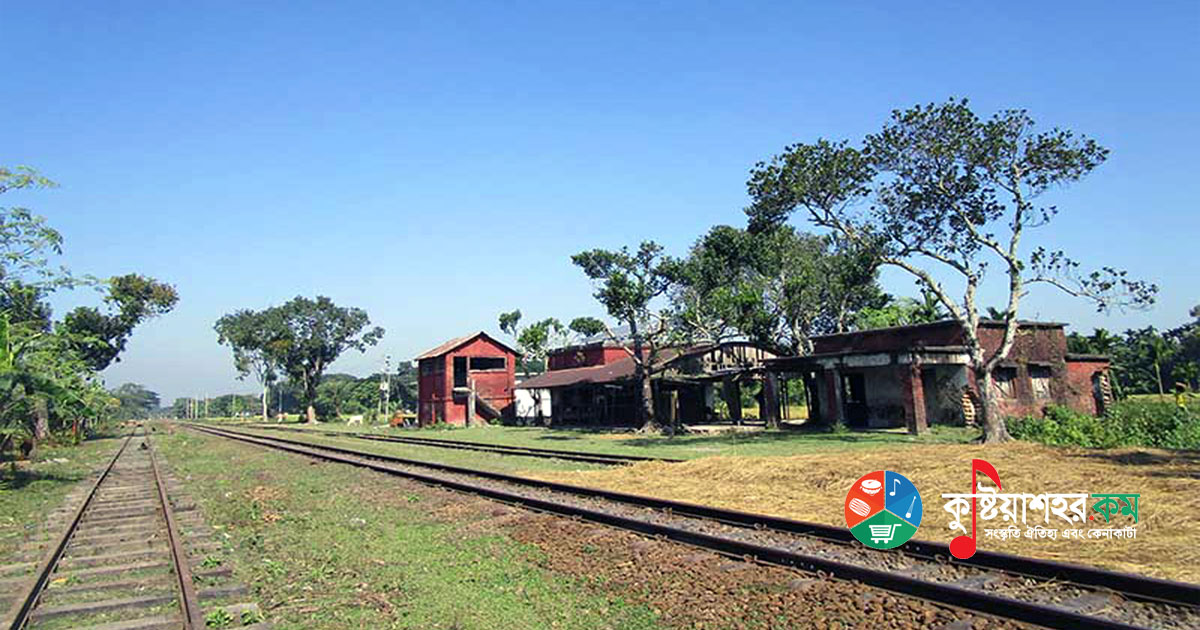
Planning of railway construction within our Bangladesh boundary began in 1852. In 1852, J. P. Kennedy proposed the extension of the railway from the Sundarbans to Dhaka. Thereafter, in 1855, in Lieutenant Great Head's survey report, a proposal was made for railway lines on two routes: the first proposal via Jessore-Faridpur to Calcutta, and the second Calcutta via Kushtia-Goalando to Dhaka. When the first proposal was cancelled because of fourteen big rivers and other reasons, the second proposal was adopted. For the implementation of this proposal, from 1857 the Eastern Bengal Railway's proposal for the construction of a single broad-gauge line from Calcutta to Kushtia was accepted. In 1852 the line was opened for running the first traffic between Ranaghat and Jagati. The railway that in 1862 had reached from Sealdah station to Jagati station. At one stage, when the construction of the Gorai bridge was completed in 1870, it was extended up to Goalanda Ghat on 1 January 1871.
In the Rajbari part, the railway ran from Pansha two kilometres north of the present Kalukhali station through Bahar Kalukhali along to the Dhawapara ghat. That railway extended eastwards through the north of the present Rajbari town up to Jamalpur. Even now its traces remain in some places. Jamalpur was then the Goalanda Ghat, which was called the Ganges port. When the railway was extended from Poradaha to Goalanda in 1871, the rail line at that time went right through the middle of Bahar-Kalukhali. Bahar Kalukhali is five kilometres north of the present Kalukhali station.
Data and acknowledgements: Ispater Path (The Path of Steel) by Shafiqul Islam; Amar Smritikatha (My Memoirs) by Trailokyanath.