বাংলা
 English
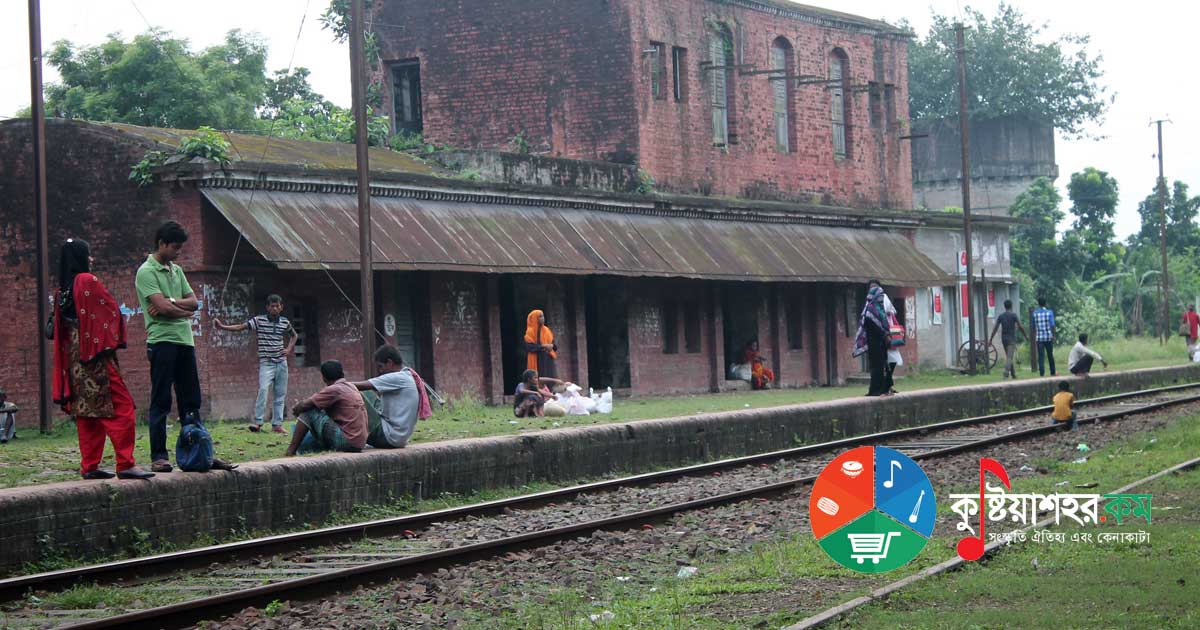
Trailokyanath: my year of birth is 1875. The name of the village is Bahar Kalukhali. The distance of this village from Kalukhali station was about two miles. On the Poradaha-Goalanda railway line were Jagati, Kushtia, Court, Kushtia (later, east of Kushtia, beside the bridge over the Gorai river, a station named Charaikhol was built).
After that KumarKhali, Khoksa, Pansha, and right after that Kalukhali. The next station was Belgacchi, and right after that Rajbari. Later, a little west of Rajbari, a station named Suryanagar was built in memory of Raja Suryakumar. The station after Rajbari was Pachuria Junction, and right after that Goalanda — pronounced 'Goalando' in English. From Pachuria a branch line went to Faridpur. The three stations of Pansha, Belgacchi and Kalukhali in between lay on a straight line up to 1910. Later, because of the erosion of the Padma river, the Kalukhali station was shifted to near Ratandia. For a short time a temporary line was laid over the Haroa. From Calcutta, taking the Changa, Kalukhali was a journey of four hours. Right after Kushtia came Kalukhali; the mail train did not stop at any intermediate station. After Kalukhali became a junction, the mail train, passing Kushtia, went straight to Rajbari and stopped there.
Owing to the fierce erosion of the Padma, the need arose in 1890 to relocate the railway. On 1 April 1890 the railway was re-established — Pansha, present Kalukhali, Belgacchi, Suryanagar, Rajbari, passing west of the locoshed, northward via Durgapur and Tenapacha up to Goalanda Ghat (Ispater Path, page 51).
In the second phase of railway construction in 1890, the name Goalanda was entered in documents and deeds. When the railway station was set up in 1890 at the centre of Rajbari town, the railway authorities acquired, centred on the station, land of one to one and a half kilometres east-west and north-south. The owners of this land were several joint-holders including Raja Suryakumar and the feudal landlord Girijashankar Majumdar, Babu Narayan Chakrabarti and others. Within a short time, along with railway officers' quarters, were established the railway playground, the S R Hall Centre, the locoshed, workers' quarters, a rest house and so on. After 1947 the railway colony was established. Many built permanent homes with jobs on the railway. Of course, the modernisation of the present Rajbari station was done in the 1960s. Taking the railway as its basis, Rajbari town gained its foundation. Through the railway, several traders made huge profits in the coal business; among them Haji Golzar Hossain is one.
In 1895 the railway was re-established via Pachuria up to Goalanda Ghat (adjacent to the present Goalanda Bazar). Then in 1899 the railway was laid from Pachuria to Ambikapur (Amirabad). At that time the Khankhanapur and Boshontopur railway stations were established. Considering the importance of carrying bamboo, cane and jute from the southern region of Rajbari district in particular, the railway was built from Kalukhali up to Bhatiapara on 1 January 1932. At that time the Ramdia, Baharpur and Adkandi stations were established. The Kalukhali railway became a junction station. Later, when silt accumulated at the mouth of Goalanda Ghat and a char appeared, the ghat was shifted to the present Daulatdia, and in 1977 the railway was extended up to Daulatdia. Akkas Ali Mia played a special role in establishing the railway up to Daulatdia. It goes without saying that the British government invested a huge amount of money in building the railway.
The East Bengal (EB) Railway Company built this railway. The company completed the railway and other construction works through contractors and sub-contractors. In this region the contract work of railway construction was completed by Govinda Dutta and Gurucharan Dutta of Sagar Dighi village in Pabna district. Through railway contracting they became owners of much wealth and built palatial houses; they came to be known as zamindars among the people.
In acquiring land from the people for building the railway, the railway company paid reasonable compensation. The employees under the contractor worked out the compensation. In those days, as compensation for immovable and movable property — would you be surprised? — not only mango, jam, jackfruit, betel-nut and coconut trees, but even the banana plant was brought under compensation. Besides, land and the crops of the land were there too. Taking the fruit, the leaves and the stalk of a banana plant into the reckoning, its compensation was assessed at 5 to 10 taka. The price of one maund of paddy was then three to three and a half taka. On that reckoning, the price of a banana plant was 10 taka — surprising indeed. The price of mango, jam, jackfruit and coconut trees was fixed at 50 to 100 taka (Amar Smritikatha, page 138).
The British were indeed merchants, but their sense of justice was not small. With the compensation money of many, the wheel of their financial condition turned around. At that time, constructing the Gorai bridge cost several lakhs of taka and many people died. The Babus of Sagarkandi became owners of vast wealth from the contract of this bridge, and they bought zamindari estates. Since the establishment of the railway, how many events have taken place centred on the railway! The railway line, the trains, the railway employees, the ordinary passengers and the students and people of Rajbari carry a history of art, literature, economics, politics, movements, struggles, accidents, suicides and lawsuits — of hope and despair, success and failure.
It is the beginning of the nineteenth century. An English sahib came as the big boss of the railway. He lived in the railway bungalow (to the north of the present National Library is the residence of this E N sahib). What is a sahib to say? In fact, a simple man. He liked the rural environment of Rajbari. He wandered about alone in the mornings and evenings. He lived alone in the bungalow. He came to know all sorts of people. In the west of Rajbari town, in the suburb, lived some 20 to 25 households of Bagdi people; even now it is known as Bagdipara. He came to know a Bagdi girl. From acquaintance grew love, and then marriage. He married the Bagdi girl and brought her to the bungalow. A few years of married life. One day the girl died of cholera. Did the sahib weep then? For the sake of his wife's memory she was buried. The masonry tomb at the road corner west of the National Library still carries the memory of that love.
Before the railway came to Rajbari, construction of the Gorai bridge began from 1861. Mir Mosharraf Hossain shed his moonlight on it in the poetry booklet named 'Gauri Setu'. In his autobiography he recorded an account of the construction of the Gorai bridge. He wrote in his biographical book:
The northern part of Lahinipara going eastwards, the rail line crossed the Gauri river and went up to Goalanda. In 1871 (English era) the bridge construction was finished and trains began to run. In India the ever-famous Mahamati Lord Mayo Bahadur, the Viceroy, opened the Gauri bridge. At the time of the Gauri bridge construction, many respectable Hindu and Muslim clerks, draftsmen and cashiers, big babus, worked under the railway company. Very few pure Europeans if any — 20/25 persons; native Firingis about the same number; Negro Habshi 10/12 persons; the clerks' group was not less than 70/80. Elephants, horses, boats, launches, steamers — there were many. The number of coolies from Chittagong, Sylhet and other places, and of native blacksmiths, carpenters and coolie labourers, is hard to reckon. Durgacharan Gupta, whose Gupta Press and Gupta Panjika are famous throughout Bengal, also worked as the salaried head babu of the railway company on the occasion of the Gauri bridge construction (Mosharraf Rachana Samvar, page 73).
At the time of the railway's construction, many received the compensation value of their land from the company, while again the crop lands of many went to waste into the company's hands.
Many became babus with railway jobs, while many left the homesteads of generations and migrated abroad. How many curious people came to see the first engine-wheeling train! Hearing the sound of the carriage and the whistle of the engine, they were amazed. How many people, crushed under the wheels of the train, were lost in time and out of time. On the railway were composed rhymes and verses:
feet slip — the potato steams'
Among people accustomed for hundreds of years to horse carriages, bullock carts, palanquins and walking, many welcomed the railway, while many thought the establishment of the railway was a new trick of the British merchants to plunder the wealth of this country. But whatever technique was invented somewhere for the growth of civilisation and culture, it slowly spread among different countries and nations. The establishment of railways in this country also bears that testimony. From the railway's beginning, its importance has only kept increasing.
If we take the hundred years' history from the arrival of the railway in Rajbari in 1871 up to the independence of 1971, we will see that the economic, social and cultural development of this district took place centred on this railway. Pansha, Belgacchi, Kalukhali, Rajbari, Goalanda, Khankhanapur, Boshontopur, Ramdia, Baliakandi were comparatively flourishing areas compared with the jungle and desolation of the south and the deer-inhabited Saurail, Kashba Majhail areas of the west. Among these, the historical importance of Rajbari, Goalanda, Pansha and Belgacchi is much greater.
From the establishment of the railway, Kalukhali became a junction, Rajbari a town, and Goalanda came to be known as the Gateway of Bengal or a great commercial hub. The capital of Bengal then was Calcutta. Education, travel, trade and commerce, literature and culture — all were centred on Calcutta. From this time developed the culture of a special class known as babu culture, whose influence can still be observed in many respects in this region. Even now the head clerk of an office is heard to be called 'babu' in many areas of Rajbari, and sons and children are naturally addressed as 'babu'. In fact, because of the railway, easy communication with Calcutta fostered the growth of education and culture. The importance of the railway in public life increased to such an extent that in 1944 a crisis arose over the railway. In the then Goalanda subdivision, because of some administrative complications and mismanagement, the authorities issued a notice on 9 December 1940 to close the Kalukhali-Bhatiapara rail line from 18 December. It was sad news for the people of Rajbari and Faridpur.
At that time the people of Rajbari and Faridpur made fervent appeals to the Viceroy of India and the Governor of Bengal to keep the line running. In this appeal they highlighted the effective and social importance of the branch line in public life and demanded that the line not be closed.
They stated in their demand: 'The Kalukhali-Bhatiapara railway is 52 miles long. The local people, too, have benefited through this railway, centring on nearly a hundred trades. There is no other means of transport here. The line is known to the inhabitants of the area as their "Life cord". The branch line carries historical, commercial and administrative importance. Besides playing a significant role in increasing agricultural production, a large part of the people travel through this railway to different places for work, for the sake of changing their livelihood. Through the expansion of the field of work, changes in people's livelihood have been achieved in the social sphere. New classes have emerged. Among them notable are businessmen, professionals associated with legal practice, physicians engaged in medical work, students, the learned society, government employees, artisans, farmers, day labourers and students. If this line is closed, difficulties will arise for the people of all these classes, particularly the employees, and because of the absence of the railway there will be an impact on the people's income too. With the coming of the railway, the inhabitants of this area, encouraged, have devoted their ability and resources to the development of this region. As travel has become easy, the inhabitants of this area have become highly dependent on Calcutta for health, education and other needs in much greater measure.' (History of the Railways of East Bengal, Dinak Sohani, pages 204, 5).