বাংলা
 English
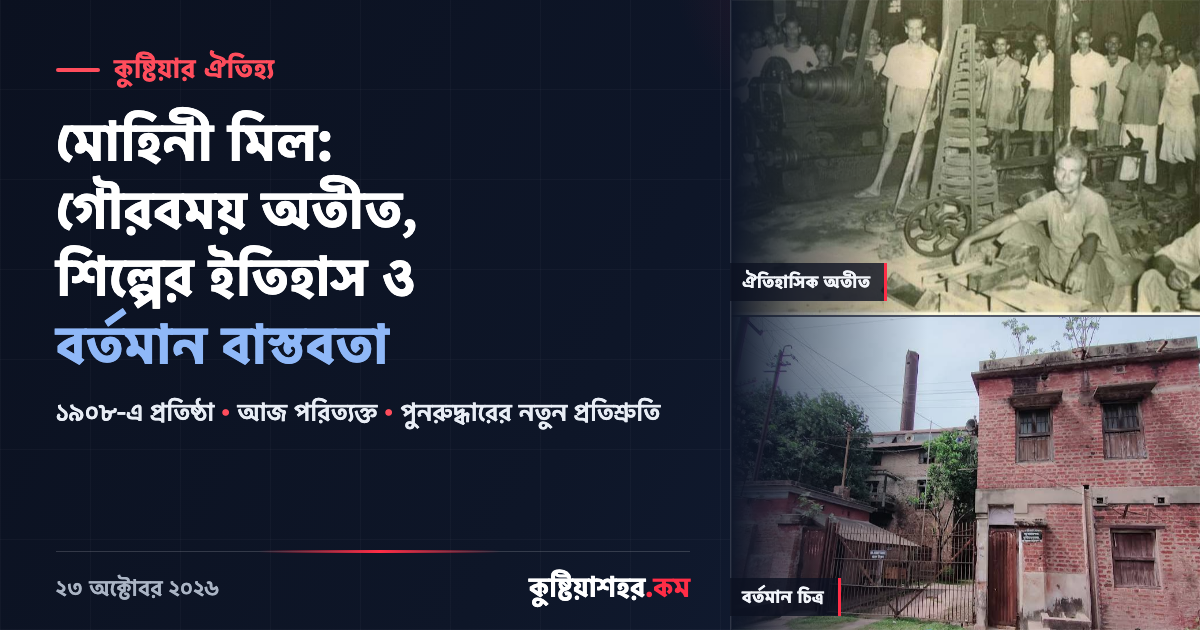
When the industrial heritage of Kushtia town is spoken of, the name that comes up most distinctly is Mohini Mill. At one time this textile mill played an important role not only in Kushtia's economy; it was also deeply intertwined with the lives of the weavers, workers, traders and ordinary people of the wider region. The yarn, sarees and dhotis the mill produced were once known in various places. Its influence on employment, trade and commerce and the local economy was considerable.
Today that historic industrial establishment faces many questions after its long stagnation, its unused infrastructure and the upkeep of its assets. The present condition of the mill around whose wheels the livelihoods of countless people once revolved brings forward an important chapter of Kushtia's industrial history.
The History of Mohini Mill's Founding
The name of industrial entrepreneur Mohini Mohan Chakrabarty is intertwined with the founding of Kushtia's historic Mohini Mill. According to various published historical accounts and news reports, in 1908 he set up a textile mill on about 33 acres of land in the town's Millpara area; in its early days the establishment was known as 'Chakrabarty and Sons'. According to a history-research article published on KushtiaShahor.com, in 1912 it was transformed into 'Kushtia Mohini Mills Limited', and among its shareholders were Jagatkishor Chowdhury and the world poet Rabindranath Tagore; it is also noted there that the Tagore family's firm 'Tagore and Company' existed even earlier, north of the mill.
In the closing decades of the nineteenth century and the early twentieth, Bengal's economy depended to a large extent on agriculture, the handloom industry and small trade. Local history researchers see Mohini Mill as part of the current of domestic mills and factories that grew up against the backdrop of the 1905-06 Swadeshi movement and the boycott of British goods. Setting up a modern industrial establishment for producing yarn and cloth locally was an important initiative at that time. Mohini Mill is a notable addition to the industrialisation history of that era.
Kushtia's geographical position was also helpful for the growth of such an industrial establishment. Using railway links and river routes, raw materials could be brought in and finished goods supplied to different places. Making use of these advantages, Mohini Mill gradually became a familiar textile-industry establishment.
Various sources show some differences regarding the year of founding, the company's formal name and subsequent changes of ownership. So, in tracing the mill's history, contemporary documents, government records and reliable historical accounts need to be pieced together.
Mohini Mill's Role in Production and Trade
Mohini Mill's main work was producing yarn and cloth. Various published accounts mention the fame of the mill's sarees, dhotis and yarn. Local historical writings record that weavers of different parts of the country once depended on this establishment for collecting yarn.
Around the activities of the industrial establishment, an environment of economic activity grew up in Kushtia town's Millpara area. Along with the workers and employees directly attached to the mill, employment opportunities were also created for people connected with transport, goods supply, trade and other ancillary activities.
The textile mill's production was not confined within the factory alone. To bring the produced yarn and cloth to the market there was need of a transport system, wholesale traders, retail sellers and various associated services. As a result, the economic activity that grew around Mohini Mill also made its impact on the local market and on trade and commerce.
When an industrial establishment runs production for a long time, the area's people build up memories of it, professional experience and social relationships along with it. The same applies to Mohini Mill. To many people the establishment is not just a factory; it is a memorial to Kushtia's past industrial prosperity.
Its Relationship with the Workers and the Local Economy
One of the most important aspects of Mohini Mill's history is its community of workers. To run the factory's production activities, workers, technical staff, officers and employees were needed. It was on their labour that the mill's production and business activities depended. Local historical research records that at one time this mill was the employment hub of several thousand workers; in the 1930s the Mohini Mill Yarn Mill Workers Union was formed here, and the worker leader Comrade Roshan Ali appeared on the scene.
While the mill's operations ran, many families connected with it received regular income. The workers' earnings also created a flow of money into local shops, markets, housing, transport and other service activities. This is how a large industrial establishment can influence the economy around it.
Yet the history of an industrial establishment is not only a story of production and success. Problems concerning the workers' working conditions, wages, job security, ownership and management are also part of it. To understand Mohini Mill's long history, one must consider, alongside the establishment's successes, the workers' experiences and the administrative and economic crises of different times.
Nationalisation and Mohini Mill's Changed Circumstances
After the founder Mohini Mohan Chakrabarty's death (1922), his grandson Deviprasad Chakrabarty, familiarly known as 'Kanu Babu', took charge of the establishment, local historical research records. During the 1965 India-Pakistan war the mill was declared 'enemy property', and, placing Kanu Babu under house arrest under the Pakistan Security Act, the government administration took control of the mill; he died in 1967 while under house arrest. The Mill Line, bazaar, hospital and theatre hall that grew up around the mill in that period also became part of Kushtia town's urbanisation.
After Bangladesh became independent, changes came in the ownership and management of the country's various industrial establishments. Mohini Mill was no exception. According to published historical accounts, in 1972 the establishment was nationalised and brought under the management of the Bangladesh Textile Mills Corporation (BTMC).
Although attempts were made to keep the establishment's production and management going after nationalisation, various problems appeared in the later period. In running an industrial establishment, production costs, the machinery's capability, market competition, raw-material supply, management and financial capacity play important roles. If problems arise in these areas, even a large factory's operations can come under threat.
In Mohini Mill's case too, news reports and historical writings have raised the losses and management-related crises. But to determine the specific causes and responsibility for these problems, one needs to analyse the government records of the relevant period, financial reports and the workers' testimony.
Production Halted in 1982
The eighties form an important and painful chapter in Mohini Mill's history. According to various news reports, the mill's regular production activities stopped in 1982, and the future of the workers and employees attached to it fell into uncertainty. According to a bdnews24 report of 2010, after closing in 1982 the mill was restarted in 1985 and then closed again because of losses - that report gives the date of the final closure as 15 August 1990. On the other hand, KushtiaShahor.com's history research takes the mill to have gone out of operation from 1 November 1987. Although sources differ from source to source over the exact date, almost all accounts agree that the stagnation began sometime between the middle and the end of the eighties.
When a large industrial establishment closes, its impact is not confined within the factory's boundaries. Effects can appear such as lost employment, families' incomes falling, purchasing power declining in the local market, and the related business activities shrinking. The closure of Mohini Mill too is important in the history of Kushtia's industry and its working people.
In the later period, discussions and activities took place at different levels over the mill's property, ownership and efforts to restart it. But production could not be kept running on a sustained basis. The long closure gave rise to concern also over the maintenance of the factory's machinery, buildings and other infrastructure.
Efforts to Restart and Shah Mokhdum Textile Mills
After Mohini Mill closed, attempts were made at different times to restart the establishment. According to a report published on bdnews24.com on 21 May 2010, after a long closure the factory was restarted under the name 'Messrs Shah Mokhdum Textile Mills'. According to that report, Pils Development Services Corporation Limited took the mill on lease from the government and ran it, and on the morning of 21 May the then Deputy Commissioner Abdul Mannan formally inaugurated the production activities. After nearly two decades of closure, it was a hopeful step in the mill's revival.
But an initiative to restart does not necessarily mean that an industrial establishment becomes operational in the long run. To maintain regular production, effective management, sufficient investment, modernisation of machinery, skilled manpower, market demand and financial stability are needed.
In Mohini Mill's case too, the restart initiative could not achieve lasting success. News reports of the following years have recorded the mill's repeated changes of hand and the fact that its production activities never fully became operational.
This chain of events shows that to revive a historic industrial establishment, a name change or an official inauguration is not enough. What is needed are long-term planning, transparent management and a realistic industrialisation strategy.
Ownership, Property and Legal Complications
Ownership- and property-related complications are also important in Mohini Mill's history. A Prothom Alo report of January 2024 says that the Textile and Jute Ministry formed a Liquidation Cell in June 1981, whose task was to sell four factories, including this one. But even after four decades Mohini Mill has not been sold. According to published accounts, around 2011 there was an initiative to hand the mill over to a private organisation; however, on the complaint that it was being sold far below the fixed price (for about Tk 20 crore), the government brought it back on the Prime Minister's Office's instruction, and the establishment is now under the Liquidation Cell's control.
When an industrial establishment stays closed for a long time, ensuring proper management of its land, buildings, machinery and other assets becomes difficult. That Prothom Alo report says that since the closure the mill's land has been encroached upon; about half the land is now no longer under the authorities' control - about 16 and a half acres are said to remain in control. If there are disputes over ownership, financial liabilities, legal injunctions or administrative complications, the initiative to restart production can also be obstructed.
In Mohini Mill's case too, news of property handovers and restart initiatives has been published at various times. But even after these initiatives, the establishment's long-term industrial operations could not be ensured.
To reach a definite decision on the property and ownership, it is essential to verify the relevant government records, court orders, agreements and up-to-date administrative information. It is not proper to present an accusation against any person or organisation, based merely on news reports or local hearsay, as final truth.
The Abandoned Infrastructure and the Question of Heritage Preservation
News has been published at various times about the buildings, machinery and other structures of the long-closed Mohini Mill. A Bhorer Kagoj report of September 2024 informed that the abandoned factory's valuable assets and machinery parts are being looted - machinery parts, including brass handloom machines brought from England, are being stolen; wire worth lakhs of taka has been cut away; the plaster of the buildings' walls and roofs is being stripped off; the buildings are dilapidated, and the mill compound has turned into jungle. That report mentions the present market price of the mill's 99 bighas of land as about Tk 200 crore.
The worth of a historic industrial establishment cannot be determined only by the market price of its land or buildings. Bound up with it are the history of technology, the lives of the workers, the evolution of the local economy and the social memory of a region. In that consideration, Mohini Mill is an important part of Kushtia's industrial heritage.
In preserving old industrial factories, several matters may be considered in particular. First, the historic value of the buildings and machinery needs to be assessed. Second, it is essential to evaluate the structures' present condition and safety. Third, the preservable parts can be documented, and photographs, drawings, documents and oral history collected.
Among possible initiatives, an industrial-heritage museum, preserved historic structures, a research and exhibition centre, or the scope for new industrial activities under suitable planning may be considered. But before implementing such initiatives, it is essential to verify ownership, legal status, technical feasibility and financing.
Election Promise: Amir Hamza's Pledge to Restart Mohini Mill
In the 2026 election to the thirteenth Jatiya Sangsad, Mufti Amir Hamza, candidate of Bangladesh Jamaat-e-Islami from the Kushtia-3 (Kushtia Sadar) constituency, was elected. Part of his election promise was to restart the abandoned Mohini Mill.
After being elected MP, on 26 April 2026 he raised in the Jatiya Sangsad the proposal to lease the unused land of the Kushtia Sugar Mill and Mohini Mill to the private sector or to use them as an economic zone or industrial park; he informed of the foreign companies' interest and mentioned that he had spoken with quite a few companies. Later, in an interview given to the Daily Andoloner Bazar, he reiterated the pledge - more than a thousand bighas of unused government land, including Mohini Mill and Kushtia Sugar Mills, would be put to use in an integrated plan, through which extensive employment for local young men and women is hoped for; in his words, the Mohini Mill-centred economy will turn around anew.
Yet in reality no progress is visible so far. After the election, no published news of any definite step, timetable or investment announcement for restarting Mohini Mill has been known. The establishment's reality is also complex - about half the land encroached, complaints of assets being removed, and being under the Liquidation Cell's control mean that legal and administrative steps lie first on the path of recovery. How far the promise takes real shape will become clear in the time to come.
The Prospects of Reviving Mohini Mill
The most important question surrounding Mohini Mill is: what may the future of this historic industrial establishment be?
To discuss the mill's future, alongside emotion, the real economic and technical situation must be considered. Detailed surveys are needed on whether production can start again as before with the old machinery, how usable the buildings are, how much new investment is required, and what kind of production could be profitable in the present market.
If restarting as a full-fledged textile mill is economically possible, planning can be done on the basis of modern technology, skilled manpower and transparent management. On the other hand, if industrial activity cannot be restarted, discussion can be held on preserving the appropriate parts of the historic structures and on alternative uses.
In this, coordination among government institutions, the property's lawful owners, the local administration, members of parliament, industry experts, historians and Kushtia's citizens is important. Before decisions are taken, it is necessary to ensure the publication of reliable information, assessment of the property's condition and the transparency of possible plans.
Mohini Mill's Place in Kushtia's History
Kushtia is known for its literature, culture, music and historic heritage. But another important aspect of the region's history is the growth of industry and the economy. Mohini Mill is a notable monument of that industrial history.
Bound up with this establishment's history are the entrepreneur's initiative, the growth of textile production, the workers' working lives, nationalisation, the halt of production and various efforts to restart. Thus Mohini Mill's history is not merely an account of a past factory; it is also a field for understanding the transformation of Bangladesh's industrial system, the challenges of management and the necessity of preserving heritage.
To portray Mohini Mill's history more richly, interviews with veteran workers and employees, old photographs, appointment letters, wage-related records, production reports, company documents and the reminiscences of local people need to be collected. If these materials can be preserved, it will be possible to present the mill's true history to future generations more reliably.
Conclusion
Mohini Mill is an important name in Kushtia's industrial heritage. This establishment, which once played a role in production, employment and trade, has long lain in stagnation. As its past is part of the local people's pride, so its present condition recalls the necessity of preserving industrial assets and planned management.
For deciding Mohini Mill's future, what is needed is proper documentation of history, transparency in the property's and legal status, technical evaluation and realistic planning. Whether the establishment returns to industrial activity, or gains a new identity through preserving its historic parts - that decision should be taken on the basis of information, feasibility and the public interest.
Preserving the history of this historic industrial establishment of Kushtia means not only keeping the memory of an old factory; it means carrying the history of this region's labour, initiative, economy and social change to future generations.
Sources and Further Reading
- Kushtia District Administration - Mohini Mill: kushtia.gov.bd/pages/tourist-spot
- bdnews24.com (21 May 2010) - Mohini Mill reopened under the name Shah Mokhdum: bangla.bdnews24.com/bangladesh/article463186
- Prothom Alo (15 January 2024) - Even after four decades, Kushtia's Mohini Mill remains unsold: prothomalo.com/bangladesh/o3qhyiaq0u
- KushtiaShahor.com (11 June 2017) - Mohini Mill of Kushtia (history-research article): kushtiatown.com/our-history/14-mohini-mohon/426-kushtia-mohini-mill
- Bhorer Kagoj (28 September 2024) - The abandoned Mohini Mill's valuable assets are being looted in Kushtia: bhorerkagoj.net/tp-country/740317
- Bengali Wikipedia - Mohini Mill: bn.wikipedia.org/wiki/মোহিনী_মিল