বাংলা
 English
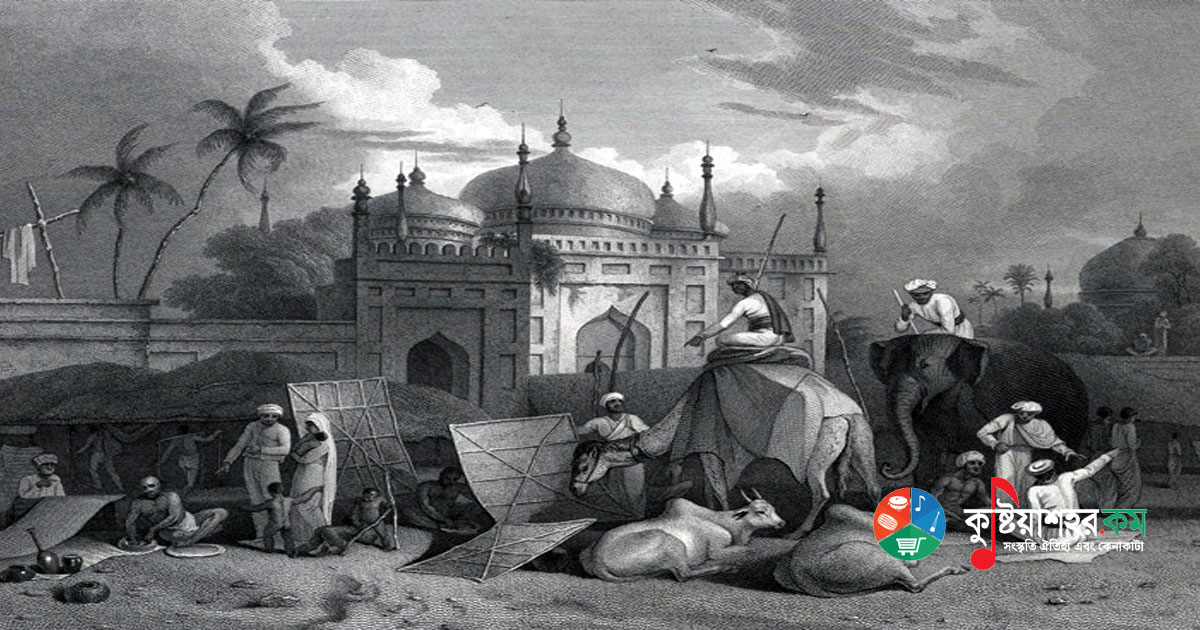
Moger Muluk (the Mugs' domain), Bombete, Harmad and Firingi are proverbial and mocking words widely used in this region and in the Bengali language. Besides, words such as papaya, guava, carambola, badami (almond), amlaki, pomegranate, orange, veranda, borders, bottle, bucket, gamla, perek (nail), mast, typhoon, cannon, pistol, church, padre and mason have come from the Portuguese and the Firingis.
We speak of tying a 'Firingi' hair-knot, and in the context of women's customs and behaviour we say 'Firingi'. Words like camisole, ironing, glass, cupboard, book, printing, syrup and auction — their language has become our language. In this region, lineage terms marking kinds of work, such as Mogo Brahmin, Mogo boatman and Mogo barber, have come from the Mugs. Above all, the naming of Goaland after the Portuguese pirate Sebastiao Gonzales, and the history of Sangram Shah, remind us of the Portuguese and Mug pirates of this region. Before learning about the menace, harassment and plunder of the Mug-Firingi pirates, let us learn about their identity.
The Mugs came from Arakan in Burma. Arakan lies to the south of Chittagong. Formerly it was known as the Arakan kingdom. Its capital was Ramawati, and Arakan remained under Muslim rule. In 1782 AD the Arakan kingdom was seized by the Bamar people. It came under English occupation in 1826. Now Arakan is a division of Myanmar and its capital is Akyab. As Arakan was surrounded by the sea, it was adept in the art of navigation. For trade or warfare the Arakanese would come north to Chittagong, and Sandwip was their main gathering place. They were generally known as Mugs, and their religion was Buddhism. At one time their very trade was banditry. The Portuguese had come from distant Portugal in Europe. In the fifteenth century Vasco da Gama found the route for them to come to this country. Gradually the Portuguese set up small posts at various places along the sea coast of western India. Besides, they established posts in Timor in Indonesia, in Macao in China, at Sandwip in Bengal, and in Goa and Bombay in India. Within a short time they established a fort and a capital in the city of Goa. Bengal was then called the earthly paradise of India. By the middle of the sixteenth century the Portuguese came from western India and began living at Arakan, Sandwip and various places along the sea coast.
At that time there was Mughal rule. The Mughals took strict steps to suppress piracy at sea. At this time the Mugs gave shelter to the sea-savvy foreign Portuguese. The Portuguese loved daring expeditions. Seizing territory, banditry and trade were mixed in their blood. Gradually, coming in groups to Bengal for trade, occupation and banditry for various purposes, they took refuge in the south of Bengal. During the reign of Mahmud Shah the Portuguese received permission to establish trading posts at Chittagong and Saptagram. The Portuguese called the safe place of the navy a port. From this word for port, 'bandel', and from that, the word 'bandit' (robber) originated. The Portuguese who lived in western India were guilty of serious villainy. Fearing punishment they would flee to Bengal. Because they came from Bombay (present-day Mumbai), they were called Bombete. Banditry itself was their trade. Even today in this country people of immoral character and profiteers are called Bombete. This word is in wide use in Rajbari. At that time Sandwip, or Somdwip, was a fertile island in the Bay of Bengal. It was famous for its produced crops and goods, being called the Golden Island, and from that came the name Sandwip. The size of the island then was 14 miles long and 12 miles wide. Sandwip was then the centre of India's main salt trade. Every year more than two hundred ships would carry away loads of salt. Gradually the Mugs and the Portuguese settled there. Muslims had lived there before them. Many of the Portuguese did not bring their wives with them. Gradually they obtained permission to marry in this country. Those Portuguese who had fled to this country for their villainy would marry in this country. Some married more than once, while others kept concubines. They indulged in luxury. Again, many, becoming restless, engaged in banditry. Besides, a good many of the colonial Portuguese in Goa and Bombay, intoxicated with sensual indulgence, produced mixed-race offspring through contact with the women of the natives, and they came to be known as Firingi.
In the middle of the sixteenth century the bands of Mugs, Portuguese and Firingis began such banditry that there was then no governance at all in Bengal. The Mug and Firingi pirates, entering from the south of Bengal by river routes wherever they could into the interior of the country, engaged in plunder, arson and the destruction of the people. The peaceful villages of Bengal were on the verge of turning into cremation grounds. From Barnier's travel account it is known that thieving and banditry were their chief business. Carrying swift little boats, they would penetrate a hundred-odd miles into the country along the rivers and canals. On receiving news of a town, a market, or goods being carried for a wedding, they would attack there and loot whatever they found. Seizing the women, they sold them as slaves.
Setting houses ablaze, the Mug and Firingi pirates came by the waterways and did not merely loot; they seized Hindu and Muslim women and men. They pierced the palms of the captives and drove tough rattan through the holes, and in this way, skewered one after another, they heaped them up below the decks of their ships and carried them off. Just as people scatter rice as feed for chickens, so they scattered handfuls of uncooked morning and evening rice as food. Those who survived eating such food were taken by the pirates to their country and put to hard labour. Many were taken to the Deccan and sold to the Dutch, the English and the French. Their tyranny spread to almost every part of southern Bengal and extended as far as Hooghly. Because of their oppression many places were turned into desolate land. Emperor Shah Jahan drove them out of Hooghly in 1633 AD. From Chittagong to Faridpur they established a reign of terror in this region. Whichever village fell under their rule had no governance. People called such an area 'Moger Muluk'. These sayings still prevail in this region. To suppress them, Raja Pratapaditya of Jessore built numerous forts, and after his death the band of Mug, Portuguese and Firingi pirates raised its head again.
In the middle of the sixteenth century their oppression began under the leadership of Sebastiao Gonzales Carvalho, and it lasted for more than 50 years. The name of the Portuguese fleet at sea was Armada. From that, the Firingi pirates were called Harmad. The word still prevails in this region. In the poet Kankan's Chandi it is said: — 'The land of the Firingi sails on the stream, day and night the dinghy sails for fear of the Harmad.' It is known that Domingo Carvalho, while being driven out of Sandwip, took with him the princess Anjalika Chowdhury, daughter of Raja Kedar Rai of Bikrampur. Domingo Carvalho named a district in the eastern part of Timor after the name of Delhi, the capital of the Indian empire.
Many memories of the Mugs, Firingis and Portuguese still exist. Even today many places in southern Bengal bear names like Firingi canal and Firingir Bazar (Firingi market). The houses or families upon which the Mug-Firingis raided were considered outcast in society, and the families were called Mogo Brahmin, Mogo Vaidya, Mogo Kayet and Mogo barber. Even today people of the Mogo-family class live in places like Bhushna within Magura-Faridpur.
At that time the bands of the Portuguese pirates Sebastiao Gonzales and Carvalho engaged in widespread banditry in the Rajbari region. They would enter this region then along the banks of the Padma. Present-day Goaland was their chief den in this region. The bands of pirates, entering the interior along the banks of the Harai, Garai and Chandana rivers of the Rajbari region, carried out banditry. It is said that two maidservants of Begum Mumtaz Mahal were abducted by the Portuguese pirates. To suppress this tyranny of the Portuguese, in 1632 AD they were besieged under the leadership of Qasim Khan. Many Portuguese soldiers were killed in the war. Though they were defeated, they later merged with the Arakanese Mugs and began their plundering rule in the lowland region. Emperor Aurangzeb sent Mir Jumla to Bengal as its subedar in 1660 AD. At this time, to suppress the Mug and Portuguese pirates of the Rajbari region, Raja Sangram Shah was sent to this region as chief of the Nawara.