বাংলা
 English

Shahjalal (Arabic: Shah Jalal, born 1271 - died 1346) was a famous Sufi dervish of the Indian subcontinent. His full name was Sheikh Shah Jalal Kunyat Mujarrad. He is believed to have come at the age of 32 to the Sylhet region of present-day Bangladesh in 703 Hijri, corresponding to 1303 AD, with the aim of preaching Islam.
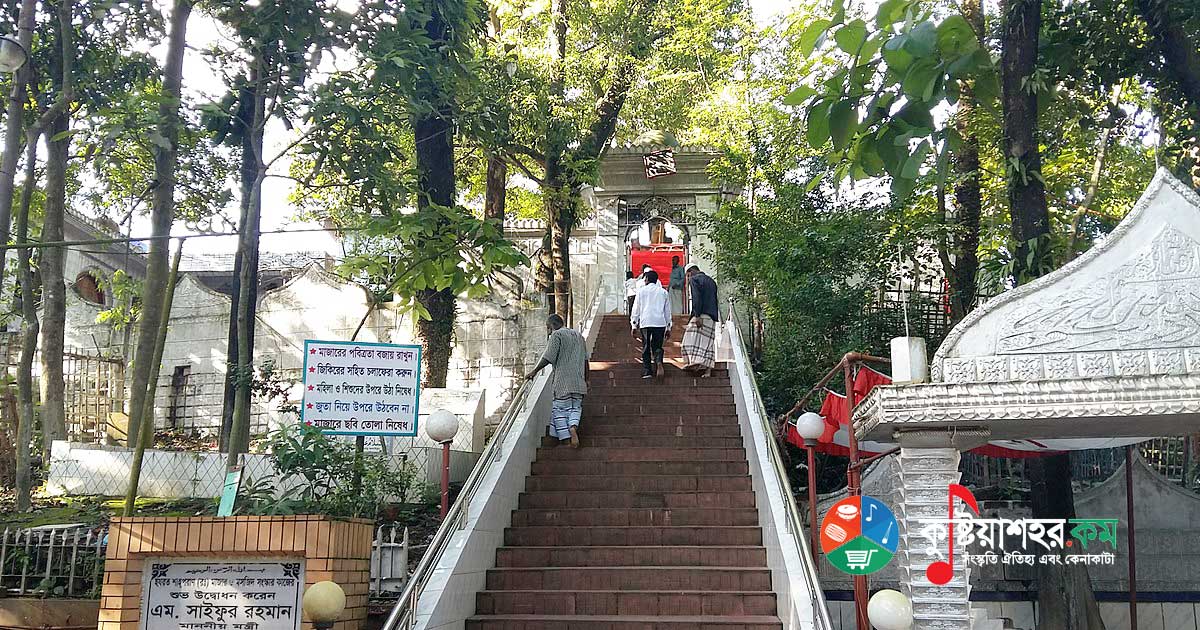
Every year on the 19th and 20th of the Hijri month of Zilqad, a two-day urs is held at the shrine on the occasion of the death anniversary of Hazrat Shahjalal (R.). On the occasion of the urs, more than 20-30 thousand people gather in Sylhet city from home and abroad.
Although there are different opinions about the period of his arrival in Sylhet, the date mentioned in a Persian-language tablet inscription obtained by the khadims (caretakers) of Shah Jalal's shrine is nonetheless considered correct. The Persian tablet inscription is now preserved in the Dhaka Museum. It was through him that Islam spread widely in Sylhet; after the conquest of Sylhet, many pirs and dervishes from among Shah Jalal's companions and followers, and after them their descendants, went and settled in various places of Bangladesh including Sylhet. The arrival in Sylhet of Shahjalal's 360 aulia companions is a notable event in history. After his death he was buried in Sylhet itself.
Early Life
In the last part of the sixth century Hijri, a branch of the Quraysh clan of Mecca left the city of Mecca and settled in the province of Yemen on the southwestern frontier of the Hejaz land. Muhammad or Mahmud of that branch was Shahjalal's father. Mahmud's father was Ibrahim.
According to the tablet inscription obtained from Hazrat Shah Jalal's mausoleum, the Suheili Yamani, Shah Jalal came to Sylhet in 703 Hijri, corresponding to 1303 AD, at the age of 32. From the information given in the Suheili Yamani it is known that Shahjalal was born in 671 Hijri (1271 AD). His birthplace was the city of Kuniya in the then province of Yamman of the Hejaz land of the great ancient Arabia. Shah Jalal's mother died when he was only a three-month-old infant.
Shah Jalal lost his mother in childhood and lost his father at the age of five. His maternal uncle Ahmad Kabir adopted him. Ahmad Kabir taught him the Quran and Hadith in Arabic and stressed familiarity with the fundamentals of Islam (prayer, fasting). Later Ahmad Kabir took Shah Jalal from Yemen to Mecca. Ahmad Kabir had an astana (hujra) in the city of Mecca. It is known that there he strove, along with his other disciples, to give Shah Jalal a proper education.
His Guru
Shah Jalal's maternal uncle and preceptor was Sheikh Syed Ahmad Kabir Sohrawardi, generally known as Ahmad Kabir. Syed Ahmad Kabir's father's name was Syed Jalal Surkh Bukhari. Before Shah Jalal's birth, Syed Jalal Surkh Bukhari came to Auch near Multan to preach Islam in India and breathed his last there. Syed Jalal Surkh Bukhari, the father of Syed Ahmad Kabir Sohrawardi, was his murshid (spiritual guide).
The list of the spiritual ancestors of Shah Jalal (R.) is as follows:
- Hazrat Muhammad (S.)
- Hazrat Ali (R.)
- Sheikh Hasan Basri
- Sheikh Habib Ajmi
- Sheikh Maruf Karkhi
- Sheikh Singri Sukti
- Sheikh Mumshad Sikandari
- Sheikh Ahmad Dinnuri
- Sheikh Amubiya
- Sheikh Aji Uddin Sohrawardi
- Sheikh Abu Najib Ziauddin
- Sheikh Hisab Uddin
- Sheikh Makhdum
- Sheikh Bahauddin Zakaria
- Syed Jalal Surkh Bukhari
- Syed Sheikh Ahmad Kabir Sohrawardi
- Shah Jalal.
Spirituality
It is known that Ahmad Kabir's main aim was to initiate Shah Jalal into the Sufi doctrine; that is why Ahmad Kabir brought Shah Jalal to Mecca. At that time Ahmad Kabir was the chief supervisor of the khanqah (mystic school) founded in the city of Mecca by Sihabuddin, the establisher of the Sohrawardi order. Ahmad Kabir initiated Shah Jalal into the teaching of both the shariat and the marifat streams of Islam.
The Dervish Life
By birth Shah Jalal was born into a dervish family. It is known that his father was a devout mujahid who was killed in a religious war in Yamman, and on his mother's side he was the grandson of the famous dervish of the Syed line, Syed Jalal Surkh Bukhari. Moreover, the dervish Ahmad Kabir was his maternal uncle, who served as his teacher; it is recorded that he too was a famous dervish of the time. From the time Ahmad Kabir took on the responsibility of raising Shah Jalal, it is also found that from childhood he taught him the ways of living the dervish path of life.
The Arrival in Sylhet
Shah Jalal Mujaradd was in the Arab lands at the astana of his maternal uncle and guru Syed Ahmad Kabir. After Shahjalal dreamed of preaching religion in India, he expressed it to Syed Ahmad Kabir. He informed his uncle and murshid Syed Ahmad Kabir. Kabir interpreted this dream and advised Shahjalal to go to India. At the time of departure, Kabir placed a handful of soil in Shah Jalal's hand and said: at the place where the "taste", "smell" and "color" of this soil match, build an astana for preaching the faith. With the blessings of his murshid Syed Ahmad Kabir (R.), Shah Jalal (R.) set out alone from Mecca Sharif in Arabia on his expedition of preaching religion.
Entering Hindustan
Of the few companions who traveled with Shah Jalal when he took leave of Mecca, the chief ones were Haji Yusuf, Haji Khalil and Haji Daria, and another companion, Chashni Pir, was the custodian of the soil. Before entering Hindustan, Syed Omar from Samarkand, Karimdad from Rome, Nizam Uddin from Baghdad, Iran, Zakaria and Shah Daud and Syed Muhammad among others became his followers. With them he entered Hindustan. Then Arif from Multan in the Punjab, Junaid from Gujarat, Muhammad Sharif from Ajmer Sharif, Syed Kasim from the Deccan, Halim Uddin of Madhya Pradesh and others became his murids and traveled along with him. By the time he reached Delhi in this way, the number of his disciples was believed to be 240.
Meeting Nizamuddin Auliya
After coming to Delhi, a disciple of Nizamuddin Auliya spread slander about Shah Jalal to the guru. Nizamuddin immediately drove out of his court, as fitting punishment, this slander-spreading disciple, and summoned two other disciples and sent his greetings to Shah Jalal through them. In reply to the greeting, as a token of affection, Shah Jalal sent Nizamuddin Auliya a small box containing some cotton placed among burning embers. Recognizing Hazrat Shah Jalal's spiritual power, Nizamuddin Auliya invited him warmly to a meeting. At parting, as a token of affection, Nizamuddin Auliya presented him with a pair of surma-colored pigeons. The surma-colored pigeons seen in the area adjoining the shrine are descendants of those pigeons, known as Jalali pigeons.
Meeting Sheikh Burhan Uddin and the Expression of Sorrow
It may be noted that, according to the descriptions of Islam Jyoti and various other historical texts, a Muslim settlement grew up in Srihatta through the Turkish conquest. At that time Muslims had settled in the Tultikar mahalla of Sylhet and in Taraf of Habiganj. At this time there was in the Gaur kingdom of Srihatta a tyrannical king named Gaur-Govinda. Burhan Uddin, a Muslim inhabitant of the Gaur kingdom, was declared guilty before the Hindu king of Gaur, Gaur Govinda, for slaughtering a cow on the occasion of his son's birth festival. For this reason Govinda seized Burhan Uddin's infant son and killed him. When Burhan Uddin went to Shams Uddin Firoz Shah, then king of Bengal, and complained of this cruel killing, the king sent his nephew Sikandar Gazi to the Gaur kingdom of Srihatta with a huge army. When the royal troops tried to cross the Brahmaputra river, King Govinda frustrated the entire attempt by hurling fire arrows at the Muslim soldiers with the help of uncanny powers. When the news of Sikandar Gazi being repelled and his mission left unfulfilled by Govinda's magical powers reached Emperor Alauddin Khilji of Delhi, the emperor was grief-stricken by the news. Later the emperor, in consultation with the astrologers along with his court officials and ulama, learned that there was a man of spiritual power in the Sultan's army, and that if the expedition were sent under his leadership it would be possible to counter Gaur-Govinda's sorcery and conquer Sylhet or Srihatta. As a way of identifying that man of spiritual power, the astrologers also said that within the next one or two nights a terrible storm and rain would flood the whole city of Delhi, severe damage would be seen in every house, and nowhere would there be a lamp alight - except a single tent. Following the astrologers' words, the emperor made a search and, on that stormy night, discovered an ordinary soldier sitting absorbed in reading the Quran in a tent. The emperor went there, learned everything about him, and requested that he lead the Sylhet expedition. When Syed Nasir Uddin agreed at the emperor's command, the emperor sent him to Sikandar Gazi by conferring on him the sanad of Sipahsalar. Meanwhile, Gazi Burhan Uddin was then staying in Delhi. At this time Shah Jalal also came to Delhi with his companions. According to the historian Azhar Uddin, it was in Delhi that Shah Jalal met Burhan Uddin, and here Burhan Uddin narrated his sorrowful tale to him.
Meeting Sipahsalar Nasir Uddin
From Delhi Shah Jalal set out for Sylhet with Burhan Uddin and 240 companions. When Shah Jalal reached Satgaon, near Triveni he joined the vanguard sent by the Emperor of Delhi, Sipahsalar Syed Nasir Uddin. Learning about Shah Jalal, Syed Nasir Uddin expressed his desire to become his disciple. Along the way Shah Jalal's disciples kept growing. After Triveni, on coming to the province of Bihar, a few more warriors joined his company, among whom Hisam Uddin and Abu Muzaffar were notable. From here Shah Jalal, with his own companions and with the one thousand cavalry and three thousand infantry brought by Sipahsalar Syed Nasir Uddin, set out toward Sonargaon with the aim of joining Sikandar Gazi.
Meeting Sikandar Gazi and Crossing the Brahmaputra
As soon as Shah Jalal arrived at Sonargaon he met Shah Sikandar Gazi. Sikandar Gazi received Shah Jalal with honor. Shah Jalal, arriving at Shah Sikandar's camp with his companions, attendants and troops, learned all matters concerning the war from Sikandar. Inspired by Shah Jalal's ideals, Sikandar took discipleship and set out toward Sylhet. Thus Shah Jalal's disciples grew to 360. Meanwhile Gaur Govinda, learning through his spies of Shah Jalal's arrival, closed all river navigation so that this new band could not cross the Brahmaputra. Shah Jalal's devotees believe that with his disciples he crossed the Brahmaputra unobstructed with the help of his prayer mat.
Entering Sylhet
In the tenth century AD the land of Srihatta was divided into three independent kingdoms named Laur, Jayantia and Gaur. Of those kingdoms Gaur was considered one of the principal ones. As the ancient boundary of this kingdom extended over present-day Moulvibazar district together with part of Habiganj district, King Govinda's outpost stood beside the Dinarpur pargana of Nobiganj on the southern frontier of the Gaur kingdom. Shah Jalal, with his companions, after crossing the Brahmaputra, first took position there. Here the frontier guards of Gaur tried to repel them by using fire arrows; but they could do no harm to the Muslim soldiers. Learning all this and finding no alternative, Govinda declared boat traffic on the Barak river prohibited. As before, Shah Jalal crossed the Barak river with the help of his prayer mat. After crossing the Barak river via Bahadurpur, he spent the night at a place called Fatehpur in present-day Balaganj upazila of Sylhet district. The ancient book containing the above information, Twarikh-e-Jalali, records:
A pargana named Dinarpur was the outpost there
Its boundary was of the old Musur
When he arrived there
Then King Govinda got the news.
Hazrat came with his troops on this side
And arrived on the bank of a river
There was a river named Barak of Musur
Near which was the village named Bahadurpur.
When he reached the river's bend
He crossed that river without a boat.
When King Gaur-Govinda, adopting every kind of stratagem, saw that all his efforts were coming to nothing, he made a final attempt and sent a huge iron bow along with a magic incantation to Shah Jalal; the condition was that if anyone alone could string that bow, Govinda would leave the kingdom. Shah Jalal called his band's men and said: only the person who had never in his whole life missed or skipped the fajr prayer would be able to string Govinda's iron bow. Then, searching within the Muslim troops, Sipahsalar Syed Nasir Uddin was found worthy, and it was he who strung the bow.
Crossing the Surma River
On entering Bangladesh, the Barak river of northeastern India splits into the Surma and Kushiyara rivers. These rivers, which must be regarded as the encircling boundary of the Sylhet division, flowed with mighty currents in ancient times. In the monsoon the scene looked almost like a sea. The historical traveler Ibn Battuta called the Surma river Nahri Azraf. When Shah Jalal traveled from Fatehpur and took position on the bank of the Surma, it was by crossing this river that one reached the capital of Gaur. King Govinda was disheartened by the karamat (miracles) and various wondrous events of Shah Jalal Auliya. To hold back the enemy forces for some time, Govinda prohibited boat traffic on the Surma river. Even so, Shah Jalal crossed the river.
Saying Bismillah, Shah Jalal took all his murids onto his prayer mat and went effortlessly across to the other side of the river.
Govinda abandoned his royal residence at Gharduwar and took refuge in the hidden hill fort of Pechagarh. From then on no trace of him was ever found. After staying in Sylhet for three days, Shah Jalal first took possession of the royal residence situated on the mound of the minar.
The First Call to Prayer in Sylhet
In Sylhet city the first azan was given by Sipahsalar Syed Nasiruddin at the command of Hazrat Shahjalal (R.).
Gaur Govinda Goes into Hiding
Learning of Gaur-Govinda's persecution of Muslims, Sultan Firoz Shah of Bengal at that time sent an army against Gaur-Govinda, but when the first expedition failed, Firoz Shah, with the help of Sikandar Shah, sent a general named Nasir Uddin against him. At this time Shahjalal was staying at Sonargaon with his army; the two forces marched against Gaur-Govinda under Shahjalal's leadership, and hearing the news Gaur-Govinda fled.
Residential Hotels for Staying in Sylhet City:
- Hotel Metro International (Bandor, near Shishu Park): 01731533733, +8808212833404
- Hotel Nirvana Inn (Ram's Dighir Par, Mirza Jangal, Sylhet): +8808212830576, 01730083790, 01911720213, 01711336761
- Hotel Star Pacific (East Dargah Gate): 01713674009, 01937776633, 0821-2833091
- Hotel Anurag (Dhopa Dighi North): 715717, 714489, 01712093039
- Surma Valley Guest House (beside the District Administrator's/Police Superintendent's office): 01716095836
- Hotel Urmi: east of the Hazrat Shahjalal (R.) Shrine Sharif's east dargah gate, Sylhet, phone: 0821-714563, 01733153805
For food there are quite a few good restaurants in Sylhet's Zindabazar. The restaurants are Panch Bhai, Panshi, Bhojonbari, Spicy and Palki. Besides, Undal, East Zindabazar, Sylhet, phone: 0821-2832197, 01717020505, Exotica Restaurant, Hotel Supreme, Jaflong Road, Mirabazar, mobile-01711197012, and Alpine Restaurant, Chouhatta, Sylhet are notable.
How to Get There from Kushtia:
There is no direct transport from Kushtia to Sylhet. Coming from Kushtia to Dhaka or Tangail by bus, one can go on from here by many means. Coming from Kushtia to Dhaka by train or bus, you will find many vehicles for going to Sylhet. You can go by air, by rail and by road. Getting off at Sylhet railway station or the Kadamtoli bus stand, you can reach the shrine by rickshaw or CNG auto-rickshaw. Rickshaw fare 20-25 taka, CNG fare 80-100 taka. To reach the shrine one must come into the main town across the Surma river. Tourists can go by rickshaw or CNG. Fare 30-50/- taka.