বাংলা
 English
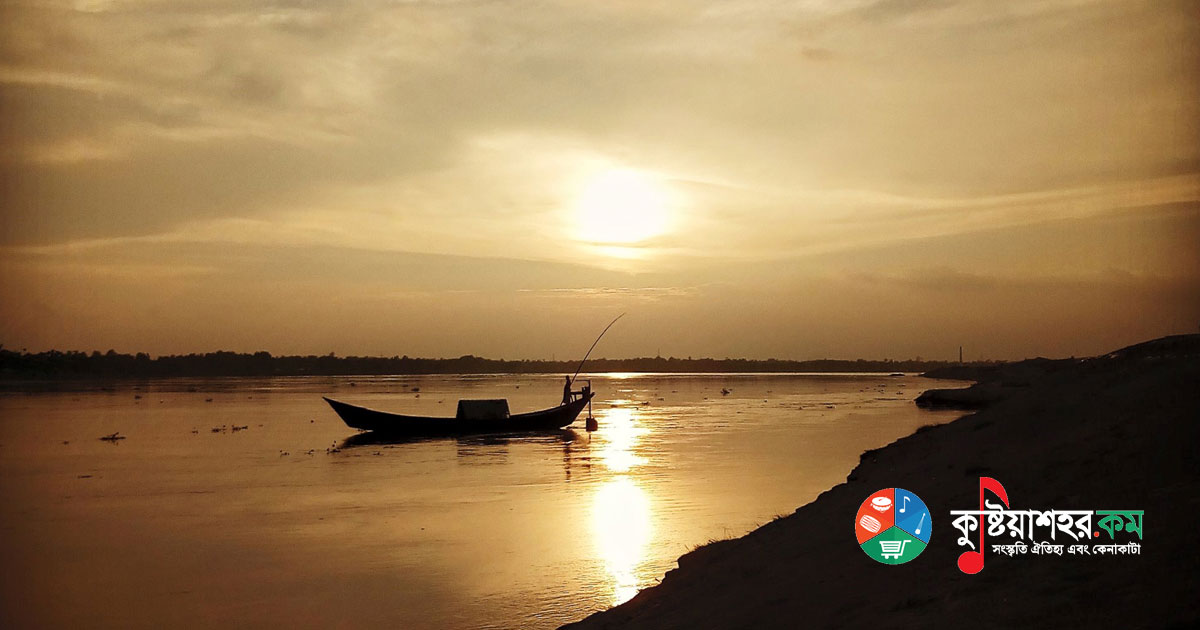
Gorai is known as Gauri at its birthplace. The first birth of the Gorai was from a beel of Amala Sadarpur of Kushtia. Flowing east from the sanghata of Lahini Para of Gorai Jananabad, passing Kumarkhali, Khoksa, Hijlabad, Jalsuka, Langalband, Amalasar and Taraujal, and in course flowing south toward Narua of Samadhinagar and Kamarkhali, at last, in the form of the Madhumati, Elanjani and Baleshwar, it falls into the Bay of Bengal.
Ancient lore about the birth of the Gorai river exists along with names such as Kushtia's Kuridaha, Patiladaha, Chengenardaha and Dakdaha. It is said that beside the beel of Amala village in Kushtia there lived a Brahmin. This Brahmin had a maid-servant. Her name was Gauri. One day the Brahmin went to bathe in the pond six miles away. Crossing over there, Gauri took a flower to offer to Mother Ganga. Returning from the bath in Ganga at the proper time, the Brahmin forgot to give Gauri's offering. When the Brahmin wished to return home and had gone some distance, seeing rainwater accumulated in a pit made by a cow's hoof, he thought, let me offer it right here - who is watching anyway? There, the moment he offered the flower, Mother Ganga herself stretched out her hand and accepted it. Amazed at this, the Brahmin thought Gauri was no ordinary girl.
Returning home he sat weeping holding Gauri's feet. At the very moment of asking his wife the reason, Gauri, in the very condition she was in, began to move far away carrying a winnow and a palm-leaf mat. Even while the Brahmin followed her making her walk, Gauri kept moving keeping the same distance, and the Brahmin, taking aim, splashed beel-water behind Gauri. Thus on Gauri's path the river was created and Gauri was lost. Where Gauri dropped the winnow became Kuridaha; where she dropped the mat from her hand became Patiladaha; where the Brahmin called her from behind became Dakdaha, and where she called out aloud became Chengenardaha. This may be folk-lore, but Kushtia's present-day channels recall that Gauri or the Gorai river once flowed through all these places. The Gorai was once a very swift-flowing and much renowned river. In the fourteenth and fifteenth centuries the river's course was not its present one. This river then flowed four or five miles north of its present course.
As evidence it is said that the present haor of Sirajpur (west of Kasba mauza, south of Pangsha thana) is the old adjacent course of ancient Gorai, though it merged into the Gorai from the Gorai. The haor of Sirajpur is an old course of the Gorai. Besides this, the Chitra river extracted from the haor of Sirajpur merged again into the Gorai at the ghat of Naldanga; its former course is visible. The ancient Gorai flowed straight from the haor of Sirajpur two or three miles north of the present course, across tilled fields, and at that time flowed eastward through the west of Baliakandi.
Due to the change of the river's course, its old flow has turned into the Tedala, Pakuria and Kachmia beels. The present Elangi and Tekati have become the Bhatikhali flow - that was the old flow of the Gorai river. Madandangi and Badshadangi are mainly the dangi or char of the Gorai. Even fifteen or twenty years ago the Gorai's flow was very strong. Plenty of ilish fish were caught in this river and its ilish had a distinct taste. Forty or fifty years ago there were crocodiles at the Naldanga ghat of the Gorai. Along the Gorai, the trade of this region once spread through this route. Baliakandi, Samadhinagar, Narua, Mrigi, the jute of Pangsha, onion, garlic, sesame and other crops were dispatched by this route to Calcutta and Khulna.
Information courtesy: - Rajbari Cyber Research Institute - Professor Motiar Rahman, Bedanga-1, Rajbari