বাংলা
 English
Kushtia district played a pioneering role in Bangladesh's War of Independence. On 3 March, the first flag of independent Bangladesh was hoisted in Kushtia. On 17 April 1971, at Baidyanathtala (present-day Mujibnagar in Meherpur), then a border area of Kushtia, the first government of the People's Republic of Bangladesh was sworn in. Under the leadership of this government, Bangladesh's great Liberation War was waged over nine months. On 11 December 1971, Kushtia was finally freed from the occupiers.
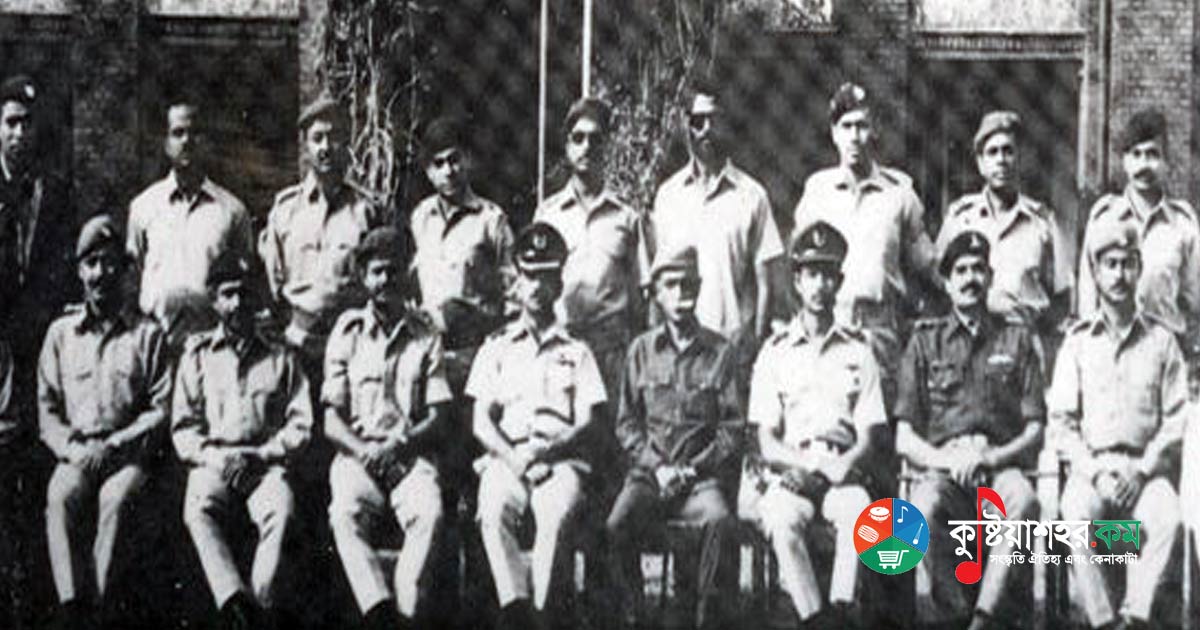
Gallantry-award freedom fighters of Kushtia
Kushtia has 10 freedom fighters honoured with gallantry awards. Among them are 2 Bir Uttam, 1 Bir Bikram and 7 Bir Protik.
The two Bir Uttams
- Martyr Group Captain Sharafuddin Ahmed Bir Uttam
- Martyr Sepoy Abu Taleb Bir Uttam
The one Bir Bikram
- Martyr Saifullah Khaled Tarek Bir Bikram
The seven Bir Protiks
- Martyr Didar Ali Bir Protik
- Abdul Alim Bir Protik
- Martyr Md. Shamsuddin Bir Protik
- Martyr K. M. Rafiqul Islam Bir Protik
- Martyr Golam Yakub Ali Bir Protik
- Martyr Habibur Rahman Bir Protik
- Major General (Retd.) Anwar Hossain Bir Protik
Roni Rahman was the first martyr in Kushtia during the War of Independence
The name of Kushtia's first martyr in the War of Independence is Roni Rahman. On 27 March 1971, just as he was about to throw a hand grenade at a convoy of Pakistani army vehicles in front of the Civil Surgeon's Office in Kushtia, Roni Rahman was killed by the bullets of Pakistani soldiers.
He was born in Kurigram, in the former greater Rangpur district, on 12 November 1949. His father was Mostafizur Rahman, a teacher at Rangpur District School, now deceased, and his mother was Rahima Khatun, also deceased. They were six brothers and sisters; Roni was the youngest of them all.
In 1970, while a student of the BA class at Rangpur Government College, he hoisted a red-and-green flag at the Rangpur Press Club on the night of 21 February, along with fellow students Runu, Jaynal, Poka and several other friends. When this news reached the ears of the Pakistani rulers, an arrest warrant was issued in his name on a charge of sedition. On the evening of 9 December, taking some cash and clothes from his elder brother through an intermediary, he secretly set out. He then took part in relief work for distressed people in various districts including Khulna, Jhalokathi, Barishal and Patuakhali, and finally on 17 December he came to Kushtia, to the home of his eldest sister Ruha Afzar (wife of Md. Najm Uddin Ahmed) at Sadr Uddin Mansion. Here too he became active in the anti-Pakistan movement.
On the night of 25 March, a company of soldiers of the 27 Baluch Regiment entered Kushtia from the Jessore cantonment and began a monstrous massacre. In protest against this, and to take revenge, Roni Rahman in the darkness of night broke the lock of the science laboratory of Kushtia College and brought out explosives. Together with his fellow fighters he made hand grenades out of them. He had learned that the Pakistanis travelled along N.S. Road. To attack them, at around ten o'clock in the morning of the next day, 27 March, taking several companions including Abdul Jalil, Komor Uddin, Shamsul Hadi, Motiur Rahman Moti, Raja, Anis and Hossen, he assembled below the Nizamatullah Sangsad. Leaving everyone below, he went up onto the roof of the Nizamatullah Sangsad with bombs and waited.
Around half past ten in the morning, the vehicles of the Pakistani forces kept advancing. Suddenly, from the roof of the Municipality Market, a boy of some 8 or 10 years threw a stone at the vehicles and ran away. Several soldiers climbed onto the roof of the building and began searching for the stone-thrower. At that moment they spotted Roni Rahman, poised to throw a bomb, and fired at him. One of the soldiers' bullets struck his head. He was martyred on the spot. A little later the Pakistani soldiers took his body away. Afterwards Roni Rahman was buried in the municipal graveyard of Kushtia.
The news of Roni Rahman's martyrdom reached his home afterwards through the bulletin of Swadhin Bangla Betar Kendra. At the very moment his death was being announced, his mother was eating rice. The other members of the family, who had been listening to the radio, switched it off right then. The account of Roni Rahman's martyrdom thus remained undisclosed to his mother. The story came to light through Roni Rahman's elder brother Dewan Masudur Rahman. He further said that after the nine-month Liberation War, when the freedom fighters were saluting his mother, she was looking for Roni among the crowd; and when the news of Roni's death was given to her at that moment, she was grief-stricken and wept for many days.
Every year the people of Kushtia observe the day with due dignity, organised by the Bangladesh Muktijoddha Oikya Parishad.