বাংলা
 English

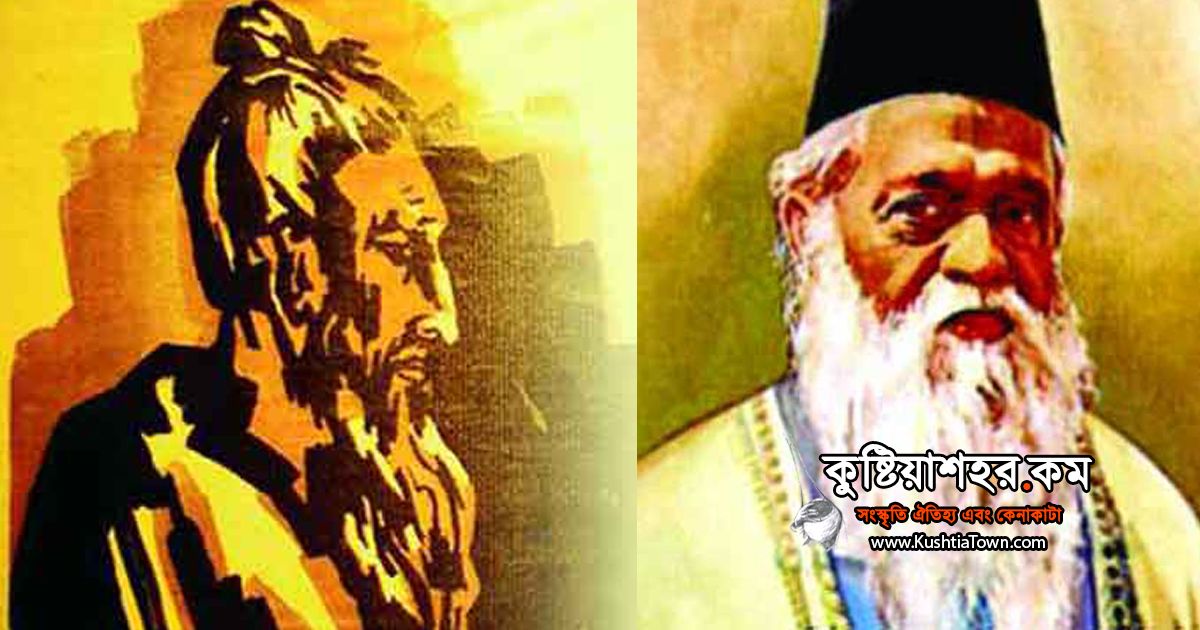
Lalon is a fakir-darvesh, a Sufi saint; Lalon is a Vaishnava, a tantric or a poet of metaphysics; Lalon is Hindu or Muslim — as to who and what he really is, there is no end to the hesitation and dispute. As a preface to this essay, let it be enough for now if we say that Lalon was a Baul, a Baul of doctrine. Step by step we shall try to uncover Lalon's true form.
Lalon was indeed a Baul; it would not be an overstatement to call him the greatest of Bauls. Baul song is a special limb of Bengal's folk culture and folk tales. It draws its nourishment from Bengal's own climate. Baul songs were composed mouth to mouth by a class of rural folk — unlettered, half-lettered, so-called uncultured. The Baul class did not arise to teach moral lessons to country people wrapped in the mantle of religion or folk custom, as is seen in the case of certain other folk songs — gambhira, bhadu, tusu, murshidi and so on, for example. Though Baul songs were sung in rural colloquial speech, the profound metaphysics hidden layer upon layer within them does not take long to see. Fakir Lalon's Baul songs are the supreme example of this. 'Listening to the words of doctrine, taking the essence of doctrine, and thinking on matters of doctrine — that was his central aim. To express the knowledge gathered in his heart through long spiritual sadhana, he took to melody and metre; for that reason he has been called a poet of doctrine.' In a word, Lalon was a 'mystic' — mystic in the sense in which Vaishnavism and Sufism are 'mystic', and in just that sense Lalon's meditations and beliefs are 'mystic'. 'Mysticism' lies latent to some degree in all Baul songs, but in Lalon's songs it takes another form, blazing at a different pitch.
Setting aside Baul song and its history, no true appraisal of Lalon's metaphysics and philosophy can be made. To grasp the line of Lalon's life and work rightly, one must look once at the historical background of Baul song. No one knows rightly who or what the founder of the Baul community was. This much can be said: the Baul fakirs or gurus were not followers of any particular religion. People of both the Muslim and Hindu communities belonged — then and now — to the Baul community. The names of a few famous fakir gurus may be mentioned here, such as Hariguru, Bonchari, Akhil Chandra or Pagla Nath, Saheb Dhoni and the like. One thing deserves special mention in this regard: all these fakirs or gurus lived in Nadia district, and almost all of them belonged to the period after the sixteenth century. For this reason many researchers think the Baul community arose in that very Nadia. From the most ancient times down to the thirteenth century, Nadia was the cultural centre of undivided Bengal. Towards the end of the thirteenth century Muslim rule began in Bengal through Bakhtiyar Khilji. The Sufi influence was then everywhere in Bengal.
In Sufi thought and idealism the oppressed and bewildered people of rural Bengal found their direction. Many researchers even think there was a Sufi influence in Chaitanya Deva's school of feeling. Jayananda, author of the 'Chaitanya Mangal', has said that in that time many brahmins read Jalaluddin Rumi's 'Mathnawi'. Krishnadas Kaviraj's book 'Chaitanya Charitamrita' records Chaitanya's meetings with pirs and darveshes. The Chaitanya Bhagavata says that when Mahaprabhu's ecstasies arose, 'Muni sei muni sei kahi kahi hase' — "I am he, I am he, saying it, saying it, I laugh" — which is akin in meaning to the Sufi thought of 'Ana'l Haq' (in sense, "I am the truth"). In the words of the noted critic Pramatha Choudhury: 'Through Chaitanya Mahaprabhu, this neo-Vaishnava faith of mediaeval India is a mere new branch of the eternal Hindu religion. But the cause of this newness is the influence of the Muslim religion. Who does not know that the Muslim religion is chiefly a religion of single-minded devotion? The reason the Vaishnava faith of mediaeval India lay so close to the Muslim religion is that for five hundred years the Hindu and Muslim religions had been living side by side.'
The monotheistic, idol-shunning idea of thought within the neo-Vaishnava faith has much in common with Sufi thought. When references to Baul sadhaks appear around Nadia in the sixteenth century, one may naturally suppose that the impress of Vaishnava thought and Sufi idealism lies within this community. In Baul doctrine the call to know oneself is repeated again and again — somewhat a reflection of the Upanishadic 'atmanam viddhi' or of the Greek philosopher Plato's thought, 'know thyself'. Where the Vaishnavas seek to arrive through love of Krishna, and Sufi doctrine seeks to know 'the One and Only', the metaphysician Baul could give that neither name nor mark. So he called him 'the man of the heart', sometimes simply 'the mind', and sometimes again 'the unknown bird'. The ache to know and to break through the mystery of that ungraspable unknown rings through line after line of the Baul songs.
'Aleek — in the seed of the universe the Shai resides in aleek
in the aleek he takes his tidings, in the aleek he utters his word.
In the aleek, eternal, forever afloat in man's rasa
Baul, your course has caught there — you shall not escape it'.
In this connection the word 'aleek shai' is perhaps a corruption of 'alakshya swami', the unseeable lord. Like the Sufi saints, the Baul too wishes to break through the unfathomable mystery of knowing and recognising that unknown — through love, which burns in the depth of the mind like a fire in a wisp of chaff, always. In this fire of love the Sufi darvesh becomes mad, and the Baul too becomes distraught, unmoored. The Baul's state of unmooring is found in his song:
'How long more will the shai of my going, the tender one, stay?
I wander country and abroad — where else shall I find him?
For whom I have gone mad — where shall I find him?
The fire of the mind burns double — with what shall I put it out?'
Through this ecstasy of love the Baul is forever trying to know that unknown mystery. Naturally he cannot. So, like the Sufi or the Vedantin, he turns his gaze inward. That is why he can say — 'what is not in the body is not in the universe'. Here 'bhand' means this body. With this thought the Sufi idea of 'qurbat' coincides. Thus within Baul thought there is, on one hand, Vaishnava love-doctrine mingled covertly, and on the other, the Sufi idea of self-realisation. The Baul believes with all his heart that this unknowable, ungraspable one is nowhere else — not in the temple, not in the mosque, not in the church — but within the shell of this very body. Though he is mysterious, if called rightly his response can certainly be had.
'Man moves in the wind, returns in the wind, abides with the wind.
Within the body dwells the golden man — called, he speaks'.
To break this mystery the Baul has recourse to the guru or murshid, just as the Sufi devotee goes to the pir's door. Set, formal religious observance is not the Baul's way. Pilgrimage, worship and rites and rituals are as much to be forsaken by the Baul as by the Sufi.
'I have neither temple nor mosque
neither puja nor Bakrid
grain by grain my Mecca and Kashi
particle by particle, the true direction'.
Like the Sufi sadhak and the Hindu metaphysician, the Baul too believes the world is maya. This earthly life is a mirage. That is why the Baul builds around himself an attitude averse to earthly life. Here the Baul is distinct from the Sufi follower or the Hindu thinker. Despite much coincidence with Sufi thought, the Baul is seen to fashion a manner and rule of his own. He depends on no caste or community. His own path is lit by the light of his independent thought. By comparison, Sufism is visibly and completely dependent on Islam. Since Sufi idealism leans on 'Allah', their conception of the 'supreme goal' is much clearer. In this regard Baul philosophy sinks deep in the darkness of uncertainty.
From so many coincidences — whether accidental or deliberate, one may suppose — Baul doctrine is built on the foundation of Vaishnava love and the Sufi monotheistic self-inquiry and self-realisation.
Keeping this context of Baul idealism in mind, it becomes much easier to throw light on the life-example of Lalon Shai, the greatest of Bauls. From his boyhood he was moving outside the conventional religious communities and caste-based ideas, along a path of non-communal belief. In later life this attitude took its place at the centre of Lalon's philosophy and thought. So in mature age he could say —
'Lalon says, what the shape of caste is, I have not seen with these eyes.
Some wear the garland, some the rosary — for that reason they say the castes differ.
At going or coming, whose mark of caste remains?'.
That this philosophy of Lalon's is exceedingly revolutionary and relevant in the face of today's communal strife and hatred, there is no doubt. The place of Lalon's akhra at Cheuria in Kushtia was once part of greater Nadia. It has been said already that in ancient Nadia Vaishnavism and Sufism had ample influence, whose impress we notice in Baul song. Being a man of that place, it is natural that the influence of Vaishnava devotion and Sufism would remain in Lalon's thought as well. Like the Sufi saints he too thought that within knowing oneself lies the key to breaking the mystery of the world. That 'unfathomable unknown' dwells in this very body-temple of ours. Within the shell of this body. The body is a medium and a carrier — nothing more. The body will perish, but from body to next body the comings and goings of the 'unknown bird' will continue. Lalon's meditation here runs parallel to the philosophical thought of the famous philosopher and mathematician Descartes. Descartes said — 'cogito ergo sum', or in plain words, 'I think, therefore I exist'. Existence as the holder and carrier of thought belongs to this body. Lalon too said —
'How does the unknown bird within the cage come and go'.
The day this cage (the body) falls away — 'Lalon says, the cage opened, where does that bird flee to?'. In short, the body will be destroyed, but the soul and mind will remain. In the Gita Lord Sri Krishna said 'vasamsi jirnani yatha vihaya' and so on. As a worn-out nest is abandoned the bird changes its nest; when this cage of the body falls, the bird, freed, changes its abode. This spiritual thought is so eternal that where is the place here for religion and caste? That is why it is difficult to bind Lalon's philosophy of thought within the bounds of any conventional religion.
Lalon had a great disinclination for temples and mosques. Bauls have always opposed institutional religion — this has been said before. No need to go to any place of pilgrimage. This body itself is the last of all mosques, the last of all temples. So Lalon says:
Primeval Mecca dwells in this human body
look, O mind, have you not seen
running from land to land,
why do you pant, dying?'.
He says — 'The ten-doored man is Mecca
sink into the guru's feet and see your self
managing the shock
Fakir Lalon says, that is the hidden Mecca
the first Imam is that spire'.
To the Baul the temple is this body, the mosque is this body, Mecca-Medina-Kashi-Brindaban is this body. Here lies the contrast between Sufi philosophy and the philosophy of Lalon or the Baul. Only the Baul attempts to catch that 'spire' through the human body.
It is well to mention here that the Bauls were almost destitute in the so-called learned society and the upper strata of society. Rabindranath reawakened people's interest in this community. Rabindranath and Lalon lived on earth at nearly the same time. He was influenced by Lalon's influence to such a degree that Baul philosophy took a special place in his poetic thought. It is heard that Rabindranath even sent for Lalon to meet him, though Lalon did not go. In any case, the reflection of Lalon's thought is seen in his song:
'Hidden you were within my heart
to see you I could not, to see you I could not'.
Or when he says, 'The man of my breath dwells within my breath, that is why I see him everywhere',
then Lalon-Rabindranath-Descartes-Plato — Sufi and saint — all fuse into one. The ideal and thought of humanity is the root of this thought. Through knowing and recognising oneself one will know 'Him' — no institutional religious observance and the preaching and judging of the discrimination that comes of it are needed. This is what Lalon reflected through his whole life and thought.
Turning about, it has been said many times in this essay that in Lalon's Baul thought there is a deep influence of Bengal's mediaeval neo-Vaishnava thought and Sufi idealism. Since Nadia district is the land of Lalon's akhra, there is no reason to think this influence could easily be avoided. Because of the many resemblances with Sufi idealism, many have called Lalon a Sufi sadhak too. Recent researchers have said outright on this point that Lalon was not a Sufi. Why? Sufi philosophy is, first and chiefly, a spiritual thought grown within the religion of Islam. The Sufis admit the existence of none but 'Allah'. Through immense devotion to Allah the Sufi sadhak wishes to attain that 'Supreme'. Here Lalon's thought stands at the opposite pole. Lalon and Baul philosophy believe in nothing except the attempt to know the 'mind-bird', the 'man of the heart', dwelling within the human body. In that thought there is no Allah, no Krishna. Man, to him, is Allah. So he can say:
'Who understands your surpassing play, O Allah
you yourself call Allah, saying Allah'.
In that sense Lalon was not a priest of religion like the Sufis. Farhad Mazhar said in an interview that Lalon is wrongly called a Sufi because his songs carry an abundance of Arabic words and the reflection of Islamic thought. But with the greatest care he kept himself apart from the Sufis and created an independent philosophy, far from conventional Islam. Look for Allah, for the 'unknown bird', within this human body — nowhere else, at no other place of pilgrimage.
To the question we had at the beginning of the essay there can be only one answer. Lalon's thought and philosophy are an independent thinking steeped in Sufi philosophy and Vaishnava feeling-rasa, nourished in the vessel of rural Bengal's folk culture. He is not Vaishnava, not Sufi, not Hindu, not Muslim. The net of caste he has drowned in the sadh's market. In an aching voice he can say:
'The bibis have no Mussalmani
he without the sacred thread is no Brahmin's own.
Understand, O brother, knower of divine truth
Lalon's caste is one just like that'.
He is Lalon Shai, Fakir Lalon — far above caste and creed, a metaphysician, a knower of divine truth.
Sources:
1) "Sufism and Peace", Mowlana Salaheddin Ali and Nader Shah Angha
2) "A History of Sufism in Bengal", Muhammed Enamul Haq
3) "Lalon –Baul's Mysticism",
4) "On Fakir Lalon Shah (an interview)", Farhad Mazhar.