বাংলা
 English
No fire had yet been lit at Harinath Majumdar's house. Six lathiyals sat surrounding his home; a torch blazed in the hand of one of them. In a moment, surely, everything would be destroyed!
Inside the closed room, the people of Kangal's house gazed out of the window with eyes brimming with tears. Does Harinath even know of such danger? In the courtyard sat a fair-complexioned man with a sharp face, puffing away at his tobacco. Probably the nayeb of the zamindar's estate.
Suddenly, piercing the shady jungle, a man with his whole band advanced in warlike stride and stood straight before that sharp-faced man. He had hardly touched the ground when the nayeb asked in a rasping voice, "Who are you?"
"We are Harinath's friends."
"Friends! Hiding yourself, you have sent them!"
"Yes, friend. Does Kangal owe any rent? As far as I know, he has given away everything to build a school. And still you have come to seize him?"
"Do I owe you an explanation! You had better move away, this very moment."
"We have not come to retreat, sir! If Harinath is seized, there will be a corpse. There will be blood! Better that — for the land has its law...."
"What! You show me the law! Hey, is anyone there...!"
This straight-spoken man, who stood up to the nayeb introducing himself as Kangal Harinath's "friend" — who is he?
He is the gem of the two Bengals, Fakir Lalon Shai.
How much truth there is to this tale — no evidence can be found today.
The novelist Sunil Gangopadhyay himself made it known that this tale, woven of history and imagination in 'Moner Manush', the novel based on Lalon's life, is not the fakir's 'actual, historically documented life story'. But the intimacy between the fakir and the Kangal is no falsehood. It is eternal truth.
It was on Harinath's initiative that, in that 1292 (Bengali era), Lalon's songs were first published in his collection 'Brahmandabed'. The song was 'Ke bojhe shaiyer lilakhela' (Who fathoms the Lord's divine play?).
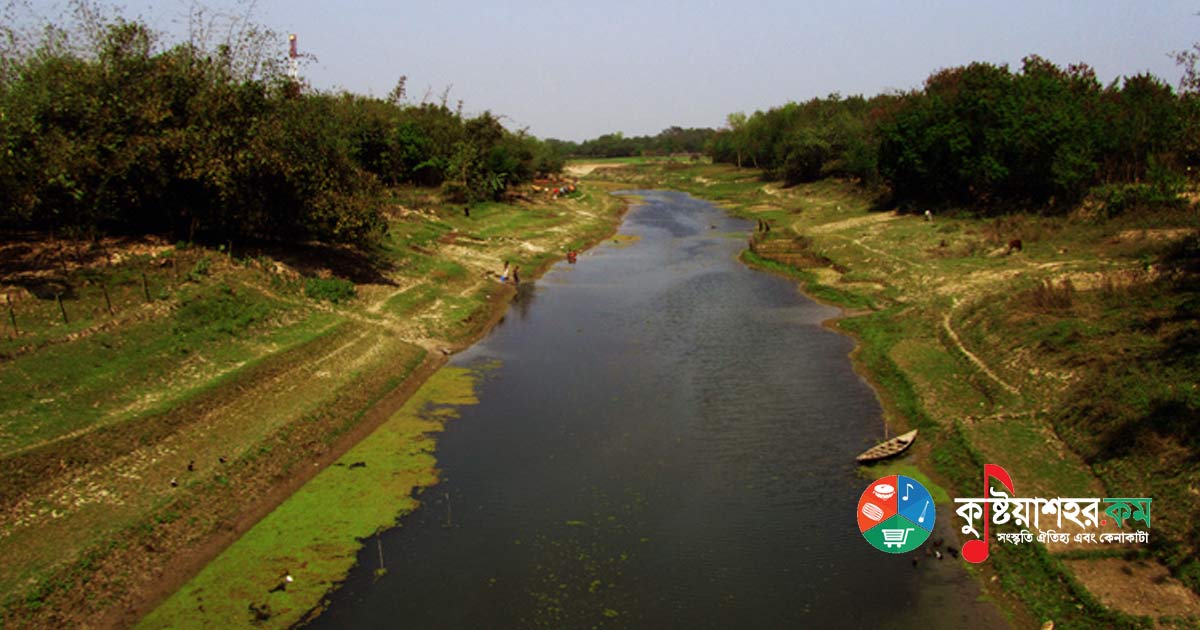
Both were born in the same area, on either side of the Gorai river in Kumarkhali. In 'Grambarta Prakashika', which he edited, Harinath published reports of the oppression of tenants by the zamindar Tagores of Shilaidaha.
To chastise him, the nayeb arrived at the house with lathiyals in tow. Hearing the news, to save the family and kin of his beloved Harinath, Lalon stood in the way with a staff in his hand instead of the ektara.
The nayeb had to return empty-handed!
Kangal, it is said, wrote of this episode in his own diary! But where is that diary to be found now?
In truth, the Shai was quite reticent and indifferent about his own identity. Even in his songs he 'covers over' his self-identity with words. His was 'a house of sound, a hut of the soundless'. Perhaps that is why so much controversy, so much discussion, surrounds the mirror-palace of one humble fakir's life.
He who has the man of the heart within
"What is the special quality of your faith — can you tell me?"
"It is hard to say; it cannot really be told."
The moment the fakir finished speaking, Rabi Thakur was about to ask something else. In the interval one of the fakir's companions said, "It can indeed be told — the matter is simple. We say that at the very beginning, by the guru's teaching, you must know yourself. When you know yourself, you find Him within that very self."
This time Rabi Thakur fell into a bit of perplexity. He rose and went to stand at the very edge of the boat.
Far away, far far away, where the Padma bends towards Kumarkhali, he kept gazing. The light of late afternoon had fallen on his gown, on its fine work. The red sunlight drew alpana patterns on the Padma's water. The poet asked, "Why do you not tell the people of the world, tell them all, of this faith of yours?"
The fakir saheb rose to his feet. Coming close to the poet he said, "Whoever thirsts will come to the Ganges."
In his essay 'Atmabodh' Rabindranath did not mention whether Lalon was one of these two fakirs, the dwellers of 'a humble hut by the bank of a small river of Bangladesh'. Yet in the breeze drifting over the Padma in the late afternoon, if you lend an ear, such a dialogue between the poet and the fakir can still be heard from afar.
So did the two really ever meet?
A large part of Lalon scholarship is taken up with that very debate! For it was the year after Lalon's death, 1891, when Rabindranath went to Shilaidaha to take charge of the zamindari.
At that time at Shilaidaha the poet talked daily with Lalon's close associates Gagan Harkara, Sarbokshepi and Gonsai Gopal about Lalon's songs and philosophy.
He even had two notebooks of Lalon's songs brought from the akhra at Cheuria and copied out by an estate clerk.
In a few songs of the second notebook he corrected the wording and wrote out the pure text. From these he published twenty Lalon songs in 'Prabasi'. In the close reading of those songs, the poet was swept away into the depths of the fakir's river of feeling.
On hearing 'He is the man of the heart — why do you keep him seated at your doorway', we think at once of Lalon's 'He who carries the man of the heart in his mind — what need has he to count beads?'. Likewise, on hearing 'I go on seeking him who dwells in my mind and in my heart', one recalls 'When will I meet with the man of my heart?'.
The poet's Lalon-fascination dates from the time 'Gora' was being serialised in Prabasi. In 'Gora' he wrote, 'How does the unknown bird come and go within the cage.' Later the same Lalon song returned to the pages of his 'Jibansmriti'.
He wrote, 'Who else but song can tell of the coming and going of this unknown bird!'
Can fakiri not be done at home?
Past the barbed wire to Meherpur, and then...
through Kushtia to that Cheuria. Nearby lies the Shai's Hridaypur!
On a spring night at the akhra in Kenduli, amid the swirl of Baul melodies, some Baul-fakir-darveshes of the two Bengals were telling the story of Lalon Shai and of his last abode at Cheuria.
With them was Raikamalini, the Baulani of Meherpur. She was very much like Tarashankar's 'Kamal'. She knew how to 'catch the green Shyam parakeet in the trap of her eyes and bind it in the cage of her heart with the chain of love'! By her twenty-second year she had surrendered her mind and passion to the Shai.
Overhead, the clouds part to wake the Falguni moon. Not far off, bonfires blaze at the Kadambakhandi ghat. Mad melodies drift on the wind. 'A woman should not be honoured so, O Kishori/ however much you court Shyam, you only swell his pride the more.' Amid the fierce debates of the fakirs and darveshes and Kamal's silent gaze from her eye-trap, the talk kept coming back to Lalon.
Reading the memories on the reverse side of this disciples' household talk about the Shai, one recalled the anti-Lalon movement that once swept Kushtia. The fatwa calling for the destruction of the Bauls.
What had he not had to endure?
Some called him 'a fakir opposed to sharia, astray, deluded and lost to the path'; others said 'establishing the creed of the worship of women was Lalon Shah's only pursuit'.
Leaflets against the Lalon followers were even distributed from the Pak Press of Kushtia. It said, "...When the news of his doctrine of incarnation is known, any person of taste will feel revulsion at even speaking the names of Lalon and his followers. Without any attempt to know the truth on the basis of legend, a handful of influential sinners against knowledge have taken to trying some new thing to become famous overnight.... The people of Kushtia are protesting vehemently against this base conspiracy!"
But does the wind blow upstream?
The Kenduli mela ended long ago. And yet in this month of Falgun too the akhra is humming brightly.
With a zikr, a darvesh of Dinajpur struck up a song on his dotara. A soaring melody. When the song 'If you would catch the unseen moon/ strain your breath, strain your breath' paused, I brought up the teaching of Lalon's songs —
Well then — Lalon's songs speak of catching this unseen moon. What is it like?
The darvesh smiled and said, "This is like catching moonlight on the Shai's new-moon night. Month after month the moon rises. But on the new-moon night one must catch the unseen moon. Lalon Shah said, 'If you would catch the unseen moon/ practise sadhana with strained breath.'"
The word 'Shah' means 'great king'; it is the title of the darveshes. But not every darvesh is a Baul. So what of Lalon Shai?
"Not all Bauls are darveshes. But Fakir Lalon was a darvesh in his initiation, and a Baul in his sadhana."
The south wind lifts its melody again: 'Look, O mind, with the divine gaze/ the four moons are flashing in the chamber of gems.'
Who am I, whose am I —
many accounts also swirl about the Shai's birth.
In the view of one section of his disciples, Shaiji lived 116 years. He died in 1890. So he was born in 1774.
Most claim that the Shai was born in the village of Bharara on the bank of the Gorai river, in Chapra union of Kumarkhali thana in Kushtia, then part of Nadia district. His father was Madhab Kar and his mother Padmavati.
Then there is the matter of a document. The document, registered on 19 January 1880, states: "Patta holder — the esteemed Lalon Shai, son of the late Siraj Shai, caste Muslim, occupation begging and the like. Resident of Chiure, pargana Brahimopur, estan Bolko, sub-registry — Kumarkhali."
After that, Lalon's identity becomes complicated.
But one identity of the fakir was never a secret: he was 'alone' — a single, solitary man.
In his childhood his father died. Caught in want, he could not get much schooling. The Bhowmik family of Chapra was his maternal home.
But in time his maternal home became unbearable. To forget his grief he wandered all day by himself, loitering across fields and meadows and along the riverbank. Sometimes, desolate, he would stare towards the woods and the wilds. Sometimes his days passed chasing songbirds. If some fakir walked down the earthen lane carrying a sarinda of melody, Lalon would leave his games and trail after him.
One day, taking the ektara from a fakir's hand, he truly did learn the discipline of melody.
Moved at heart, he sang, 'Who am I, whose am I/ what the real thing is, I do not rightly know.'
After his father's death all the burdens of the household fell upon him. One day he was married too. As the days passed, seeing his odd ways, all sorts of things flew about on the wind.
Amid the neighbours' whispers and the burn of poverty, Lalon set out on the road. With him his mother and his new bride. Walking on, they came to Daspara, the last reach of the village of Bharara. There Lalon built a house anew. But where in household life was his mind!
His mind, after all, was beyond the tethered mind!
'Without knowing the news of the home, why do you look up to the sky.' Kamal struck up the tune on the dotara.
Even when Lalon built his house anew, his dispassionate mind was secretly searching all the while for this answer.
Is this body then the home, the cage ever? Or Arshinagar?
Was Lalon then a believer in the path of shanta-rati, the temper of tranquillity?
The name is not known. A young Baul of Murshidabad, pressing the khamak under his armpit as he played, said, "Not shanta-rati — this sadhana is the discipline of kama, of desire! Lalon Shai's own songs hold the simple answer. Listen then — 'Along the banks of the Tirpini, the Shai roams in the form of a fish'.
When does my Shai play
that year many left the village for a Ganges bath at Berhampore in Murshidabad.
Lalon too shouldered his bundle and joined the neighbours of Daspara. Quite a few days passed pleasantly. So many new people, so thick a crowd of talk.
The bath was done; now the return. On the way back Lalon's body grew hot. A raging fever!
'Lalu has got smallpox! Smallpox, the poxed kind! Smallpox!'
Murmuring delirium in the fever's swirl, at some point Lalon lost consciousness. Who would look after him in this foreign land!
In the night the fever mounted fiercely. No stir was left in the body. In fear of contagion his companions left the body behind and went on. Someone, it seemed, performed the mouth-fire rite and floated his body away!
The news of Lalon's death spread through the village. In grief for her son Lalon's mother broke down in tears; weeping and weeping, the bride's eyes ran dry.
On a raft of banana stems Lalon's body drifted on, wave upon wave of the river. How many villages, how many paths.
"This very path, it is as if, is the Shaiji's road of passing from one birth to the next", the aged darvesh was telling this tale of Lalon's death and survival, drawn from oral tradition. Such a story of Lalon, mixed and melded, is in Sunil's novel too.
Imaginary. And yet, of Lalon's route, Sunil writes: "Sometimes it is caught in water hyacinth. Sometimes, when the sahibs' steamship goes by hooting, big waves shove the raft towards the bank. ... The raft comes to rest on the roots of a huge tree. There the river bank is crumbling; by the trunk of the tree the waves lap and lap. Close by is a village ghat. Men come to that ghat all day, but at evening only the women come to draw water. ... Three women are bathing at that ghat. The village is largely Muslim. The women are talking among themselves in low voices when suddenly, it seems, they hear an 'uh' quite close. At once they stop talking and listen intently.... Very close by, a man's voice. Two of the women immediately take fright and run helter-skelter. One stays standing...!"
Alas, Allah! He is alive, then!
Lalon's lips are parched with thirst. All that is heard is, 'Water, water!'
At the word 'water' the woman starts up. She says, 'We are Muslims!'
But Lalon cannot help himself. He says again, 'What caste has man, after all. Give me a little water. Water...!'
This woman of the ghat nursed Lalon back to health with her care. She took him home. What was the woman's name? And her husband's?
Some researchers say it was the Molom karigar of Cheuria, and it was his wife who nursed Lalon back to health. Siraj Shai had come to their house at that time. In a few days the woman's care and Siraj's medicine cured the illness. Strength returned to his body. But the marks of smallpox remained on his face, and one eye went blind for life. Some researchers hold that it was not 'Molom' but Siraj who gave Lalon shelter.
Lalon wanted to lose himself on the road with Siraj. Siraj did not take him along.
Why not?
Hearing the question, the darvesh smiles and says, "Because work for Lalon still remained in the world."
Lalon returned to his own village.
When will we meet
return he did — but the village would not accept him. At the sight of him his mother and wife were startled with joy and wonder. But the whole neighbourhood spread it about: Lalon's caste was gone. He had taken a Muslim's food and water. The village of Bharara cast him out of his homestead.
Clutching his ektara, sulking, he turned his face away and set out again on the very road by which he had come.
So much sorrow, so much burning!
How old was Lalon then? Midway through his youth.
He only thought: what manner of caste is this? What manner of judgement is this of God? His mind took on the colour of renunciation. When leaving home he had called his wife too. She did not come along! In pique and tears, perhaps, he then bound the song in his heart: 'Everyone says, Lalon, what caste have you in this world./ Lalon says, what the shape of caste is, I have not seen with these eyes.'
He met again Siraj, the Baul guru of the Kahar community. Who is this Siraj Shai?
"Siraj is the guru-darvesh of our Shai. A Sufi sadhak."
When the darvesh finished, a fakir on the far bank said, "Many people, many opinions. But some say that even before his initiation, Lalon Shai's conversion had taken place."
One recalled the opinion of Basanta Pal, Lalon's first biographer. He says Siraj Shai was born in the village of Fulbari in Jessore.
Like Lalon's own, his guru's identity too is wrapped in many a puzzle!
Lalon questioned Siraj every day about this and that. Siraj Shai satisfied all that curiosity about the world, the household and creation. Little by little Lalon came to know of 'Rangmahal', another form of sadhana. That too is a doctrine of the body. It is said a lock is set upon it; to enter within, one must learn to open that lock. So Lalon took initiation from Siraj. He came to know of the sadhana-sangini, the spiritual companion. Day by day Lalon seemed to grow restless in his search for the man of the heart.
Sitting alone in the deep woods he sang, 'When will I meet with the man of my heart.'
From just this time, new thoughts came and made their home in his breast. He even set them to melody and sang them.
"Coming into contact with Siraj Shai, Lalon came to know the tidings of the Great Yoga. Those tidings must be grasped by holding to Yogeshwari. He learned that everything is the play of rasa and rasi. And within it, the Baul's sadhana is the discipline of the breath. One must know it now as new moon, now as tide. The door of the chamber of desire must be shut," the fakir pauses as he speaks.
Sadhana needs a companion. Yet sadhana is done alone! What manner of path is this?
Setting down the khol, he says, "The Baul is forever alone. He never believes on hearsay. Guru Lalon Shai did not either. Nor do we who follow Lalon! Lalon has said, in the yoga-sadhana of rasa and rati, purusha and prakriti are fused. He says, 'Catch the breath, steady the fire/ so that dying, you may live/ die before your death/ and let the cremation turn back.'"
In what pique will you play the mad fakiri
a house of bamboo and thatch under a roof of straw. A winding river flows past. On the far bank, charlands stretch to the horizon. Blowing dunes of sand.
Now and then a boat stops at the lonely river ghat. Humming low tunes, the disciples come and sit in the akhra.
Lalon sings; they play the khamak-dotara. 'Close to home lies Arshinagar. A neighbour dwells there.' He sings, 'Within the body there is a river./ On that river a boat is sailing/ six are drawing the oar/ one holds the helm.'
After taking initiation from Siraj, Lalon built his akhra by the river at Cheuria, near Kushtia. Oral tradition has it that in the Cheuria mouza, Lalon's devotee Molom Shah, the karigar, donated sixteen and a half bighas of land to Fakir Lalon. It was on this land that the akhra rose.
That was the Bengali year 1230.
From the charland the wind comes back touched by the waters of the Ajay. From distant villages drifts kirtan — the name-song of Mahaprabhu on khol and kartal. Here on this bank the akhra's Lalon melodies sometimes merge and mingle with those kirtan tunes until the two are one. The night wears on in song-duels: now the fakir withers before the Baul's answer, now the Baul yields to the darvesh's argument.
In the midst of this, one asks intently of the Baul and Baulani across the way what the Shaiji's akhra was like in the early days.
"The word that passes from mouth to mouth is this — at first Lalon Shai sat in sadhana beneath a mango tree in a wood outside the village of Cheuria. In the beginning he hardly came out of the woods. Later, with the help of the village's karigar community, the akhra was built. One by one his disciples gathered: Shital, Mansur, Moniruddin. The village folk too accepted him as guru. Shital and Bholai were like sons to him.
Now and then, it is said, he would set out on horseback for the charlands — sometimes alone, sometimes with disciples — by the roads to Pabna, Rajshahi, Faridpur. In that time his disciples kept growing." The fakir across the way stopped mid-sentence. He said that not only Cheuria: even now Lalon's story travels from mouth to mouth just so, over there.
Lalon also practised kabiraji (herbal) medicine in the service of people. Researchers say there is record in disciple Bholai's song notebook of rules for the use of such medicines. In truth, his heart ached for people. After a helpless, solitary mother died, the Shai sent food from the akhra to her village for the shraddha rites.
In truth Lalon was not only a sadhak fakir; he also kept abreast of the affairs of the world. He was a natural-born poet, one who did not sweat over metrics. His disciples wrote the songs down. Manik Shah, alias Manik Pundit, did the work of scribe, and Moniruddin Shah too.
When a song came alive in him he would say, 'Look, a shoal of puna fish has come to me.'
Some say that after building this akhra the Shai married a second time as well.
Let us cite such a piece by Mohammad Mansuruddin. He writes, "Some time later he (Lalon) married a widowed Muslim weaver woman and set up a betel orchard, trading in its produce. The fakir was seldom to be seen; it was heard that he sat in secluded places absorbed in his own truth and composed songs." Some researchers claim she was Lalon's companion in the sadhana of love — his sadhana-sangini.
After his first wife's death, the Shai made this Bishakha, or Motibibi, his life's companion and practised sadhana and devotion in a room of the akhra itself named 'Haker Ghor', the House of Truth. Sitting there he debated with his disciples too. He would say, "In this world's household I am destitute!"
Arshinagar close to home
What did Fakir Lalon Shai look like?
I dive from memory into the pages of 'Moner Manush', where at Jyotirindra's call Lalon went to meet him. Jyoti-dada was then in the middle of painting portraits.
"Finishing the line-drawing with a few swift strokes, Jyotirindra said, come over here and see whether I have got your face right.
Lalon came up and stood beside Jyotirindra. Looking at the picture, a smile spread over his whole face.
He said, Babumoshai, what my face looks like — that I do not know. I have never seen it.
Jyotirindra said, what! You have never seen your own face? And yet you sang of Arshinagar?'
Lalon said, "In Arshinagar you cannot see yourself, nor can you see your neighbour!"
What sort of picture did Rabi Thakur's Jyoti-dada draw of Lalon, at which the novel's Shai laughed!
The pencil sketch of Lalon that Jyotirindranath Tagore drew on the boat at Shilaidaha on 5 May 1889, now in Rabindra Bharati, shows Lalon bowed. Incomplete though it is, it is the only earthly likeness of Lalon. On the picture is written, 'Lalon Fakir. On the boat at Shilaidaha.' Researchers surmise it was drawn a year before Lalon's death. Nandalal too once drew Lalon after seeing this sketch. But Nandalal's Lalon has an aquiline nose, and the hair of the head tied up.
The writer of the article in 'Hitokori' saw Fakir Lalon with his own eyes. His Lalon is a little different.
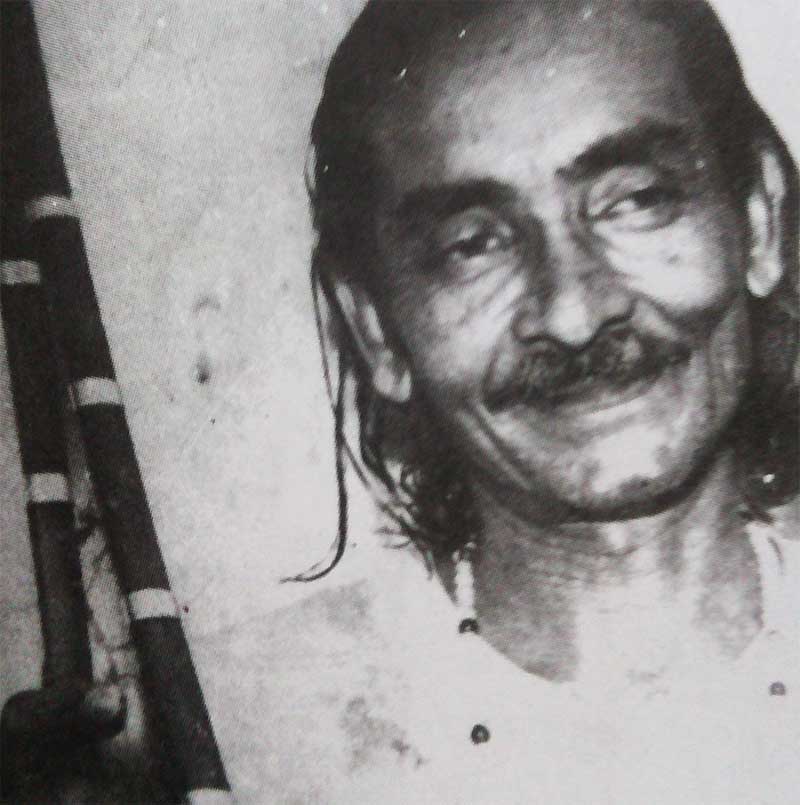
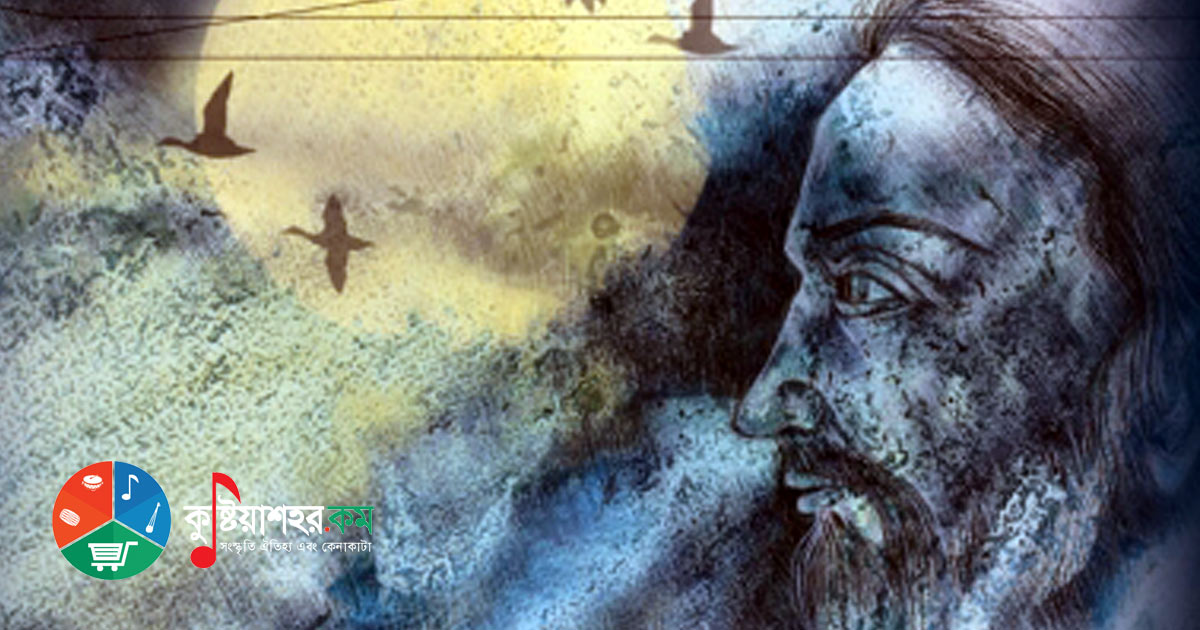
Bushy babul-like hair, one eye without sight. The marks of smallpox on the face.
A moment ago kirtan was sounding across the way; at some point it has stopped. A sweet shiver in the south wind off the charlands.
The akhra is empty now.
Dawn is descending on Kenduli.
Breaking the sand, crossing water that soaks the ankles, the Bauls and Baulanis, the fakirs and darveshes are walking away into the far depths of the water.
Their united Lalon melody still rings in the ears.
'The chatak, night and day/ keeps gazing at the dark shashi, the moon.'
Somehow the bird is about to fly away
towards the end he fell ill. But he kept up his unending talks of doctrine. In those days on his sickbed he ate little besides milk. What he craved was fish.
One day, in his ailing body, he executed his last deed of gift, giving away the little cultivated land and homestead he had to his wife, daughter and son-in-law-disciple Shital.
As the end drew near his breast, the sadhana-sangini and dharma-daughter Piari stayed constantly at his side; yet Lalon would not let them know of his pain.
One day he also set aside two thousand taka in cash for the funeral rites. He told his disciples,
"When I pass away, by Hindu custom there will be no cremation; and by Islamic custom the janaza prayer cannot be read either."
And on the day he departed, his disciples sang the name from night on. 'Ferry me across, O merciful moon./ Forgive my sins in this prison of the world.'
Of that dawn of Kartik, Basantakumar Pal has written, of Lalon's sickbed.
On his last day too the Shai sang through the whole night. His voice rose to the tara-saptak, the upper octave: 'Somehow the bird is about to fly away./ An ill wind has struck the cage.' When the night was ending, when light had only just fallen on the river's water, the song was over.
Basantakumar writes, "The wave of melody ceased; the whole house sank silent. Then, addressing his disciples, he uttered the last sound from his throat, 'I am going'; he closed his eyes; and the curtain fell on the life-drama of that humble fakir abandoned by society."
Soon after, his pulse grew still. The disciples broke out in loud weeping.
That day was the first of Kartik!
Credits: 'Lalon Shai' (Abul Ahsan Choudhury), 'Fakir Lalon Shai' (Shaktinath Jha), 'Moner Manush' (Sunil Gangopadhyay), 'Baul' (Jasimuddin), 'Alaldost Sebakamalini Lalon' (Sudhir Chakrabarti), 'Lalon Fakir and His Songs' (Annadashankar Ray), 'Mormiya Lalon' (an anthology published on the occasion of the All-India Banga Sahitya Sammelan), the documentary 'Achin Pakhi' (director: Tanvir Mokammel)
Source: Anandabazar Patrika