বাংলা
 English
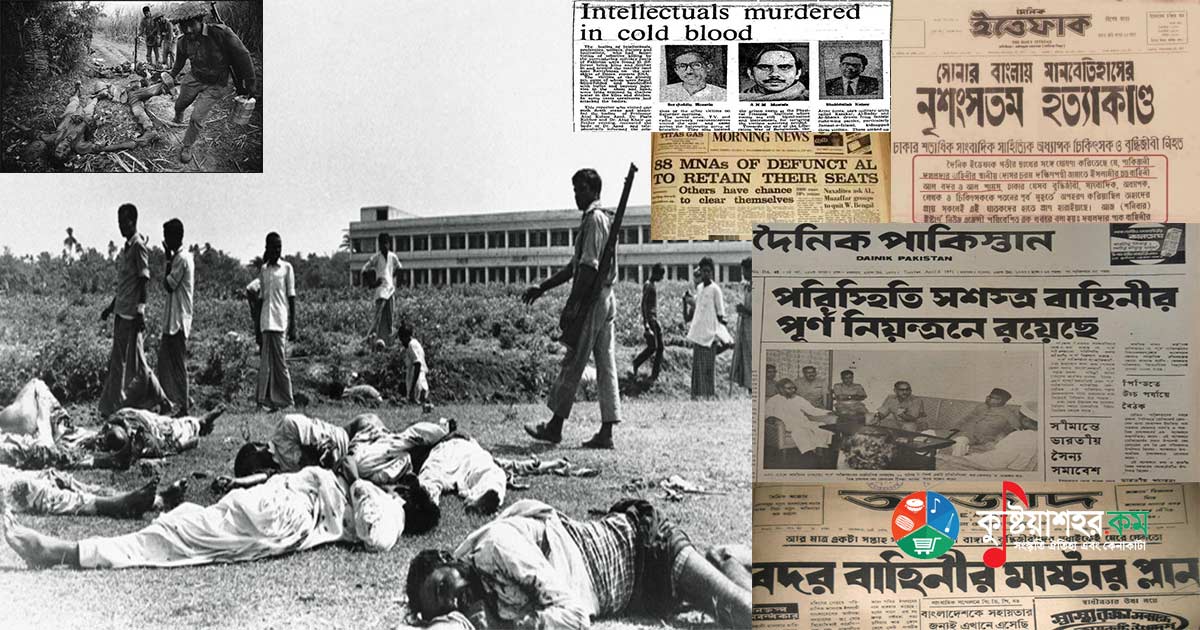
Martyred Intellectuals Day is a special day observed in Bangladesh. Every year 14 December is observed in Bangladesh as Martyred Intellectuals Day. From 10 to 14 December 1971, the Pakistani military killed all the first-class intellectuals of Bangladesh. In this task, the Razakars and members of the Al Badr and Al Shams forces among the Bangladeshis gave the Pakistani military direct and indirect assistance.
According to the prevailing notion, those who give mental or intellectual labour instead of physical labour are intellectuals. The definition given to intellectuals in the book Shahid Buddhijibi Kosh (Encyclopaedia of the Martyred Intellectuals), published by the Bangla Academy, is: “Intellectuals mean writers, scientists, painters, vocal artists, teachers of all levels, researchers, journalists, politicians, lawyers, physicians, engineers, architects, sculptors, government and non-government employees, persons associated with cinema and drama, and social workers and cultural workers.”
Ever since the formation of the undemocratic and unscientific state called Pakistan, the state machinery of West Pakistan had been behaving discriminatively towards the Bengalis or East Pakistanis. They struck at the language and culture of the Bengalis. As a consequence, resentment kept accumulating in the Bengalis' minds, and the Bengalis began political and cultural movements against this injustice. Leading all these movements were the intellectuals of every stratum of society. They inspired the Bengalis, socially and culturally, with a sense of Bengali nationhood. It was as a result of their cultural movement that the people gradually became conscious of their own demands and rights, which later drove them towards political movements.
For this reason, from the very beginning the intellectuals had become the targets of Pakistan's military rulers. So from the start of the war the Pakistani forces began killing the intellectuals selectively. Moreover, in the final phase of the war, when Pakistan's defeat was only a matter of time, they prepared lists and killed the intellectuals with the aim of rendering the Bengali nation devoid of talent, so that it would become weak educationally, culturally and socially. On this point, the argument given in the book Shahid Buddhijibi Kosh is relevant and well reasoned:
“It is inevitable: it is the intellectuals who keep the conscience of the nation awake, keep it awake through their writings, through the pens of journalists, in the melodies of songs, in the teaching given in schools, and by coming close to the people through medicine, engineering, politics and the like. The first way to sterilise a nation is to render it devoid of intellectuals. This process began suddenly on the night of 25 March, then slowly, and finally, knowing that defeat was inevitable, swiftly between 10 and 15 December.”
Planning of the Killings
The killing of the intellectuals was planned together with the plan for Operation Searchlight on the night of 25 March. During the operation, the Pakistani soldiers went about hunting down and killing the intellectuals. Many teachers of Dhaka University were killed on the very night of 25 March. However, the bulk of the planned killing took place only a few days before the end of the war. During the war, the Pakistani army and their trained para-military forces, the Al-Badr and Al-Shams, prepared a list in which the names of these pro-independence intellectuals were included. It is believed that the main planner of this task on behalf of the Pakistani forces was Major General Rao Farman Ali. Because after independence, a diary in his own hand was found in the destroyed Bangabhaban, in which the names of many killed and surviving intellectuals are found. Moreover, from an interview with Altaf Gauhar, information secretary of the Ayub era, it is known that on Farman Ali's list was the name of his friend, the poet Sanaul Haq. At Altaf Gauhar's request, Rao Farman Ali struck Sanaul Haq's name from the list in his diary. Besides, a note found in his diary says that he himself made arrangements for cars for the Al-Badrs.
Besides, his diary mentions two American citizens named Heit and Duspik. Next to their names were written USA and DIGIS. Among them, Heit had been attached to the military intelligence apparatus since 1953, and Duspik was a CIA agent. For this reason it has been suspected that the CIA had a role in the planning of the whole incident.
Description of the Killings
From 4 December a new curfew was imposed in Dhaka. From 10 December preparations began for the killing of the intellectuals. The main part of the plan was carried out mainly on 14 December. The Pakistani army and their collaborators forcibly abducted marked intellectuals — professors, journalists, artists, engineers, writers and others. That day, about 200 intellectuals were picked up from their homes. With their eyes blindfolded, they were taken to torture centres located in Mirpur, Mohammadpur, Nakhalpara, Rajarbagh and many other places. There they were subjected to horrific torture. Later they were gruesomely killed and left at the Rayerbazar and Mirpur killing grounds.
Indeed, even after the surrender and the official end of the war, there are complaints of gunfire by the Pakistani army and its collaborators. In one such incident, on 30 January 1972, the renowned filmmaker Zahir Raihan lost his life. It is suspected that armed Biharis were behind it. In memory of the killed intellectuals, 14 December is observed every year as “Martyred Intellectuals Day”.
Persons Involved
On the side of the Pakistani military junta, the main planner of this massacre was Major General Rao Farman Ali. And helping him prepare the lists, and behind the carrying out of the massacre, was mainly the notorious Al-Badr force formed by Jamaat-e-Islami. The chief executioners of the killing of the intellectuals were Chowdhury Moinuddin of the Badr force (operation in-charge) and Ashrafuzzaman Khan (chief executioner). After 16 December, a personal diary of Ashrafuzzaman Khan was recovered from his house at Nakhalpara, on two pages of which were written the names of about 20 intellectuals along with their university quarter numbers. According to the testimony given by Mofizuddin, driver of his car, the melted corpses of several intellectuals were found in the marsh of Rayerbazar and at the Shialbari killing ground in Mirpur — people he had shot dead with his own hands. And Chowdhury Moinuddin was a member of Jamaat-e-Islami's central committee in '71.
From the Observer building he would deliver the names and addresses of the intellectuals to Rao Farman Ali and Brigadier Bashir Ahmed. Also involved were A. B. M. Khalek Majumdar (killer of Shahidullah Kaiser), Maulana Abdul Mannan (killer of Dr Alim Chowdhury), Abdul Kader Molla (killer of the poet Meherunnesa) and others. In Chittagong the chief killers were Fazlul Kader Chowdhury and his two sons Salahuddin Kader Chowdhury and Gias Kader Chowdhury.
Statistics of the Killings
According to information from Banglapedia, the number of martyred intellectuals is as follows:
- Educators - 991
- Journalists - 13
- Physicians - 49
- Lawyers - 42
- Others (cultural figures, artists and engineers) - 16
In 1972 a district-wise approximate list of martyred educators and lawyers was published; it is as follows:
| District and Division | Educators | Lawyers | ||
|---|---|---|---|---|
| Primary | Secondary | College | ||
| Dhaka | 37 | 8 | 10 | 6 |
| Faridpur | 27 | 12 | 4 | 3 |
| Tangail | 20 | 7 | 2 | |
| Mymensingh | 46 | 28 | 1 | 2 |
| Dhaka Division | 130 | 55 | 17 | 11 |
| Chittagong | 39 | 16 | 7 | 1 |
| Chittagong Hill Tracts | 9 | 4 | 1 | 1 |
| Sylhet | 19 | 7 | 2 | |
| Comilla | 45 | 33 | 1 | 4 |
| Noakhali | 26 | 13 | 4 | 2 |
| Chittagong Division | 138 | 73 | 13 | 10 |
| Khulna | 48 | 15 | 2 | 2 |
| Jessore | 55 | 31 | 5 | 4 |
| Barisal | 50 | 21 | 4 | |
| Patuakhali | 3 | 1 | ||
| Kushtia | 28 | 13 | 4 | |
| Khulna Division | 184 | 81 | 15 | 6 |
| Rajshahi | 39 | 8 | 3 | 5 |
| Rangpur | 41 | 22 | 9 | 4 |
| Dinajpur | 50 | 10 | 1 | 2 |
| Bogra | 14 | 12 | 2 | |
| Pabna | 43 | 9 | 1 | 2 |
| Rajshahi Division | 187 | 61 | 14 | 15 |
| Bangladesh | 639 | 270 | 59 | 41 |
| Total number of martyred educators (excluding universities) = 968 | ||||
| Number of martyred university teachers = 21 | ||||
| Total number of martyred educators = 989 | ||||