বাংলা
 English
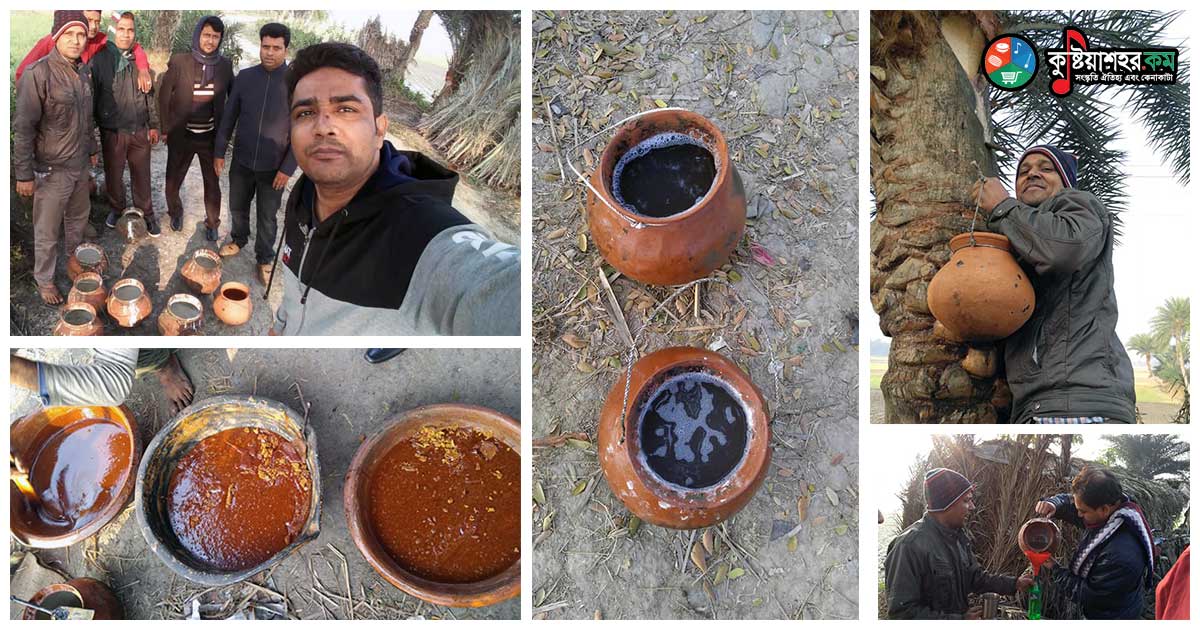
Date juice is the sap collected from the date palm tree. Its taste is sweet. Date juice is collected only in the winter season. Pithas, gur (jaggery) and other sweet delicacies are made from date juice. Date juice is rich in minerals and nutrients. There is a great demand for date juice in Kushtia.
Since the date palm is a plant of dry and desert regions, the date trees of the lower Gangetic basin do not yield sufficiently fleshy, that is, first-rate dates. So it is not much used as food. But the sap of this tree is attractive.
Sap is collected from the third week of Ashwin to the first week of Baishakh (from the second week of October to mid-April). Cold weather, a cloudy sky and a foggy morning are favourable for plenty of sap. The taste of the sap obtained in this period is also good. That is why the most sap is obtained in the months of Paush-Magh (December to January). As the temperature rises, the quantity and quality of the sap begin to decline.
Sap collection starts from trees at least 5 years old. Besides the age of the tree and the area or type of soil, the abundance of sap also depends on different times of the same season and on the care of the tree. Again, male trees give more sap than female trees, and the sap is comparatively sweeter.
In Kushtia, during the winter season, a variety of pithas and payesh made with date juice are prepared in household after household in the rural areas. So the gachhis (sap collectors) also pass a busy time collecting date juice commercially. Gachhis from outside Kushtia district also come to the district to collect sap and make gur. Various kinds of patali and lali gur are being made from this delicious date juice by boiling. The gachhis here are also benefiting financially by selling dates and sap.
The change in the normal life of the people of Kushtia is noticeable. People's movements are increasing around the date trees on the roads, in the fields, in the ponds and in the open grounds. Sap collection from the date trees begins from the start of the winter season. Sap can be collected for almost four months of winter. The gachhis run their households by making various kinds of patali and lali gur from this sap and selling them in the market. There is extra demand for date juice and gur for winter pithas and payesh. Here date gur sells at 100 taka per kilogram, and a pot of sap sells for one to one and a half hundred taka depending on the kind.
Outside Kushtia town, sap is available in the winter season at various places around Mollathegaria Bhitore, the bypass road, Gopalpur, Takimara and Bottoil, and in Mirpur, Bheramara, Kumarkhali, Khoksa and Daulatpur.