বাংলা
 English
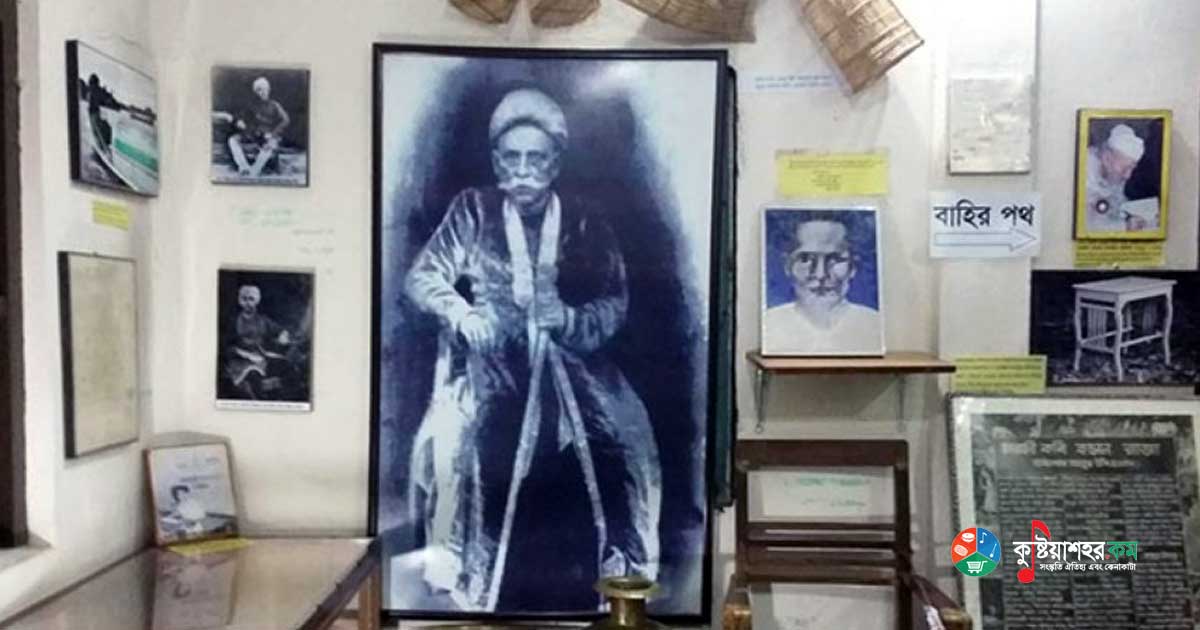
Dewan Hason Raja (21 December 1854 - 6 December 1922) - (Bengali calendar - 7 Poush 1261 - 22 Agrahayan 1329) was a mystic poet and Baul artiste of Bangladesh. His real name was Dewan Hason Raja. Mystic sadhana in Bangladesh has formed an extraordinary union of music with philosophical consciousness. In the opinion of most experts, Lalon Shah is its chief pioneer. Alongside his name one must also place Duddu Shah, Panju Shah, Pagla Kanai, Radharaman, Arkum Shah, Jalal Khan and many more. But in terms of philosophical consciousness, the characterful name that comes after Lalon is that of Hason Raja.
Hason Raja's lineage
Hason Raja was born on 21 December 1854 (7 Poush 1261), at Tegharia village of Laksanshri (Lakshanshri) pargana on the bank of the Surma river, near the town of Sunamganj in the then Sylhet district. Hason Raja was a child of a zamindar family. His father, Dewan Ali Raja Chowdhury, was a powerful zamindar. Hason Raja was his third son. Ali Raja married, at an advanced age, Hurmat Jahan Bibi, the childless widow of his maternal uncle Amir Bakhsh Chowdhury. Hason Raja was born of Hurmat Bibi. On the advice of his incomparably handsome step-brother Dewan Obedur Raja, Hason's father Dewan Ali Raja named him Ahidur Raja, in the pattern of his own name.
Hason Raja's forefathers were Hindus. One of them, Birendra Chandra Singha Deb - or, in another account, Babu Ray Chowdhury - accepted the Islamic faith. The abode of Hason Raja's forefathers was in Ayodhya. Before coming to Sylhet they were residents of Jessore district in southern Bengal.
Childhood
At that time the practice of Arabic and Persian was very strong in Sylhet. According to the advice of a famous Persian-scholar named Abdullah, the Nazir of the Deputy Commissioner's office in Sylhet, he was named - Hason Raja. In numerous documents Hason Raja signed his name in Arabic letters - Hasan Raja. Hason was handsome to look at. Mazharuddin Bhuiyan says, "He had a countenance so gentle that he caught the eye among many people; his high frame, long arms, sharp nose, luminous tawny eyes and head of poetic locks - the countenance of a Persian Sufi poet floated before the eyes." (p. 14, Eid issue 'Hanafi', 1344). In the opinion of most experts he received no institutional education. But he was self-taught. He composed nearly a thousand songs in the regional tongue, in simple, unaffected melody.
Youth
By inheritance he was owner of a vast landed estate. In his first youth he was given to luxury and refinement. In the midst of this, at various special moments, he composed a great many songs; these were sung with dance and musical instruments. The surprising thing is that in these songs he reminded himself of the impermanence of life, and of the limits of luxury and indulgence.
Hason Raja loved birds. The 'kura' was his favourite bird. He kept horses. His two favourite horses were named Jung Bahadur and Chandmushki. In short, his time began to pass in pursuit of refinements. Passing the time in pleasure became the sole desire of his life. He began to drift away from his subjects. He came to be marked as an oppressive and cruel king.
The unknown Hason Raja
Many took him for a street ruffian, and besides there was the flourish of his moustache! But later, in the eyes of ordinary people, he was known only as the singer of the Hason songs.
What left the deepest mark of his youth was his attack on the naiyori boats of the haor. He used to carry the women off. To bring him back, one day his mother herself set out in a naiyori boat, disguised as an unknown naiyori, and, putting him in an embarrassing situation, turned her son back from this destructive path.
The beginning of detachment
Hason Raja began to run the zamindari with authority. But one spiritual dream-vision changed Hason Raja's philosophy of life from the roots. The doors of Hason Raja's mind began to open. A gentleness came into his character. He gave up his pleasure-loving life. He began to mend his faults and failings. He gave up wearing splendid dress. Not only the outer world: a vast change came into his inner world too. He became detached from worldly things. A kind of indifference came into his mind. A kind of detachment. Enquiring after ordinary people became his daily work. And above all his works was the composing of songs. He became immersed in the love of Allah. All his meditations began to find expression as songs. He set melodies to those songs in this way:
People say, say, O friend, home and household are not good for me
What house shall I build, in the midst of the void
Building the house well, how many days more shall I stay
Looking in the mirror I see, my hair has not yet greyed.
Thus his feeling of detachment came to find expression. Hason Raja changed completely. He gave up the taking of life. Not only service to mankind - he devoted himself to the service of living creatures as well. The dashing king who had once come to be known as 'Chondo Hason' (Fierce Hason) now became 'Nomro Hason' (Gentle Hason). In one of his songs the cry of regret resounds:
O youth, dream of sleep
Without sadhana, with women I lost my capital.
In his mature years he distributed his property and lived the life of a dervish. At his initiative the Hason M.E. High School and many religious institutions and akhras were established.
Music sadhana
Hason Raja's thought is known from his songs. No exact count of how many songs he composed has come down. 206 of his songs are compiled in the book 'Hason Udash'. Beyond this, some more songs were published in 'Hason Rajar Tin Purush' and in various journals including 'Al Islah'. It is heard that Hason Raja's descendants possess manuscripts of his songs. It may be supposed that many of his songs still live on the lips of the people of Sylhet-Sunamganj, while by the rule of time quite a few songs have been lost. The subject of Hason's other book, composed in verse metre, 'Soukhin Bahar', is - judging nature from the shape of women, horses and the kura bird (Lok Sahitya journal, July-December 1979. Syed Murtaza Ali, 'Mystic Poet Hason Raja'). Another book of his, named 'Hason Bahar', was discovered some time ago. Traces of some Hindi songs of Hason Raja are also found.
Hason's songs were composed following the set subject-line of the mystic song. Love of God, the impermanence of worldly life, and the lament of man gone mad with pleasure, incapable of sadhana and devotion - these are chiefly reflected in his songs. Somewhere he counts himself destitute and humble, and again he expresses that he is a kite tied in the hands of the invisible controller:
You fly me, my kite, with the string in Mawla's hand.
As Mawla turns Hason Raja, so I turn.
In Mawla's hand is the string, and I am tied to it.
As He turns me, so I turn - such is the knot of the string.
And this 'Mawla' is again Hason Raja's friend. Worthy only of the experience of touch, His encounter is had solely through the third eye:
Open your eyes and see the form, O, open your eyes and see the form.
Look with the eye of the heart at the form of the Friend.
But with this Friend, Hason Raja's hope of love was fettered by kinsfolk and family. Hason's lament:
The wife is a shackle on the feet, the son a stake.
How shall Hason attain union with the Friend.
Meanwhile the limited span of this mortal life is running out - yet 'the thought of death never came to mind, Hason Raja'. Earthly wealth, desires and the enchantment of union held Hason Raja entranced. Yet again he himself understands his own error:
Yama's messenger will come and put the rope in your hand.
Pulling and hauling, he will take you to the city of Yama.
At that time where will remain your beautiful, beautiful wife?
Where will remain Rampasha, where Laksanshri?
Hason Raja will speak no more of zamindari in Rampasha.
Hason Raja will speak no more of roaming by the Kapna river.
Hason Raja will go no more through Rajaganj.
Hason Raja will speak no more of going from land to land.
Give up, give up, Hason Raja, the hopes of this world.
Take refuge at the feet of the Lord who binds life.
Through this self-analysis and self-realisation Hason Raja found the lot of the mystic sadhak.
The very characteristic of mystic sadhana is to rise above caste, religion and the sense of difference. The essence of all religions, the tradition of all communities, the sadhak makes his own through spiritual realisation. In his experience one common form of religion appears - transcending the limitations of sectarian religion, it weaves a popular bond of universal religious consciousness. This consciousness is reflected in Hason Raja's music, sadhana and philosophy. The paired identity of Hindu and Muslim tradition is found in his songs. It must be remembered, however, that a few generations back the stream of Hindu tradition flowed in Hason Raja's blood. In Hason Raja's mystic lot there was no place for communal division. So on one hand Hason, yearning for the love of 'Allaji', could effortlessly sing the praises of 'Srihari' or 'Kanai'. On one hand Hason says:
I shall go, O I shall go, with Allah,
Hason Raja begs for nothing without Allah.
And again, alongside, from his voice resounds:
In my heart is Srihari,
Shall I fear your wiles?
A hundred wiles I shall tear through; my aid is Shiva-Shankari.
Hason's heart is drenched in weeping - 'What will become of me on the day of Hasr, O brother Mumin' - and again, alongside, his yearning is expressed thus - 'If I die and win Shyam's red feet', or 'Merciful Kanai, merciful Kanai O, ferry this destitute one across'. And again he says, 'The Hindus call you Radha, I call you Khoda'. Clearly, in Hason's sadhana and music, the puranas and traditions of both the Hindu and Muslim communities are combined. In this respect he was of the same faith as Lalon and the other mystic sadhaks.
It is not clearly known of which order Hason Raja was a sadhak. There is no mention of any guru in his songs. Some say he was a sadhak of the Chishtiya tariqa. Though the inspiration and influence of Sufi thought are present in his music and philosophy, he perhaps was not entirely a sadhak of that doctrine. He sometimes referred to himself as 'Baula' or 'Baul'. But although he was of the same kindred as the Bauls, he himself was not a formal Baul. Many believe that his path of sadhana was built out of the combination of the indigenous popular mystic stream and his own thought-philosophy with Sufi doctrine. Behind his song-composition one may speak of the influence of a sadhana-philosophy.
Hason Raja in Tagore's eyes
On 19 December 1925 Rabindranath Tagore was elected president of the first session of the Indian Philosophical Congress. In his presidential address he, in passing, quoted parts of two songs of Hason Raja and introduced his philosophical thought.[8] The speech was published in 'Modern Review' (January 1926) under the title 'The Philosophy of Our People'. Its translation was published in the 'Prabasi' journal (Magh 1322). The portion of the speech relating to Hason Raja is quoted here:
"In the song of a rustic poet of East Bengal [Hason Raja] we find a great theory of philosophy, and it is this: the truth of the world lies in the bond of relation with the individual form. He sang -
From my eyes arise heaven and earth
In the body He made firm and soft
And He created cold and heat
In the nose He created fragrance and breeze.
This sadhak poet sees that the Eternal Man, emerging from within him, appears on the path of his eyes. The Vedic sage also spoke thus, that the Man who is within him, He it is who is seated in the orb of the sun.
I saw the form in my eyes, saw my own form.
Emerging from within me it appeared to me.
In 1930, in the 'Hibbert Lecture' at Oxford University, in the address he gave under the name 'The Religion of Man', Tagore too made mention of Hason Raja's philosophy and music.
Hason Raja died on 7 December 1922.
Works
- Hason Udash - compiled by Dewan Hason Raja
- Soukhin Bahar
- Hason Bahar
How to get there
From Dhaka one has to go to Sunamganj via Sylhet. On the way one can get down at Sylhet, shake off the fatigue and settle one's meals in the restaurant-rich city of Sylhet. From here to Sunamganj you will find both bus and car. For the bus you have to go to the Kumargaon bus stand, and if you want to ride a car you can reach Sunamganj town from beside the gate of the shrine of Shahjalal (Ra.). Besides, you may use private transport. The road is quite good. By bus it takes one and a half to two hours, and by car about an hour. Getting down at the new bus stand area of the town, a rickshaw or an electric autorickshaw is easily found. These vehicles are also available to go to any other place in town.
From the traffic point area of Sunamganj the destination can be reached by car in 5 minutes.