বাংলা
 English

Salimpur is a renowned village lying beside the dying Hisna river near the Padma, in Taragunia of Daulatpur upazila of Kushtia district — which belonged to Nadia district of India at the time of 1947. It was here that, on 7 January 1886, a colourful, immensely accomplished man came to rest in the lap of his father Bipinbihari Pal and mother Magnamoyi Devi, destined to write history for the ages. He is the pride of the Bengalis, the amazing human Justice Radhabinod Pal.
There was no means in the home of the father and mother — nothing from which to secure even a handful of rice for the family. When Radhabinod, barely three years old, had only just begun to depend on the world for shelter, his father Bipinbihari took the vow of an ascetic and abandoned the household. With her two daughters and only son Radha, mother Magnamoyi Devi set out on the road of an uncertain life. Radha never knew the touch of a father's love. He grew up beneath the brooding, sighing pensiveness of his mother's self-forgetting bosom, wrapped in her unasked-for affection and in the warm shade of the blessings and tenderness of his grandfather Phalan Chandra Pal.
Like a few other children of the country and society who clutched to their hearts the uncertain hope of the days to come, Radha began his schooling at the age of eight at the pathshala of Iman Ali Pandit of Taragunia. Behind the start of this education, too, lies an eventful and memorable wonder. While his loving mother, to cope with the family's want and poverty, wore out her days labouring at other people's work, our Radha rode that tide and spent his time herding cattle. As the pathshala stood beside their home, Radha would turn the cattle loose every day in the deep forest next to the school and, through the open window of the school room, listen with rapt attention to the lessons of the class. One day a school inspector came from town to see how learning fared at the pathshala. Entering the class, he began questioning the students one by one about the syllabus. But the students, unable to answer, stayed silent. Our Radhabinod Pal, unable to bear the situation any longer, said to the school inspector, 'Sir, I know the answers to all your questions.' Astonished at the boy's courage, the inspector asked, 'What is your name? What do you do?' Radha said, 'Sir, we are very poor, so we have neither the time nor the means to study.' Hearing the boy's unbroken string of answers, the inspector sahib grew all the more amazed.
He made inquiries about the boy from the teacher Iman Ali and learned of their poverty and of the family's circumstances. As he was leaving the school, he told Iman Ali Pandit to make arrangements for the boy's education, promising that he himself would bear the cost of Radha's studies, and directed that he be admitted to school. From here began the foundation of Dr Pal's education and the shaping of his life. With grandfather Phalan Chandra gone, his studies there came to an end. But Radha's extraordinary intelligence and boundless appetite for learning won him shelter — and, so to speak, patronage too — for this family, at the home of his maternal uncle Kedarnath Pal of the village of Morbhanga in Alamdanga upazila of the present-day Chuadanga district. Our proud Radhabinod Pal was then only eleven years old.
Self-assured Radha worked as an errand boy at his uncle's shop for a monthly wage of four taka, while his proud, golden-hearted mother looked after the cooking in that house. Sitting beside his mother in the kitchen, by the dim glow of an earthen lamp, the amazingly gifted Radha studied on his own, in his own unplanned, informal way. One regular educated gentleman customer of the shop, seeing this unfamiliar new Radha at night after the shop closed, made inquiries about the boy from Kedarnath. He could see the talent hidden within the boy's gentleness, calm sharpness and far-sightedness, and, seizing on that, proposed in the gaps of various conversations that Radha be sent to school. Despite his own difficulties, uncle Kedarnath had Radha admitted to the Bansbari M.E. School. In return for all the expenses of the school, Radha had to attend to all his uncle's errands. This pull towards education and knowledge never let Radha drift away from his appointed goal. Having no time in the day, he would take the stars of night as witness and, by the flickering light of the earthen lamp, go on laying the foundations of the future creation of his unimaginable success. Finishing the shop's work from dawn onwards, he was often late for school. The teachers loved him dearly for this reason: in any examination Radha showed himself the finest of intellects and produced remarkable results. His unfailing, exceptional achievement and brilliance caught the eye of Shailen Chandra Pal, the education-loving zamindar of Kumari village. Taking upon himself all responsibility for Radha, he had him admitted to the Kumari M.E. School. There, with outstanding merit and a scholarship, he was admitted for higher studies to Kushtia High School in town. He lodged at the house of Ramchandra Ray Chowdhury, the zamindar of Kamalapur-Jiyarkhir. It was so that this radiance of talent might shine that Radha, drifting like water hyacinth on the current, had to move to the shelter of the zamindar of Dubahati in Rajshahi. In 1903 he passed the Entrance (matriculation) with distinction from the Raja Harnath High School at Dubahati. He then passed the higher secondary examination again with a scholarship from Rajshahi College (now Rajshahi Old Degree College). From the very beginning he used to send the whole of the scholarship money to his needy mother. He studied while staying at the town house of Dinabandhu Pal. When Dinabandhu Pal was transferred, Radha took shelter at the 'Hemanta Kumari' boarding house. The college's English professor Rakhal Chandra Ghosh helped with the boarding house's monthly fee of six taka, and the college authorities paid the college expenses. But at the time of the final examination there was no money left in Radha's hands, and Radhabinod Pal fell into anxious worry over the examination fees. The Creator now entrusted the task of relieving this burden to Tejendra Singha Roy, a friend he had come to know while staying at Dinabandhu Pal's house. In 1908 he obtained a first class in Mathematics (Honours) from Presidency College, Calcutta. Radhabinod Pal taught at Anandamohan College in Mymensingh from 1912 to 1920. In 1920 he passed his LL.M. in the first class from the University of Calcutta. In 1921 he was enrolled as an advocate at the Calcutta High Court. In 1924 he received the degree of Doctor of Law from the same university.
The year 1935. At the invitation of his close clansman and kinsman Bodinath Pal, Radhabinod Pal came to the village of Kakiladah in Mirpur upazila of Kushtia, saw the place, and was enchanted. After that, when he was pressed, he decided to build a house there to live in. After Radhabinod Pal had bought a modest plot of land, a certain Saha Babu, the zamindar of the Amla Estate, gave him a good deal more land. All told, he then had some 50 acres of land. Having built an attractive house, he planted saplings of fruit-bearing native and foreign trees all round it for its upkeep, creating a grove delightful to the eye. For everyone's daily use he made a huge pond, which to this day, a witness of time, sways gently and waits with a deep, searching gaze. His life itself was a succession of dramatic events rocking on the see-saw of fortune.
The year 1941. Radhabinod Pal's life now joined the pulse of the universe. Appointed a judge of the Calcutta High Court on 27 January, he took up the office of Chief Justice on 1 December of the following year and remained in it until 23 June 1943. He afterwards served as Vice-Chancellor of the University of Calcutta, staying on until April 1946. The shadow of the Second World War still lingered. The so-called enemies and allies had both advanced into the war; the time was then moving towards its end. In that dreadful carnival of death wrought by deadly weapons, he could never accept within himself, as something natural, the smearing of civilisation's face by maddened aggression. The sacred cry of the piteous plea of his inner soul touched the divine touch of the Creator. The year 1945. Japan was defeated in the Second World War. America, laying claim as a victorious Allied power, decided to try the Japanese for their war crimes. Paying no respect to any international law or to civilisation, and taking only Britain and the Netherlands with it, America formed the 'Tokyo Far Eastern Military Tribunal'. Judges for the tribunal were appointed from eleven countries, and a panel of judges was formed. On the soil of Japan itself, as the defeated nation of the world war, Japan's strategist General Hideki Tojo was tried at the Tokyo Tribunal. At the instance of the victorious American forces, heavyweight judges for this court were chosen from the whole world; indeed, the discerning judges were picked out from among the celebrated judges of various countries. Our Dr Radhabinod Pal was included in that panel as the judge-member for British India. As a member of the international panel of judges, Radhabinod Pal brought to this subcontinent and to the Bengali nation a rare honour. From 1946 until about the middle of 1948, Dr Pal made a close and thorough study of the whole course of the trial.
Before the formal proceedings began, an extra sentence was added to the judges' regular oath, providing that none of the information of these proceedings shall be made public. Radhabinod Pal dissented from so odious a decision concerning the trial. At one stage of the trial, the other four judges, finding him guilty of war crimes, ordered that Japan's strategist General Hideki Tojo be hanged.
The four judges of this court in effect gave their verdicts to gratify their appointers. But Radhabinod Pal's verdict set the whole world astir. In his long, thorough judgment of 1,235 pages he stated in striking terms that this verdict had been staged in America's favour, and was a farce into the bargain. 'If the Allied side claims it entered the war only to meet a war thrust upon it by the enemy, then by exploding atomic bombs of about twelve thousand kilotons' weight, of high radioactivity, at Hiroshima on 6 August 1945 and at Nagasaki on 9 August, and killing nearly three hundred thousand innocent people, children and women, the Allied forces committed another criminal act against humanity. For this he demanded the trial of America and her allies themselves. Taking care to mention scientists such as Albert Einstein, the discoverer of mass and motion, and Oppenheimer, the maker of the atomic bomb, he pointed out that the bombs they had devised were a threat to world peace and humanity — the place where, within a few hours, the lives of hundreds of thousands of ordinary innocent people were destroyed, and among them the old, women and children.' With this 'Note of Dissent' he saved a humane judge from the one-sided condemnation of the trial. Sanctions fell upon Japan: for fifty years it might take part in no nuclear activity. Thanks to that sanction, the world afterwards looked on in astonishment at the spectacle of Japan's unbroken path towards a new world.
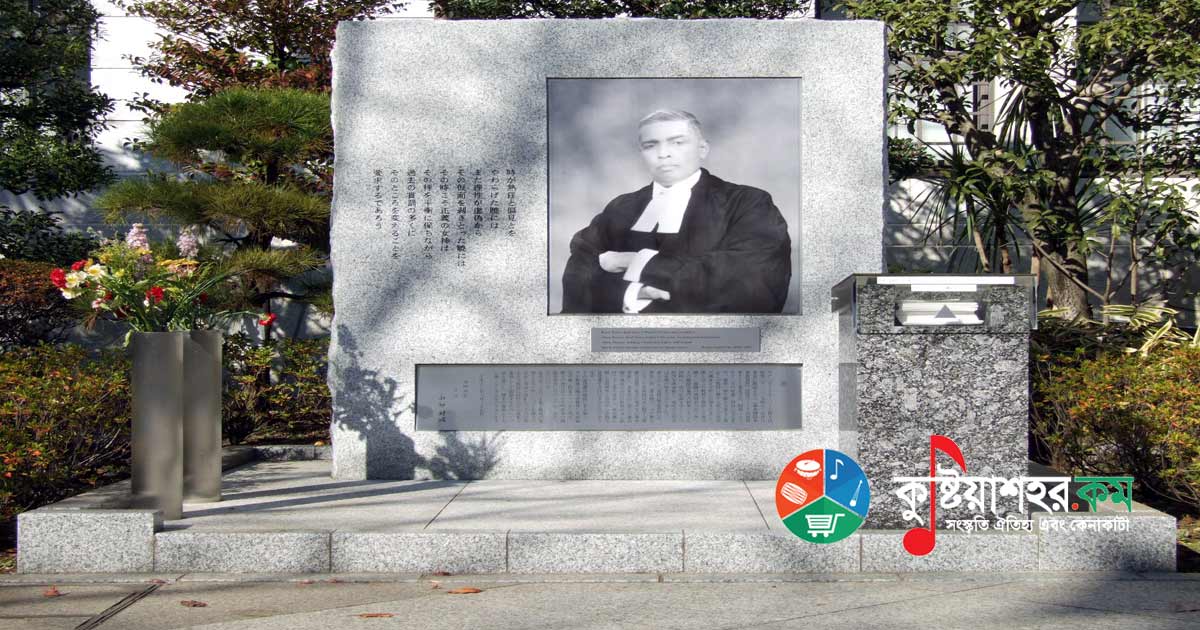
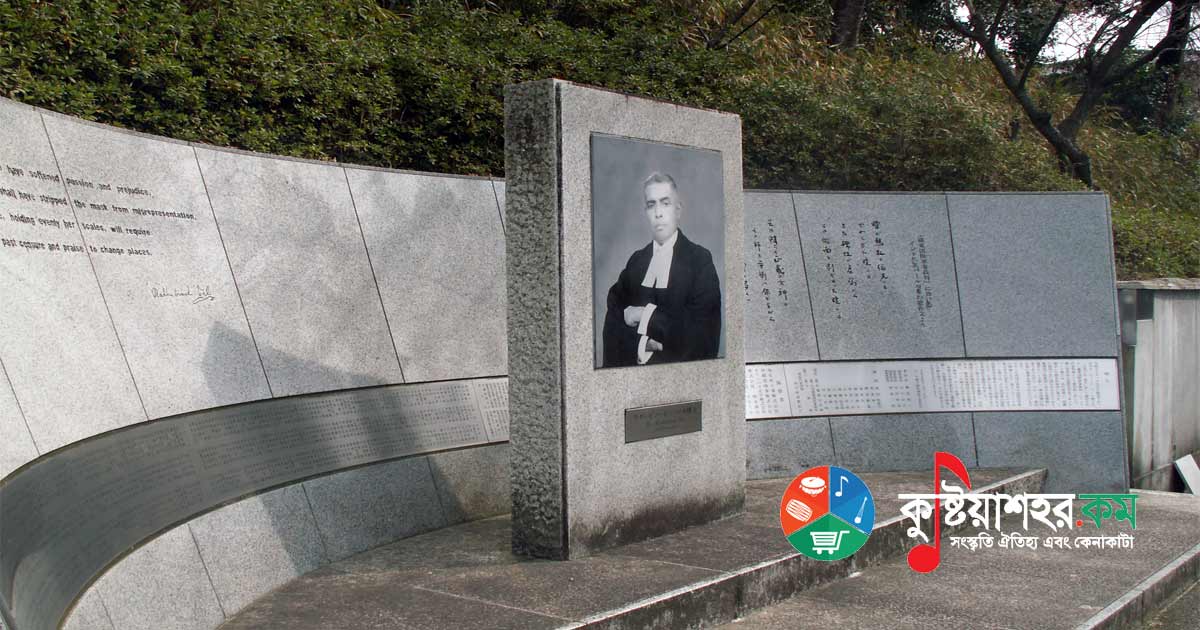
Towards the beginning of the twentieth century, Japan and India — and with them the Bengalis — were knit together by ties of one pulse. It was Radhabinod Pal who created the bond of this relationship — that is to say, Dr Radhabinod Pal of Bangladesh, of Kushtia. For the orderly conduct of justice, this Radhabinod Pal sits among the Japanese in the seat of a second god. The year 1952. An international peace movement was begun in Tokyo under the leadership of Dr Pal by a number of Japanese and Bengalis. In that movement, with speeches fiery yet charged with harmony and equality, Dr Pal again demanded the trial of warlike America and her allies. That year he spoke at various universities of Japan and at renowned institutions. At this time Dr Radhabinod Pal was conferred an honorary doctorate by Nihon University. The year 1966. On his visit to Japan he received from that country's Emperor Hirohito Japan's highest honour, the 'Kokka Kunsho' or 'Purple Ribbon'. One of the largest avenues of Tokyo, Japan's capital, has been named after this legendary man of genius. The judge's portrait, set upon a memorial draped in a judge's gown, stands in Japan as a proud symbol. In the city of Kyoto in Japan there is a museum, streets and a statue in his name. Still today the Japanese come to his house at Kakiladah, seeking documentary footage of Radhabinod Pal, godlike to the Japanese, in search of the pulse of his existence. Radhabinod Pal's descendants now live at 16 Dover Lane, Calcutta. Research into the life and substance of this pride of Bengal, this glory of Kushtia, brings out the context of Dr Radhabinod Pal's birth, death and upbringing, and of his original home, in Bangladesh.
The years 1952–1962. Dr Radhabinod Pal served as chairman of the International Law Association at the United Nations. The year 1957. Dr Pal was honoured as National Professor of India. In 1960 he received India's highest national honour, the 'Padma Bhushan'. In this period Radhabinod Pal set up two stone memorial plaques, one at the controversial national seat of learning and religious shrine in Tokyo called 'Yasukuni Jinja', and the other at the Showanomori hillside garden in the city of Kyoto. So great is the honour the Japanese pay him that they have given this honour to no other foreigner.
The renowned Dr Radhabinod Pal passed away on 10 January 1967 at his own house at 16 Dover Lane in Calcutta. Though the curtain thus fell on a history, on courage and on proud glory, the firm works and the thoughtfulness he left behind are an inspiration in the hearts of the Japanese, and he remains to us likewise a source of feeling and of wealth, dwelling in the inner soul of singular reverence. His historic judgment of 1,235 pages, written and studied, has been translated into Bengali, Japanese, English and many other languages of the world. Today that judgment is being read at renowned universities and law institutions such as Cambridge, Oxford and Harvard.
The year was 1941. In an obscure village called Salimpur of Daulatpur upazila of the present-day Kushtia district there was a schoolteacher, Iman Ali Pandit. The student shaped by his benevolence and by following his ideals was Justice Dr Radhabinod Pal. He was the dispenser of justice of vast India, the Chief Justice, whose name now spreads from land to land. His alphabet-guru, the giver of his knowledge and his guide, was Pandit Iman Ali. As the teacher's breast swelled with pride, so the justice-dispensing Radhabinod Pal felt blessed, embracing in eye and mind the ideal-suffused figure of the Pandit with a touch of reverence. After his appointment as Chief Justice, when the fame of Radha's unsullied justice was spreading on every side, a feeling began, little by little, to gather in a corner of the Pandit's fond heart. His great desire to see his darling Radha just once grew awake. Whenever the Pandit got the chance he would call people and say, 'Do you know, our Radha has grown very great. You will see, he (Radha) will grow greater still. One day my Radha will surely brighten our (the Bengali's) face before the whole world.' Suddenly one day, unbidden by his mind, Pandit Iman Ali set out from home. Searching and searching he reached Calcutta, and then presented himself at the High Court. He knew his Radha was there. Where does Radha sit? Whenever he found anyone ahead of him he would ask, gripping their path. Is the man mad? Some would remark sidelong and vanish away into the crowd, and again the Pandit would ask people. At length Radha was found. Iman Ali's Radha sat in the high chair of the great courtroom, conducting the court. Behind his chair the punkha-pullers were swinging the punkha and scattering the air. Many high-priced lawyers and pleaders dressed in black coats stood before the bench, saying 'My Lord' and giving their accounts to Radha. With an untroubled mind Radha listened to those accounts. At every door of the courtroom guards in half-pants kept watch, security without a seam. 'I will go to Radha' — the Pandit's plea could make no impression on the guards' minds. They pushed the Pandit out beyond the door. Once more the Pandit begged and implored the guards, saying 'I will go to Radha,' and this time the guards sent him still further beyond the door with a strong shove. The stubborn Iman Ali went on crying aloud, 'I will go to my Radha.' When the guards, pushing him hard again, moved to put him out beyond the courtroom, the Pandit fell to the floor. Now it reached Justice Radha's ears; by then Iman Ali had fallen to the floor. 'Why, he seems to be like my Pandit, Iman Ali.' Why, so he is! The discerning judge Radhabinod adjourned the court and came down from the bench. He went to Iman Ali, took hold of the Pandit and set him on his feet. By then all the lawyers, pleaders, officers and clerks of the whole court had followed at the Chief Justice's heels. Everyone was watching in curiosity. What is happening? What is their Chief Justice going to do? Who is this stranger? Standing Iman Ali Pandit before him, Radha knelt down, laid his own head upon the bosom of the earth, and, touching Iman Ali's feet with his own, offered his salute and homage — our Justice Radhabinod Pal. Then, introducing him to everyone, he said, 'This is my teacher, Pandit Iman Ali. It is he who laid the foundation for me to sit in this seat.' One by one, many then began to offer the Pandit their salute and reverence. Radhabinod Pal took his guru with him and went out towards his chambers. Neither of the emotion-laden guru and shishya could hold back his tears for long.
Such marks of a student's devotion and reverence towards his teacher have now altogether vanished. In that event the pride and glory that filled the teacher's breast seemed to tell him that the Creator had made his birth fruitful. Reaching his teacher, the Justice went back to that childhood in the village of Salimpur of Daulatpur, where, while herding the cows, the unceasing art of Pandit Iman Ali's teaching, coming through the chink of the school window, used to stir Radha's heart deeply towards study.
Source: Daulatpurer Matir Rupgandhe, and sayings current in the hearts of the people. Acknowledgements: Kanchan Kumar Halder, President, Amla Press Club, Kushtia; Kartik Chandra Biswas, researcher and essayist, Khoksa, Kushtia.
The author: a researcher and a figure of the environment movement.