বাংলা
 English
In the history of the world there are the stories of many communities who, although living on their own land, at some point had to live the life of strangers. Losing citizenship, denial of one's own identity, social discrimination, state persecution and, finally, the brutal experience of displacement — these are what they had to go through. The Rohingya community of Myanmar's Rakhine State is the victim of precisely such a humanitarian catastrophe.
Arakan: The Historical Roots of Rohingya History and Identity
To understand the history of the Rohingya, one must first know the history of Arakan. The region along the coast of the Bay of Bengal in present-day western Myanmar was historically known as Arakan. Arakan had long-standing political, commercial and cultural contact with Bengal.
Historical evidence of the presence of Muslim officials, poets, soldiers and administrative figures can be found at the royal court of Arakan. In particular, the history of the Mrauk U kingdom records Muslim cultural influence. However, the Muslim population of ancient Arakan should not be treated as directly identical to the modern Rohingya ethnic identity.
The 1799 Document: The Historic Mention of the Name 'Rooinga'
In an article published in 1799, the British researcher Francis Buchanan referred to the Muslims of Arakan and used the word 'Rooinga' in describing their self-identity. In the discussion of the history of the name Rohingya, this is an important early written document. However, this document alone does not conclusively prove the complete continuity of the modern Rohingya identity.
British Rule and Demographic Change in Arakan
The First Anglo-Burmese War began in 1824, and through the Treaty of Yandabo in 1826 Arakan came under British control. During the British colonial period, owing to agricultural expansion and the demand for labour, people migrated to Arakan from various regions of Bengal, including Chittagong. As a result, the Muslim population of Arakan increased further.
However, a Muslim community was living in Arakan even before British rule. Therefore, interpreting the history of Arakan's Muslim population solely as the outcome of colonial-era migration is historically incomplete.
The Development of Modern Rohingya Identity
The modern political and social development of Rohingya identity became especially visible around the middle of the twentieth century. During the 1950s, the use of the Rohingya identity grew among the Muslim population of northern Arakan. Historians hold discussions about the origin and continuity of this identity.
Yet disagreements over the history of an identity can never serve as a justification for denying any community's fundamental human rights.
Independent Burma and Rohingya Citizenship (1948)
After independence in 1948, the Union Citizenship Act was enacted in Burma. The law provided for citizenship on the basis of birth, descent and residence for a specified period. At that time many members of Arakan's Muslim community received citizenship documents and took part in political and electoral activities.
However, the 1948 law did not explicitly list any separate ethnic group named Rohingya. For that reason, historical and legal research offers various interpretations of their legal basis for citizenship.
The 1962 Military Coup and the Citizenship Crisis
After General Ne Win's military coup in 1962, changes came to Burma's political and administrative system. Restrictions on the Rohingya's ethnic identity, citizenship, freedom of movement and other fundamental rights steadily increased.
The 1982 Citizenship Law: On the Path to Statelessness
The Citizenship Law of 1982 is one of the most important legal turning points in the Rohingya citizenship crisis. Under this law, citizenship was divided into three classes:
- Citizen, or full citizenship.
- Associate Citizen, or associate citizenship.
- Naturalized Citizen, or citizenship acquired through naturalization.
The exclusion of the Rohingya from the list of state-recognised ethnic groups and the stringent conditions for verifying citizenship made their path to citizenship difficult. However, the simplistic claim that with the coming into force of this law every single Rohingya's citizenship was revoked in the same way is not correct. It was the combined effect of the law's discriminatory application, identity-document problems and administrative obstacles that left countless Rohingya effectively stateless.
The 2017 Military Campaign and the Rohingya Genocide
After the attack by the Arakan Rohingya Salvation Army (ARSA) on 25 August 2017, Myanmar's military launched a sweeping campaign in northern Rakhine. During this campaign countless allegations arose of killings, rape, torture, villages burned to the ground and forced displacement. More than seven hundred thousand Rohingya were forced to take refuge in Bangladesh to save their lives.
The Case at the International Court of Justice on Gambia's Initiative
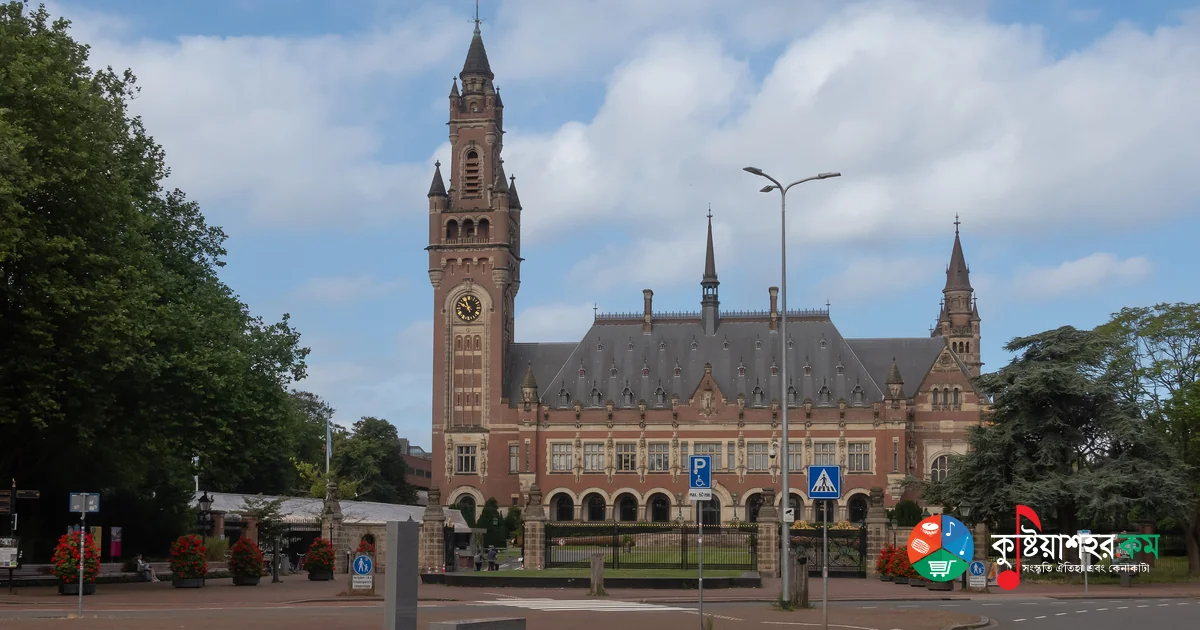
On 11 November 2019, The Gambia filed a case against Myanmar at the International Court of Justice under the Genocide Convention. On 23 January 2020 the Court issued provisional measures directing Myanmar to prevent genocide and to preserve relevant evidence.
19 November 2026: The International Court of Justice's Historic Verdict
On 19 November 2026, the International Court of Justice delivered its final judgment in the case of The Gambia v. Myanmar. By a vote of 9 to 6, the Court ruled that Myanmar committed genocide against the Rohingya in northern Rakhine during the 2017 military campaign.
The Court further established Myanmar's responsibility on several other important counts:
- Failure to fulfil the international duty to prevent genocide.
- Breach of the obligation to investigate and prosecute individuals involved in the genocide.
- Failure to preserve evidence of the genocide.
- The obligation to take effective measures to prevent crimes of this kind in the future.
- Compensation for and rehabilitation of the affected Rohingya.
- Arrangements for the safe, voluntary and dignified return of displaced Rohingya.
The Court decided that the amount and modalities of compensation would be determined at a later stage. Myanmar is required to submit a report on compensation and restorative measures within two years.
The Significance of This Verdict for Bangladesh
Bangladesh has had to bear the direct impact of the Rohingya crisis. For a long time now Bangladesh has been working to provide shelter, food, medical care, education and security for the vast number of Rohingya in Cox's Bazar and on Bhasan Char.
- International legal recognition of the crimes committed against the Rohingya has been established.
- A strong legal basis has been created in support of the demand for safe repatriation.
- The opportunity has arisen to increase international pressure on Myanmar.
- The demand for the restoration of citizenship and fundamental rights has grown louder.
Rohingya Repatriation: Not Merely Returning, but Living with Rights
The return of the Rohingya does not merely mean going back to Myanmar. It involves citizenship, security, freedom of movement, education, medical care, employment and the right to property. Unless these rights are ensured, repatriation will not be a lasting solution.
- Full and effective citizenship must be ensured.
- The rights to homesteads and property must be restored.
- Ethnic and religious discrimination must be brought to an end.
- The rights to safe movement, education and medical care must be ensured.
- Repatriation must be voluntary, safe and dignified.
The Responsibility of the International Community
The Rohingya crisis is not merely a problem between Bangladesh and Myanmar. It is bound up with international human rights, the prevention of genocide and world peace. The United Nations, ASEAN, China, India, the European Union and the world's influential states should play an effective role in implementing the Court's verdict.
Conclusion: Awaiting the Realisation of Humanity's Victory
The history of the Rohingya teaches us how catastrophic the consequences can be when any community is long deprived of state recognition and fundamental rights. When we analyse the history of Arakan, the demographic changes of the colonial era, the citizenship laws and the continuity of state discrimination, it becomes clear that the Rohingya crisis was not created overnight.
The judgment delivered by the International Court of Justice on 19 November 2026 is an important legal recognition of a long-standing injustice. However, there is no scope for regarding this verdict as a final victory. True justice will be established only when the Rohingya are able to return safely to their homeland and regain citizenship, fundamental rights and a life of dignity.
No human being on earth deserves to be deprived of rights because of their ethnic, religious or cultural identity. The true victory of humanity will come only when every person has the right to live safely, freely and with dignity on their own native soil.
References
- International Court of Justice (ICJ), The Gambia v. Myanmar, Judgment, 19 November 2026.
- Francis Buchanan, A Comparative Vocabulary of Some of the Languages Spoken in the Burma Empire, 1799.
- Jacques Leider, Rohingya: The History of a Muslim Identity in Myanmar.
- United Nations Independent International Fact-Finding Mission on Myanmar, A/HRC/39/CRP.2.
- Archana Parashar and Jobair Alam, The National Laws of Myanmar: Making of Statelessness for the Rohingya, 2019.
- International Convention on the Prevention and Punishment of the Crime of Genocide, 1948.
Editorial Note
In this article, the Rohingya's history, the evolution of their identity and their citizenship crisis are presented in the light of historical documents, research and international law. Matters on which researchers hold differing views have been treated as historical debates under research, not as established truths.