বাংলা
 English
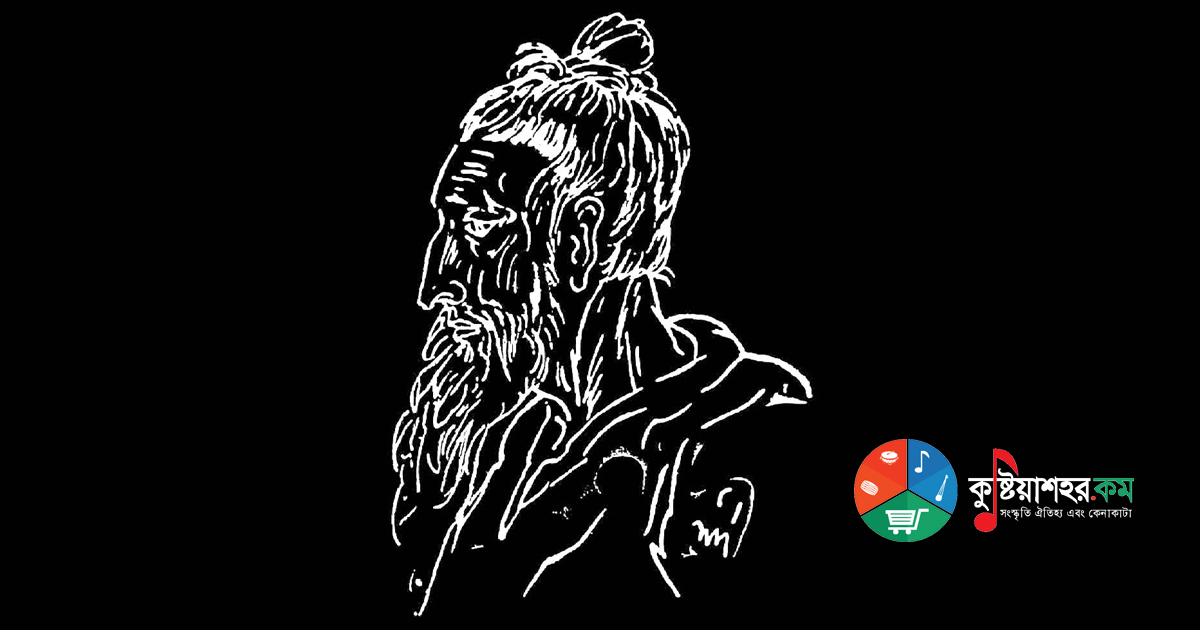
Lalon Shah is one of the influential spiritual sages of the Indian subcontinent. He is known by such names as Fakir Lalon, Lalon Sai and Lalon Shah. Lalon Shah is at once a sage, a philosopher, a humanist, a lyricist and a composer. In the last part of the twentieth century he was acclaimed as 'Baul Samrat'.
Yet one matter about Lalon remains unresolved to this day: what was he by birth — Hindu or Muslim? There are all kinds of arguments, counter-arguments and differences of opinion about this.
A detailed account of Lalon's life is not available. Yet from his songs a fair idea of him can be had. But in none of his songs did he leave any information about his own life. In a few songs he styled himself 'Lalon Fakir'. After his death, in an editorial of the 'Hitakari' periodical published from Kushtia it was said, “The materials to write his biography are hard to come by. He himself said nothing. His disciples, at his prohibition or out of ignorance, could say nothing.” Nevertheless, without any reliable source, one account described him as a Kayastha Hindu. Dr. Upendranath Bhattacharya said that Lalon was by birth a Kayastha Hindu and that his birthplace was the village Bharara on the bank of the Gorai river, on the other side of Kumarkhali. Although Lalon had to face this curiosity and question of whether he was Hindu or Muslim in his lifetime.
However, many again believe him to be a Muslim. The researchers who believe Lalon was a Muslim have correctly identified his birthplace Harishpur along with the identities of his parents and relatives. Lalon himself, of course, said nothing about himself; he was even conscious lest any identity be revealed by chance anywhere in a song. In his songs, denying all religious identities, he placed himself above caste and religion. He wrote in his songs —
“Everyone says, Lalon, what caste are you in this world.
Lalon says, what is the form of caste
I have not seen it with these eyes.
Some wear beads, some the tasbi round the neck,
Does that say the caste differs?
At the hour of going or coming,
Whose body bears the mark of caste?”
However, many hold some tales responsible as the reason for Lalon's rising above caste-identity. Inferred from the prevailing ambient notion, it is thought that Lalon was born into a Hindu family, but in his childhood, ill with smallpox, his family set him afloat on a raft. Then Molom Shah and his wife Motijan, a Muslim couple, gave him shelter and restored him to health. Molom Shah sent him to a fakir named Fakir Siraj Sai for religious instruction.
The Hindu society contemporary with Lalon was extremely rigid. Returning to Bharara from the Muslim couple, he found himself harshly excommunicated. Perhaps there was some provision of expiation, but with intense hatred and anger toward his own society and in resentment, Lalon returned to Cheuria to his Muslim benefactors. Society rejected him. He too, severing his ties with the blood-religion, became a new-born — Lalon. Logically this self-concealment is thought to be natural. This information is known from an article published in the 'Hitakari' periodical.
In fact, believing in no particular religion, Lalon was a believer in humanism. But his relations with the people of all religions were good. Because of his good relations with Muslims, many considered him a Muslim. Again, seeing him cherish Vaishnava religious views, Hindus thought him a Vaishnava. In truth, Lalon accepted no caste distinctions. Yet it is known to some that he believed in Krishna's avatar. There is much difference of opinion about his date of birth. But no correct information about his date of birth has been found. One group of researchers believes Lalon Sai was born in 1774. Another group's opinion is 14 October 1772. Contradictory views also prevail about the account of his birth.
The eminent folk researcher and thinker Farhad Mazhar wrote in an essay on Lalon Shah, “Nobody knows when, where, in whose house, how Fakir Lalon Shah was born. But even so, since his tirodhan, some have clubbed one against another, calling him Hindu and some Muslim, none sparing. Even after Lalon had concealed his identity completely, crooked communalism has again and again tried to tarnish him — sometimes unknowingly, sometimes knowingly. Why should a communal identity be stuck on the body of one who, in his lifetime, knowingly and consciously rendered his own identity invisible? Why must it be established that he was a Hindu by birth? Why must even his caste be determined and declared, that he was the son of a Kayastha house? He stood against communalism not only by writing caste-defying songs but also through the sadhana of concealing or effacing his own identity. In the direction of Bengal's bhab-movement, understanding its bhaber significance and the politics of that significance is rather far more urgent in this age.
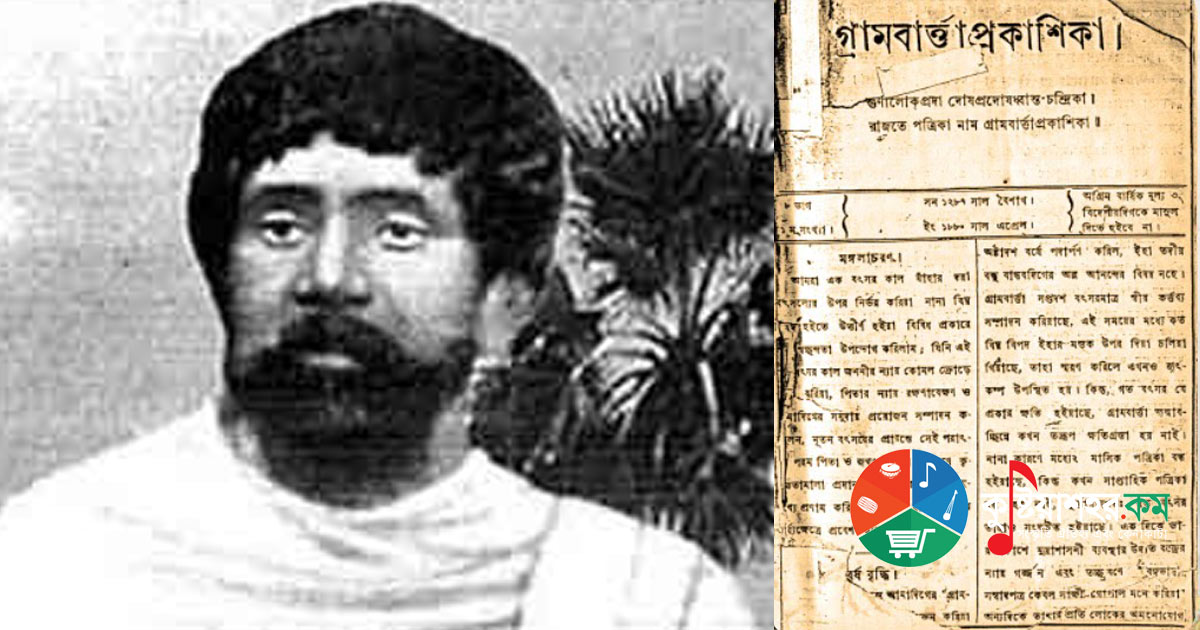
In his lifetime, the other folk of his caste-group were supposed to live in Kushtia itself. But nobody came to know who Lalon's mother was, who his father was, in which family he was born. Mir Mosharraf Hossain published the folk tale of 'Hitakari' honestly as a folk tale of the people's mouth.”
The direct ill effect of proving Lalon 'Hindu' is the counter-attempt to make him 'Muslim'. As a reaction against Hindu communalism, this is the face of Muslim communalism. About this Sudhir Chakraborty discussed with great heat in his book 'Bratya Lokayat Lalon'. Sudhir Chakraborty writes, “But meanwhile there has passed a phase of a great change of opinion, especially in Bangladesh. From the editorial of the 'Hitakari' of 1297, the biography of Lalon Fakir and the accounts of his Hindu origin that everyone knew — doubts about them began to thicken in the fifties. In 1335 Basanta Kumar Pal wrote an extensive introduction of Lalon Fakir in the 'Probashi'. Later he wrote the complete book 'Mahatma Lalon Fakir' in 1362. Muhammad Mansuruddin, Upendranath Bhattacharya, Motilal Das and the other leading Lalon researchers all knew that account of his life and accepted that Lalon was a man of the village Bharara, that is of Kushtia, a born Hindu, but that through a series of events he became a caste-less Baul or fakir. But a group of new researchers wanted to say that Lalon was a Muslim by birth.” [Chakraborty 1992; pp. 30-31]
What Sudhir Chakraborty overlooks is that it was precisely Basanta Kumar Pal's concocted tale that the others knew and accepted. Another tale is being concocted as the counter of this tale precisely because at first Lalon was made Hindu and the poison of communalism was sown. And between these two communal streams, Lalon's devotees, admirers and followers are being harmed.
In fact, Lalon Shah was neither singly a sage, nor a theoretician, nor a Baul. He was neither a preacher of religion nor a reformer. Only, he had found the endeavour of the synthesis of various religions in folk life. He also said —
“Dharma said, in religion as such there is nothing;
sing the virtue of love.”
However, Lalon Shah is the upholder of one generous, novel, scripture-less humanist religion. Lalon therefore strikes a fierce blow at the limitations of caste and religion in his songs —
Failing caste, I have not found Hari
What use is the pride of caste,
Saying so-and-so.
Lalon says, had I got caste in hand,
I would have burnt it with fire.
Yet another difference of opinion about Lalon exists. Some acclaim him as an aulia. Lalon was not a Muslim. He never in life touched the hem of namaz and roza; he accepted the Dol Purnima of the month of Chaitra as the night of his annual sacred rite; the question of his being an aulia does not arise at all; yet today he is being called by these titles.
In the spiritual stream Lalon composed nearly six thousand songs. In his songs are expressed the mysteries of human life, humanity and a non-communal outlook. His songs are therefore equally cherished by both religions. When, in the British era, caste conflict and clash between Hindus and Muslims was increasing, Lalon was a protesting voice against it. In each of his songs he presented himself as a fakir. About Lalon Fakir, Rabindranath Tagore said — “A Baul sage named Lalon Fakir, synthesising the Hindu, Muslim, Buddhist and Jain religions, wanted to say something — we should all pay attention to that.”
While staying at Shilaidaha under the Kumarkhali police station of Kushtia, Rabindranath collected 298 songs from Lalon Shah and published 20 songs in the Probashi periodical. From there came Lalon's introduction to educated society. More than a thousand of his songs have been collected from various parts of Bangladesh. Muhammad Mansuruddin alone collected more than three hundred Lalon songs, which are compiled in his book Haramoni. Besides, the titles of his two other books are, respectively, 'Lalon Fakirer Gan' and 'Lalon Gitika', in which Lalon songs are compiled.
Several feature films and documentaries have been made about Lalon. In 1972 Syed Hasan Imam directed the film 'Lalon Fakir'. M. Hamid directed the documentary 'Dekhe Kojona' in 1988. Tanvir Mokammel directed the documentary 'Achin Pakhi' in 1996. In 2004 a feature film named 'Lalon' was made under Tanvir Mokammel's direction. Besides, in 2010, based on Sunil Gangopadhyay's novel, Gautam Ghosh made a film named 'Moner Manush', which won the best film award at the 41st India Film Festival in 2010.
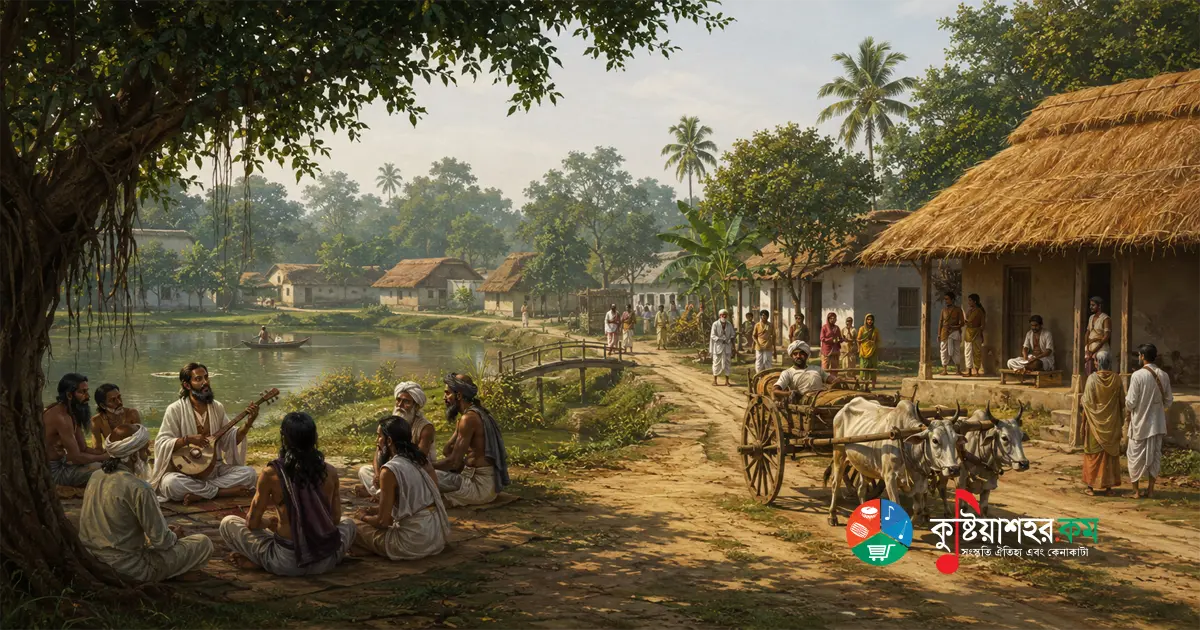
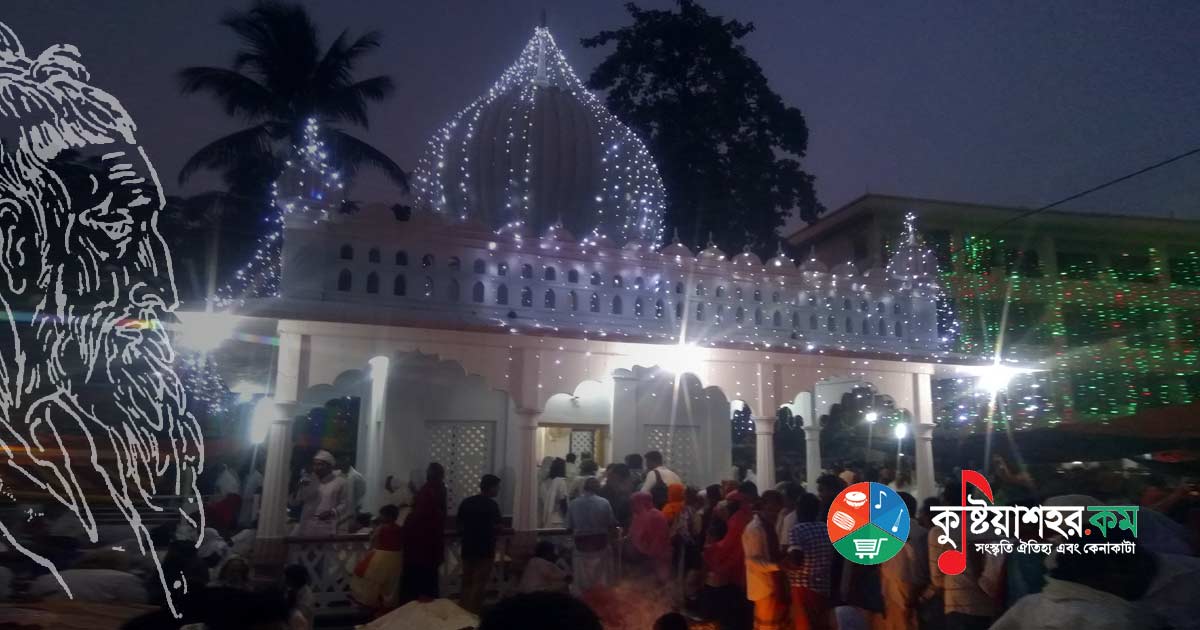
Lalon built an akhra at Cheuria in the Kumarkhali upazila of Kushtia, where he taught his disciples ethics and spirituality. He passed the last part of his life in this akhra. Lalon Sai died on 17 October 1890. By many accounts he was then 116 years old. According to his wish he was buried in a room of the akhra. After Lalon's death, in a piece published in the fortnightly 'Hitakari' edited by Mir Mosharraf Hossain, he was acclaimed as 'Mahatma' for the first time. Every year on Dol Purnima and the death anniversary, devotees offer respect to the guru at his mazar through sadhu-seba and the performance of songs.