বাংলা
 English
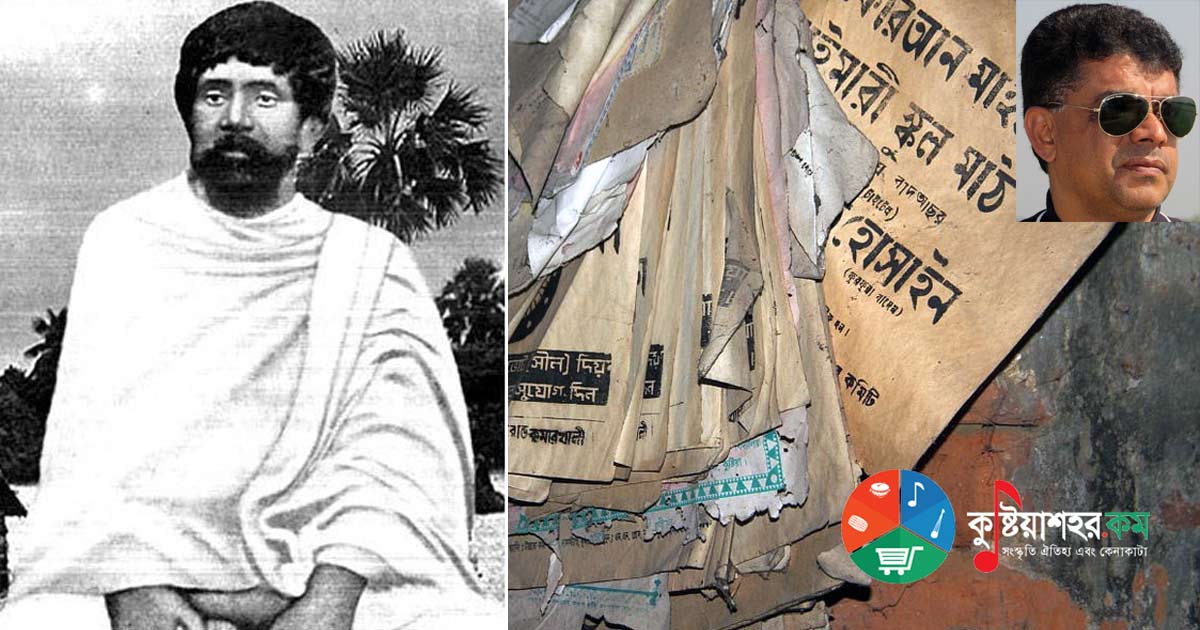
Since the existence of Bangla and the Bengali came into being, the Bengali's life has, for many reasons, been at times one of glory and at times one of sorrow. In the sweep of the great age, certain moments and epochal events have sealed our life in a special way. That is why we sometimes weep, and sometimes laugh; at times we blaze forth in exultation, and at times fall silent.
It can undoubtedly be said that our life and the cycle that governs it are intertwined with the elements of nature and their offerings at different times. The first of these is the silt and stone that come floating each year on the turbid yet sweet waters of the Ganga basin, brightening and enriching our agriculture, economy, society and even our mental landscape.
The second is the swing of blow and counter-blow: after Mughal rule in this land, in 1740, through the failure of Bengal's Subedar Sarfaraz Khan, Alivardi Khan, ruler of Bihar, seized the masnad. After this ruler's death, largely by custom, the governance of Bengal and Bihar passed to the departed's grandson, the young Nawab Siraj-ud-Daula. But Siraj in effect became Nawab on 9 April 1756; and then, on 23 June 1757, through the treachery of the general Mir Jafar, with the young Nawab's death there dimmed an independent sun at Plassey on the banks of the Bhagirathi river. Thereafter the English settled their rule across the Indian subcontinent. Over the two hundred long years of Bengal's — that remarkably varied land of India — attainment and acquisition, the poison boil of the Hindu-Muslim two-nation theory spread its roots. At last, as time's wheel rolled and the Ganga's waters flowed, came 14 August 1947. From the poison spread of the two-nation theory was born a state named Pakistan — a tainted emblem of scars — in the dissonant chapter of the slogan "Hans ke liya Pakistan, ladke lenge Hindustan".
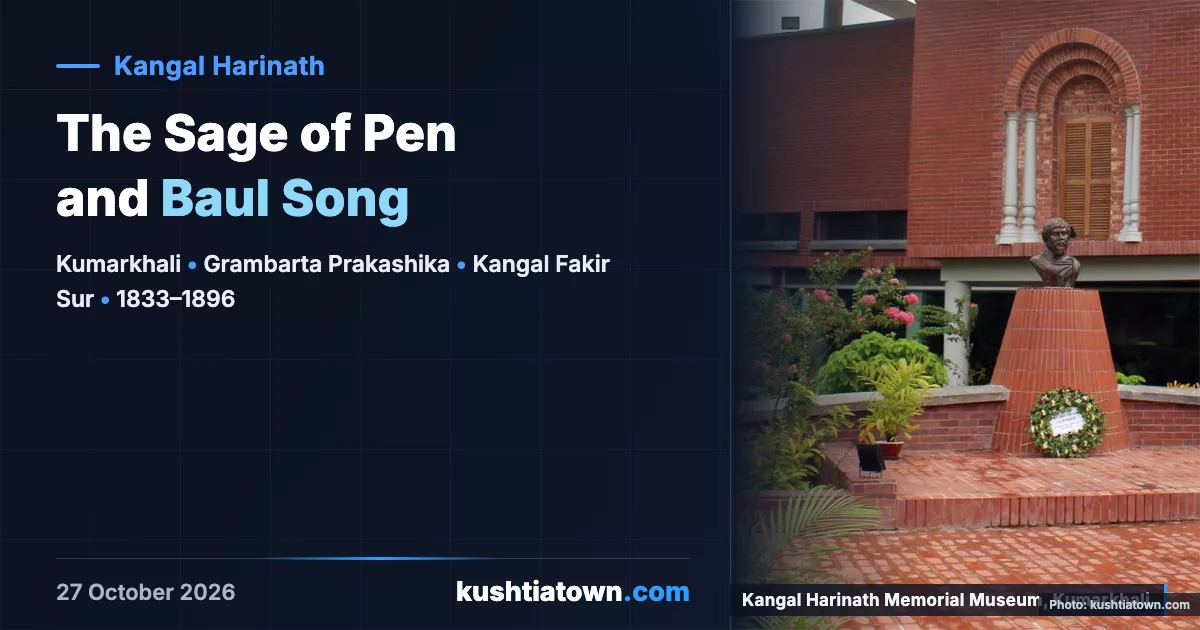
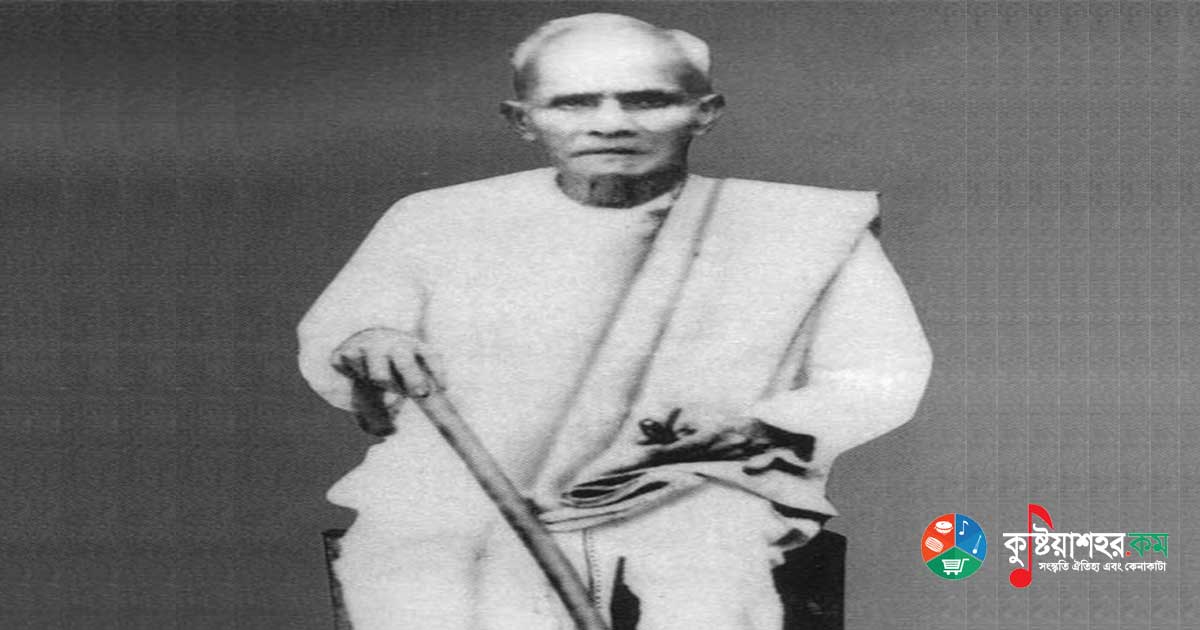
1971. At time's supremely fateful moment came the indelible touch of freedom — the epochal junction of our supreme attainment. Nine months of strength, patience, courage, sacrifice and attainment resolved themselves simply in our independence. In the great cosmic flow of the age, one great man after another was born for discipline and attainment; and again, their discipline broken, they passed away into destruction and decay. On the road of coming and going, some are lost with the setting sun while some remain in remembrance through the ages. In this stream of time, one eternally resplendent personality is Kangal Harinath Majumdar, the time-defying, nature-born blessed son of Kumarkhali in Kushtia. He was born on 20 July 1833 and departed for his divine abode on 16 April 1886. In the sixty-three years between, he lived in this theatre of the world amid manifold thoughts and deeds.
Under Mughal rule, Sultanate rule, Company and British rule, and Pakistani rule — in every age the people of Bangla lived in subjugation. From the burn and ache of this fettered life, our eager longing and yearning for freedom date from those very days. Amid the changing times, after the self-sacrifice of many, came our independence. Master Da Surya Sen, Pritilata Waddedar, Khudiram Bose, Bagha Jatin — liberation-intoxicated men gave their lives age after age, establishing our right to freedom. Another great hero of this lineage of simplicity is our Kangal Harinath Majumdar, who in the May issue of 1880 germinated the seed of freedom through his writings in his Grambarta Prakashika, saying:
Tell me, who can bear the shackles of slavery, who can bear them?"
The dream Kangal Harinath had envisioned for release from contemporary rule, exploitation and the transformation of society found its manifestation in '71. That dream-vision of Kangal's desire was his creation — the paper "Grambarta Prakashika".
From the beginning of Bangla 1270, 'Grambarta Prakashika' began publication. With the razor edge of his pen the battle went on against injustice, against tyranny and persecution. Because of their exposure, the tyrannical zamindars of the area subjected Kangal to persecutions of every kind. Writing of his utter helplessness, he sent word to one beloved, affectionate disciple. He wrote:
"The zamindars, having abandoned their tenants, persecute me to the utmost of their ability. But even that failing, they have at last curbed the hand of their oppression. Now their oppression is heard of no more. Grambarta Prakashika has served the tenants as far as it could. What happens later I cannot say. When the zamindars persecute me and strive to bring false lawsuits in my name, I then call together all the villagers and state the situation. Even if a dog of the village is somehow persecuted, the villagers do something for it; but the sorrow is that my misfortune runs so deep that not one of them ever said, 'We shall do something for him.' Such was the treatment from those for whom I wept, and bore quarrels upon my head."
Bibhutibhushan Bandyopadhyay's first novel was Pather Panchali, its subject the eternal village, its people and the embrace of nature. Amid want and poverty in the family lives of the village people there was an unalloyed joy. Satyajit Ray, taking this story as his basis, created the world-famous film "Pather Panchali". The song he set to melody in that film, in the voice of the artist Chunibala, was:
You are the master of the far shore; hearing the message, I call out to you."
Yet no lyricist's name was attached to this song. The matter came to the notice of M. Maniruzzaman, Kushtia's recently departed luminary and a researcher of Kangal. He at once wrote to the filmmaker Satyajit Ray to inform him of it. In his reply of 08-11-1980, Satyajit Ray told M. Maniruzzaman that when the song was composed for the film, he did not know who the lyricist of this famous song was — yet the song was one passed from mouth to mouth among the Bengalis; "but later I (Satyajit Ray) learned that the lyricist of this song was the famous Kangal Harinath Majumdar."
In the May issue of 1880, through Grambarta Prakashika, Kangal spoke of release from the shackles of life. Only a human being can know the taste and distaste of freedom and subjugation; that is why humans raise their voices to win their rights. But how merciless this devoted, conscious human being can be towards animals, trees and plants, hills and rivers — strangling their freedom to death. And yet Kangal, through the song "Hari Din To Gel Sandhya Holo...", sought the taste of liberation. There he spoke of the great liberation. We find further evidence of the yearning of Kangal's heart: not only did he express enthusiastic support for educating the Bengali nation — particularly women, then lagging behind — he even arranged for their education at his own home. Coming 118 years after the day of Kangal's departure for his divine abode, we reflect that at the juncture of the Kangal era he had pondered how to spread, moonlight-like, the idea of social liberation and freedom of the mind; and he stirred this idea through poetry and song. In the current of our own age, alongside the comrades of the coming Mongolic freedom, we may call Kangal Harinath Majumdar one of the foremost men of this caravan.
Author: Goutam Kumar Roy — researcher, innovator and environmental figure.