বাংলা
 English
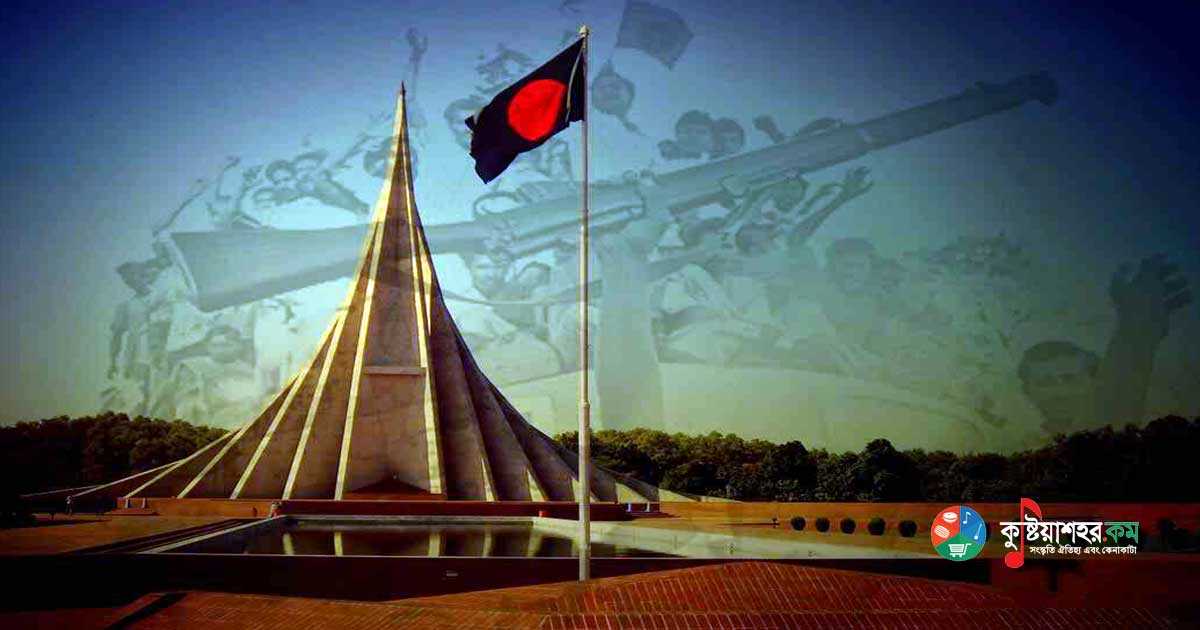
Victory Day is observed as a special day throughout Bangladesh, nationally. Every year on 16 December the day is observed in Bangladesh in a special way. Under a notification issued on 22 January 1972, the day was designated for celebration as a national day in Bangladesh and was declared a government holiday. After nine months of war, on 16 December 1971 some 91,634 members of the Pakistani forces formally surrendered at Suhrawardy Udyan in Dhaka to the Joint Forces formed of Bangladesh and India. As a result, a new independent and sovereign state named Bangladesh emerged in the world.
On this occasion the day is observed in Bangladesh every year with befitting solemnity and immense enthusiasm. The day begins at dawn on 16 December with a thirty-one gun salute. Members of the Bangladesh Army, the Bangladesh Navy and the Bangladesh Air Force join the combined military parade held at the National Parade Square. The salute at the parade is taken by the country's President or Prime Minister. Large numbers of people gather to watch the parade.
As part of paying homage to those killed in Bangladesh's Liberation War, people of all classes, including the President, the Prime Minister, leaders and activists of the opposition and various social and cultural organisations, lay floral wreaths at the National Martyrs' Memorial located at Savar in Dhaka.
Surrender of the Pakistani forces
In 1971, after nine months of bloody war, the Pakistani forces were compelled to surrender to the Joint Forces on this day. That day, on the Racecourse maidan in the heart of Dhaka, General Amir Abdullah Khan Niazi signed the instrument of surrender on behalf of Pakistan. He surrendered to General Jagjit Singh Aurora, the chief of the Joint Forces. At this surrender ceremony, Group Captain Abdul Karim Khandker, deputy chief of the Mukti Bahini and Deputy Chief of Staff, was present. However, General Osmani, the supreme commander of the Liberation War, was not present. The text of the instrument of surrender was as follows:
The Pakistan Eastern Command agrees to surrender all the armed forces of Pakistan stationed in Bangladesh to Lieutenant-General Jagjit Singh Aurora, General Officer Commanding in Chief of the Indian and Bangladesh forces in the Eastern Theatre. This surrender shall apply to all Pakistani army, naval and air forces, as well as all paramilitary and civilian armed forces. These forces shall lay down their arms and surrender where they are, to the nearest regular troops under the command of Lieutenant-General Jagjit Singh Aurora.
As soon as this instrument is signed, the Pakistan Eastern Command shall come under the orders of Lieutenant-General Aurora. Disobedience of orders shall be considered a breach of the terms of surrender, and measures shall be taken accordingly in accordance with the accepted laws and usages of war. Should any doubt arise as to the meaning or interpretation of the terms of surrender, the decision of Lieutenant-General Jagjit Singh Aurora shall be final.
Lieutenant-General Jagjit Singh Aura declares his commitment to give the surrendering troops the dignity and respect due to them under the provisions of the Geneva Convention, and pledges the safety and welfare of the Pakistani military and paramilitary personnel who surrender. Protection shall also be given to foreign nationals, ethnic minorities and persons of West Pakistani origin through the forces under the command of Lieutenant-General Jagjit Singh Aurora.
Recognition of Bangladesh
With the surrender of the Pakistani army, the nine-month Liberation War came to an end, and an independent state named Bangla Desh (the name later came to be used as a single word, Bangladesh) came into being. Almost all the countries belonging to the United Nations recognised Bangladesh within the month of independence.
Celebration of Victory Day
Since 1972, Victory Day has been observed nationally in Bangladesh. The Liberation War of Bangladesh is an important event for the nation, and it is portrayed in various ways through films, poems, articles, the mass media and so on. On the occasion of this day, the armed forces of Bangladesh organise the Victory Day parade at the National Parade Square; besides, Victory Day parades, special discussion meetings, exchange-of-views sessions and cultural programmes are also arranged in every upazila of the country. The main roads of the country are decorated with the national flag. On this day, special homage is paid at the National Martyrs' Memorial at Savar in Dhaka.
Some notable events of Victory Day
- 1971: The State Bank of Pakistan was renamed Bangladesh Bank.
- 1972: The first constitution of the Government of the People's Republic of Bangladesh was published.
- 1972: On 15 December, state honours for special contributions to the Liberation War were announced through the Bangladesh Gazette.
- 1996: The twenty-fifth anniversary was celebrated.
- 2013: 27,117 volunteers gathered together at the National Parade Ground with the red and green blocks of the national flag of Bangladesh and set a new world record for the largest human flag in the world.