বাংলা
 English
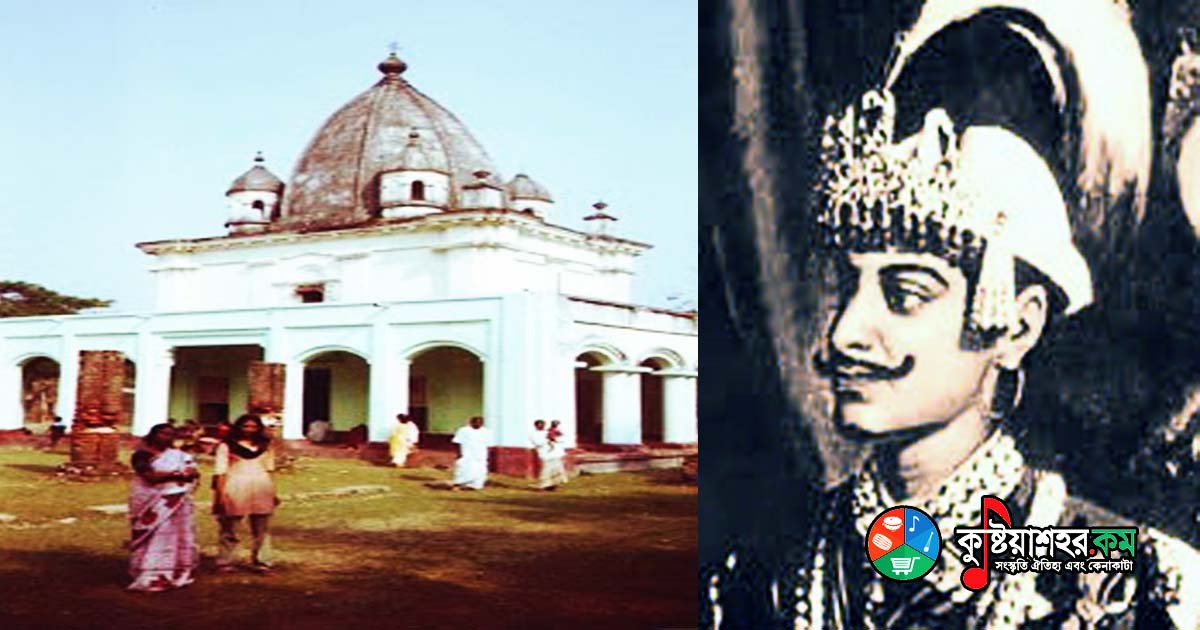
Maharaja of Jessore Kingdom Pratapaditya
Pratapaditya (1561-1611 CE) was a zamindar who later revealed himself as a Hindu king, and he was one of the most powerful zamindars of the Baro Bhuiyans. He fought wars against the Mughals. His kingdom stretched from North 24 Parganas to Kushtia, Jessore and Narail of present-day Bangladesh. The history of Jessore is the history of Pratapaditya.
The saga of glory of his 25-year reign lives on to this day in the Jessore-Khulna region. According to many, the name 'Yashohar' (Jessore) was formed by taking over the glory of the ancient Gaur kingdom. From James Westland's report it is learned that Vikramaditya had a son. His name was Pratapaditya. It was said of him that he possessed all the beautiful virtues of the world. After his father's death Pratapaditya became the sole successor to all the wealth of Jessore.
Pratapaditya's father Vikramaditya Srihari was a Kayastha and an influential royal official under Daud Khan Karrani, the Afghan ruler of Bengal. Daud Karrani killed the prime minister Lodi Khan and, by royal power, confiscated his property. Daud Khan Karrani conferred on him the title 'Vikramaditya' and granted him the zamindari of the deceased zamindar Chand Khan. It is worth noting that Chand Khan had no descendants. After Daud Khan's fall, Srihari became the owner of vast government properties. In 1574 Srihari went to the Bawar area and there declared himself Maharaja Vikramaditya. According to the Vaishnava faith his parents had named him Gopinath. In 1584 AD, at a very young age, a child was born in the womb of the Basu daughter in the wedlock of Srihari Vikramaditya. He was named Pratap Gopinath. This Pratap is the world-renowned Maharaja Pratapaditya, the lord of Bengal. As crown prince he came to be known by the name Pratapaditya.
Ram Ram Basu wrote about Pratap,
"The astrologers said he would be excellent in everything but guilty of patricide. Grieving for Harisha, the king, at the time of the annaprashan, named his son Pratapaditya."
In effect Pratap became the cause of his mother's death and turned patricidal. When he was only 5 days old his mother died in the maternity home. Srihari was heartbroken at the loss of his wife, and likewise, accepting that his son had proved fatal to the father, he began to suffer unrest. So from the very beginning he was annoyed with Pratap.
Pratap did not receive much paternal affection. As his mother died when he was very young, he was brought up in the affection of Basanta Roy's first wife, his aunt. Though his father remained annoyed with him, thanks to the affection of King Basanta Roy, an embodiment of loving kindness, he suffered no particular harm. In his aunt's boundless affection Pratap did not even know that he had no mother of his own. Pratap revered his aunt as his mother with great devotion. His arrogance dissolved in the hint of maternal affection. During Pratap's reign this mother was known as "the Maharani of Yashohar".
In very early childhood Pratap was quiet and innocent. Under the influence of parental affection he became restless and fickle-minded in boyhood. At this time Pratap became famous for valour and courage. He was extremely sharp-witted and meritorious. In his life he received education in the Sanskrit, Persian and Bengali languages. He could recite Sanskrit tantric hymns most beautifully. He could write letters in Persian and speak most beautifully. In provincial Bengali he used to converse with soldiers. He was not so fond of all these educations. He favoured the learning of arms more than the learning of the scriptures. His best teacher of all was King Basanta Roy himself. Under the worthy guardianship of his uncle Basanta Roy, Pratap grew into a worthy personality of the Jessore kingdom. From the beginning King Basanta Roy, seeing the indomitable zeal of the rising youth and his ability in the management of men, expected much of Pratap.
In childhood Pratap acquired proficiency in the art of war. He learned the sword, archery and wrestling. From birth Pratap had a close relationship with the Sundarbans. He hunted tigers, deer, rhinoceroses (they existed formerly) and the like in the forests of the Sundarbans. Entering the forest with friends, Pratap achieved special feats. At this time, at the boy Pratap's unruliness, Vikramaditya and Basanta Roy fell into great trouble. Finally, after deliberation, the two decided that if Pratap were married his mind might change. For this they both took the initiative and married Pratap off. The matchmaking records mention Pratap's three marriages. Pratap was first married to the daughter of Jagadananda Ray (Basu), of the highest kul. In 1578 AD Pratap was married with great pomp to Saratkumari, daughter of the honoured and wealthy Jitamitra Nag. This Saratkumari was his Pattarani or chief consort. Pratap's third marriage took place long after he had become king. He obtained as wife one of supreme beauty, of virtue and of love, but his arrogance and his hunting expeditions did not diminish. Vikramaditya and Basanta Roy again consulted and sent Pratap to the capital Agra for political education. The purpose was that if he went to represent the Jessore kingdom at the court of Emperor Akbar, the troubles of the royal house would be dissolved, and in his absence the two brothers could govern the kingdom in peace for a time. At the end of 1578 AD Pratap, together with Suryakanta and Shankar, was presented at the court of Agra carrying a letter from King Basanta Roy. Pratap met Todar Mall with the letter, and it was he who opportunely introduced Pratap to the Emperor. He told Emperor Akbar about Pratap in the best terms. There Pratap learned much about the governance of the vast Indian empire and about the deeds and arts of various heroes, especially the Rajput heroes. He stayed in the capital Agra for nearly three years. In 1580 AD Todar Mall came to Bengal to suppress the rebellion of the jagirdars of Bengal and, being appointed governor of Bengal the following year, conducted the administration most admirably. During Todar Mall's absence Pratap, adopting a stratagem, took the sanad (charter) of the Jessore kingdom into his own hands and began to control it. While Pratap was in the capital, his father and uncle sent him the revenue. Two or three times Pratap embezzled the money instead of depositing it with the government. When the government sought the revenue in due time, Pratap laid the blame on Basanta Roy. Because of him the revenue was not sent to the capital. After the rebellion in Bengal this news did not seem auspicious. When an order was issued to take the Jessore kingdom out of Vikramaditya's hands, the grateful Emperor showed favour to Pratap and wrote out a second sanad of the Jessore kingdom in the name of the rising youth. Pratap paid off the remaining revenue from his accumulated money. In 1561 he ascended the throne. Sri Hari divided his kingdom into two parts, giving five parts of eight to Pratapaditya and three parts of eight to his brother Basanta Roy.
Basanta Roy's brother was Laksikanta (who later became known as Laksikanta Raychowdhury), whom he brought up. He taught him zamindari and administrative matters alongside Pratap. Pratapaditya joined the administration of Jessore and proved himself a capable ruler. At the time of Pratapaditya's coronation many of the Baro Bhuiyans went to Jessore and pledged to work together with Pratapaditya to keep the independence of Bengal unimpaired. Pratapaditya saw that Emperor Akbar was occupied with the royal court of Agra, with politics and with the internal feuds of the royal family, and that as a result rebellion was sprouting up all over India. Taking this opportunity Pratap began preparing the army for troop formation and the defence of the frontiers. Essentially Pratap was striving for self-defence and self-pre-eminence, for support of the Pathan side, for the re-establishment of Hindu power in Bengal, and for protecting his subjects from the savage oppression of the Magh and Firingi pirates as well as the Mughals. With this aim he was organising the new capital, and had begun discussions with the other Bhuiyans of Bengal on ways of expelling the Mughals. While some of the Bhuiyans expressed solidarity with this rebellious spirit of Pratap's, many kept their distance. After becoming the lord of the state, Pratap planned to shift the capital. After King Vikramaditya's death in 1583, he founded a new city at a place called Dhumghat beside the Sundarbans, at the confluence of the Jamuna and Ichamati rivers, 8/10 miles south of Jessore city. There Pratapaditya's coronation was completed. The ruins of Dhumghat are today located in the Tirakati forest. The main burden of building the fort of Dhumghat lay on the Pathan general Kamal Khoja. There is a legend that one crore taka was spent at the festival of Pratap's coronation. Even after the division of the kingdom, Basanta Roy remained in charge of the kingdom's management for a long time.
Pratapaditya, one of the Baro Bhuiyans of Bengal, upon ascending the throne concentrated on increasing his military strength. The shrewd Pratap, from the beginning, kept up good relations with the Mughals. At the Mughals' call he marched to war several times as a vassal king. Among the campaigns he joined with the Mughals, the Orissa campaign with Man Singh is notable. From Orissa he brought the Govinda Deva idol and, from Utkaleshwar, a Shiva lingam, and installed them at places called Gopalpur and Bedkashi.
From the information available it is learned that in 1587 AD Pratapaditya began ruling the kingdom himself. In that same year construction of the Dhumghat fort began, and the work was finished soon after. To become the Mughals' vassal he went with Man Singh on the Orissa campaign. After returning from the Orissa war he resolved to declare independence and began to act against the Mughals. His uncle Basanta Roy tried to disarm him, making him understand the terrible consequences. Pratap took the words of restraint in the opposite sense. Uncle and nephew no longer had trust in each other. Pratap began always to look upon Basanta Roy with suspicion.
For some days Pratap kept up good relations with his uncle. Basanta Roy, performing many good works, became beloved of the subjects. This good repute of the uncle gave birth to feelings of enmity in Pratap's mind. Invited to a shraddha festival, Pratap went to his uncle's house and, on a trifling matter, under the sway of suspicion, killed him together with his three sons. At the time of this massacre, Basanta Roy's youngest son Raghav Ray saved himself in a kachu grove, for which he later became famous by the name Kachuray.
Some say that at the root of the estrangement that arose between Pratap and his son-in-law Ramchandra Ray lay Basanta Roy's intrigue. Pratap took his revenge merely by killing his uncle. In this incident Laksikanta was extremely enraged; he resigned from the zamindari administration and went to Kalighat, his birthplace. It is said that Pratapaditya at that time put coins into circulation in his own name. After declaring independence, Pratapaditya's self-ruled kingdom also became vastly extended. In 1600 AD Pratap's power and fame spread across the whole of India. At that time everyone believed that none but a god could be so mighty.
Wars and victories against the Mughals and friendship with other kings
After his uncle's death Pratapaditya gained possession of the whole Jessore kingdom and, assuming the title of Maharaja, went on ruling the kingdom. At this time clashes continued between the Mughal and Pathan forces of Bengal and Orissa. Pratap was naturally inclined to the Pathan force. At that time in his mind the hope of founding an independent kingdom in the Vati lands of lower Bengal also raised its head. Around 1599 AD Pratap began ruling the kingdom defying the Mughal Subahdar of Bengal and declared independence. When the purpose of Pratapaditya's war preparations reached the ears of the Subahdar of Bengal, he sent in succession two Mughal generals named Sher Khan and Ibrahim Khan against Pratap. But they, considering Pratap a petty landlord, came to Yashohar. Yet they could not take any effective measures. They retreated, admitting defeat before his Yashohar forces. News of these victories of Pratapaditya spread in all directions. The Bhuiyans of various areas made friendship with him and vowed to fight unitedly against the Mughal Emperor. Defeating the Mughal army twice in a row, his lust for wealth grew. He proceeded to plunder the Mughal-ruled port of Saptagram and amass wealth. The foujdar of Saptagram could not prevent Pratapaditya's surprise attack. As a result all the wealth of Saptagram fell into Pratapaditya's hands. The Sreepur zamindar house - within 1 km of Sreepur upazila sadar stand the ruins of the royal palace of the Pal kings. Here Sardaranjan Pal Chowdhury founded the zamindari. Sreepur and the surrounding areas were within the zamindari. The magnificent, captivating, eye-catching palace-like house of the Sreepur zamindar bari - its entrance gate, that is the Singhadwar, now lies in ruins. About the history of the zamindari it is learned that the zamindari was purchased from Nawab Alivardi Khan. By ties of marriage Sardaranjan Pal Chowdhury was related to Maharaja Pratapaditya of Jessore, one of the Baro Bhuiyans of Bengal. The daughter of zamindar Sardaranjan Pal Chowdhury, Bibha Pal Chowdhury, was married to Udayaditya, son of Maharaja Pratapaditya. Through this connection Maharaja Pratapaditya came to Sreepur. There is also hearsay that around this Bibha Pal Chowdhury the poet Rabindranath Tagore wrote the novel 'Bouthakuranir Hat'. At present the entrance gate of the house, that is the Singhadwar, remains in a ruined state.
Suppression of the pirates
Maharaja Pratapaditya, taking the reins of rule, concentrated on suppressing the oppression of the Magh and Portuguese pirates along the coast of the Bay of Bengal. Through the oppression of the Maghs and Firingis, anarchy arose in Bengal, India's paradise on earth. The Maghs obeyed no rule. Wherever the Maghs went they utterly destroyed that territory. At that time southern Bengal was tormented by the oppression of the pirates. They seized the men and women of this country and sold them as slaves. The captives had the palms of their hands pierced, thin canes thrust through, and were loaded in hali rows under the decks of the ships and carried away. From the Bhagirathi to distant Chittagong they wrought such mischief. These pirates were called the Harmad. Pratapaditya subdued them. Many joined his army.
Military campaigns
At this time various kinds of unrest prevailed at the court of Agra. After Emperor Akbar's death, Prince Selim assumed the name Nuruddin Muhammad Jahangir and ascended the throne. Now at Jahangir's court various complaints were raised about Pratapaditya. At this time Kachu Ray, son of Basanta Ray, also laid the whole story before the Emperor. Hearing all the complaints, Jahangir sent his general Man Singh to subdue Pratapaditya.
In 1600 AD Man Singh came from Kashi to Rajmahal and began planning to bring Bengal truly under Mughal control. In 1603 AD he marched towards Jessore with a vast host of troops. For about 25 years the Pathans had been defeated in Bengal, but because of Pratapaditya and the other Bhuiyans that defeat brought the Mughals no gain.
About this journey of Man Singh, Bharatchandra says:
'Ahead and behind, two ranks of troops on either side.
Man Singh marched to the city of Yashohar.
Taking Majundar along, riding a horse,
asking near and far, countless and special questions.'
Man Singh crossed the Kalindi river and camped at Basantapur, and saw that Pratapaditya had arrayed his troops all around and kept every preparation for war ready. This battle was fought in the eastern part of Basantapur and Shitalpur. Suddenly one day a terrible storm and rain came, and Man Singh's provisions and camp were drenched by the rainwater. For lack of dry firewood and food the soldiers fell into great hardship. At this time a zamindar named Bhananda Majumdar, a resident of Andulia, gave King Man Singh every kind of help. With his help Man Singh was able to attack Dhumghat.
This war was fought for countless days, and Man Singh, victorious, took Pratapaditya prisoner. Man Singh knew Pratap and loved him dearly. The memory of Pratap's valour in the Orissa campaign was in his mind. In the Jessore war he was charmed by the extraordinary military strategy of the Bengali hero. He himself was a great hero, so he understood the worth of valour. Though he won the war, at its end he made peace with Pratapaditya. Pratapaditya was recognised as a vassal king of the Mughals over the 10-anna share of the Jessore kingdom (the remaining 6 annas belonged to Basanta Roy's son Kachu Ray). Man Singh ordered the abolition of the flag and the coinage, the marks of independence. Although Laksikanta's descendants claim that King Man Singh held Basanta Roy in the greatest respect. After defeating Pratapaditya, King Man Singh met his guru-son Laksikanta.
The Sundarbans' contribution in Pratapaditya's reign
The Emperor Akbar of Delhi sent armies many times to suppress these rebellions, but the Sundarbans gave Pratapaditya a good position, as a result of which he could easily oppose the Emperor. This rebellion of his continued for a long time. Yet this rebellion was not like any ordinary war. The silence of the Muslim historians on this subject proves that in fact the Emperor sent only a very small troop to settle a local dispute. From the records of the royal family of Chanchra it is learned that a general of Akbar named Khan Azim managed to occupy some parganas of Pratapaditya. Although Pratapaditya defeated that royal force many times, his power and influence were thereby much diminished. Most of the vast kingdom belonged to the Sundarbans. In his time the kingdom of Yashohar being a principal land of Bengal, the impenetrable Sundarbans became accessible to people. But even then the dense forests of the Sundarbans remained equally in existence as the abode of the tiger, the wild buffalo and the crocodile. In the accounts of the Jesuit priests who came hither for this purpose in Pratapaditya's time, the description of the Sundarbans is found to mention its dense forest and wild animals. The marks of Pratapaditya's capital and of the villages, towns, forts and ghats he founded still exist within the Sundarbans, bearing witness to how glorious it had become in the sixteenth century.
From the seventeenth century its settlements again began to turn into dense forest. As for why the dense forest of the Sundarbans became densest, generally two causes are supposed. The first cause is flood and earthquake, and the second cause is the oppression of the Magh and Firingi pirates. Because of these two causes its inhabitants were compelled to abandon the villages and towns within it and flee, and so in the seventeenth century the destruction of the Sundarbans began again.
Alliance and campaign against the Mughals
Among the zamindars of Bengal, Pratapaditya was the first person to send representatives to gain the favour of the Mughal Subahdar Islam Khan. In 1608 Pratapaditya's representative Shaikh Bari and his youngest son Sangramaditya appeared at the Subahdar's court with abundant presents. According to the agreement, Prince Sangramaditya was kept in the Subahdar's custody on condition that Pratapaditya would appear in person. In 1609, on the bank of the Atrai river, Pratapaditya surrendered to the Mughal Subahdar.
Pratapaditya agreed that, after returning to his kingdom, he would send his youngest son Sangramaditya with 400 warships to join the Mughal army. And that he himself, proceeding along the Arialkhan river with 20,000 paiks, one thousand cavalry and 100 military naval vessels, would conduct a campaign against Musa Khan. Because Pratapaditya did not keep his promise, Subahdar Islam Khan prepared a military campaign against him. In apprehension of the coming attack he sent his youngest son Sangramaditya to the Subahdar with eighty vessels. But the Subahdar, not accepting the vessels, ordered their destruction.
Pratapaditya had built a strong army composed of soldiers of Afghan origin and hired Portuguese soldiers. He gave Udaynarayan the responsibility of defending the Salka fort. With Udaynarayan was an Afghan general named Jamal Khan. Jamal Khan was the chief of the cavalry and the elephant corps. And another Afghan led a fleet of 500 vessels.
The battle of Salka
The Mughals sent a huge force of 1000 cavalry and 5000 musketeers. In this force were quite a few experienced military officers such as Mirza Makkih, Iftikhar Khan, Mirza Saifuddin, Sheikh Ismail Fatehpuri, Sayek Qaysar and Lachmi Rajput. The chief of the Mughal infantry was Ghiyas Khan alias Enayet Khan, brother of the Subahdar Islam Khan. At the same time another campaign was sent against his son-in-law Ramchandra, king of Bakla, so that he could not advance from Bakla to Jessore's aid. In December 1611 the Mughal army advanced towards Jessore along the banks of the Ichamati and Bhairab rivers. Quickly they reached a place called Salaka at the confluence of the Jamuna and the Ichamati. As the Mughal force advanced towards Salka, Udaynarayan suddenly attacked them. The Mughal force suffered some damage. He left the Afghan Jamal Khan in charge of the fort. The Jessore force compelled the Mughal force to retreat. Later, before the fierce attack of the artillery, the Jessore force suffered extensive losses. Khwaja Kamal was killed. Uday Narayan fled. Jamal Khan, with his elephant corps, pursued Uday Narayan.
The battle of Khagar Ghat
Pratapaditya made preparations for war a second time. This time the battlefield was the confluence of the Khagar Ghat canal and the Jamuna. In January 1612 the Mughal army attacked the Jessore army and compelled it to take position inside its fort. The Jessore army hindered the Mughal army's advance with massive bombardment. But in a surprise attack the Mughal army seized the fort. Pratapaditya was compelled to abandon control of the fort and flee. After defeat for the second time, Pratapaditya's fate was sealed. King Man Singh asked Laksikanta to take the throne. But he refused it. An employee of Pratapaditya named Bhananda Majumdar was placed on the throne. Later he founded the Nadia royal family.
Administration
King Pratapaditya was a capable administrator. In his time the rule of law prevailed in the country. The poet Bharatchandra wrote -
'The city of Yashohar, the abode,
Pratapaditya is the name,
the Maharaja, a Kayastha born of Bengal;
he accepts no Badshah,
none can bar his way,
in fear all the kings stand at his door;
the darling son of Bhavani,
dearest on earth,
his villages number fifty-two thousand,
sixteen squadrons of elephants,
ten thousand steeds swift,
in war his general, Kali.'
Among Pratapaditya's amirs and omrahs, Suryakanta and Shankar were powerful. Shankar Chakravarty, learned, sedate, devoted to duty and endowed with a Brahmin's gifts, used to superintend matters of revenue and state governance. The great warrior, peerlessly daring, versed in all the scriptures and unmatched in the management of men, the powerful Suryakanta was the chief general of the kingdom in the first part of the reign. He discharged the duties of maintaining the troops, arranging for war and accumulating strength. Shankar was the head of the diwan and counsel departments, and Suryakanta the head of the military department.
Territory
Pratapaditya's kingdom was made up of greater 24 Parganas, Jessore and Khulna. Present-day Kushtia, Barishal and Bhola were also included in his kingdom. In the first phase Pratapaditya's capital was in the Mukundapur area. Later he established the capital at Dhumghat, in the Ishwaripur area. Later Dhumghat itself came to be called Yashohar.
The Yashoreswari Kali temple
The presiding deity of Jessore was Yashoreswari. According to popular legend, one morning an ordinary official of the royal family discovered a radiant light in a nearby forest. When he was informed of it he went in search of the source of the light. Deep inside the forest he found an idol of Mother Kali, which was giving off light. He realised that this was the idol of the presiding deity, the guardian of his kingdom and of its people. So he brought the idol to his capital and built a temple so that he might worship it.
Armed forces
Pratap was a master of statecraft. During Pratap's reign, as need arose, he built forts in various places. Pratap's forts stretched over an area from the Hooghly river in the west to the Baleshwar river in the east. The broken remains of some of the forts can still be seen. Among them, 14 notable forts stood at Jessore, Dhumghat, Raygar, Kamalapur, Bedkashi, Shibsa, Pratapnagar, Shalikha, Matla, Haydergar, Arai Kaki, Mani and Raymangal. Seven forts stood in present-day Kolkata. The places are Matla, Raygar, Tala, Behala, Shalika, Chitpur and Mulagor.
Although Pratap was a Hindu king, he employed Pathan and Portuguese soldiers because they were more skilled in war. Pratap's army had nine divisions. Under the commander-in-chief each of these divisions had its own soldiers. The army was divided into nine divisions: shield-bearing or infantry soldiers, cavalry, archers, artillery men, naval soldiers, secret soldiers, guards, elephant soldiers, and the hill and Kuki soldiers. In war shields, swords, sharkis, spears, leja, cannons, muskets, javelins, arrows and the like arms were used. The head of Pratap's artillery was Francisco Rodra. The chief of the navy was Augustus Pedro. A daring hero named Sukha was the chief of the secret force. The chief of the guard force was Ratneshwar, not Yajneshwar - Bijay Ram, Bhakt Chowdhury and others. No name of a chief of the elephant corps is found. The names of the chiefs of the infantry were Kalidas Ray and Madan Mall. According to Bharatchandra's writing, Pratapaditya's army had 52,000 shield-bearers. There were many Kuki soldiers; their general's name was Raghu. The cavalry had 10 thousand soldiers, whose general was Pratap Singh Datta; Mahiuddin and Nurulla were his assistants. The chiefs of the archer force were Sundar and Dhulian Beg. 1600 elephants were trained for war. Besides these, Pratapaditya had a strong intelligence force.
Most of the members of Pratapaditya's army were Bengali Kayasthas, Rajputs, Portuguese soldiers and Afghan Muslims. A large number of Arakanese and Kuki soldiers were in his force. Among the generals of his force were Jamal Khan, son of Gotra Khan, and Khoja Kamal - all of them Afghan Muslims. There was also a Bengali Brahmin whose name was Rudraditya Upadhyay. Rudraditya was the husband of his brother's daughter.
Navy
Against the background of the continual attacks of the Portuguese and Arakanese pirates on the coast of Bengal, no ruler of Bengal could deny the need for a strong navy. All the Baro Bhuiyans had navies of their own. According to Professor Radha Kumud Mukherjee's analysis,
In that era the Hindus of Bengal had their main naval bases at Chandikhan and Sagar Island. These two naval bases were under the control of the doughty king Pratapaditya. Many warships always stood ready for expedition. Besides, Pratapaditya had shipyards and dockyards at three more places. Those places are Dhubali, Jahajghata and Chakrashi. There the warships were repaired and preserved.
The warships were generally built of Sundarbans timber. Some ships had 64 oars. Most of these vessels were armed with cannons. According to the Dutch historian Jos Gommans, the number of the Mughals' vessels at that time was 500. The number of King Pratapaditya's vessels then was nearly double that. Although Pratapaditya's navy was at first under Bengali generals, its leadership was later given into the hands of Portuguese generals. Considering the rivers, canals and beels of lower Bengal and the Sundarbans region, Pratapaditya concentrated on naval power and the navy. Judging the country's needed equipment, the state of the rivers and the nature of the coast, he built katris. Among the fast boats used in Pratap's force were the ghurab, bepari, kosh, baliya, pal, machwa, pashta, jalia, piyara, mahalgiri and the like. Among all these boats the ghurab was the strongest and most powerful. In his time the artisans of Jessore acquired special skill in shipbuilding. At that time Shaista Khan had many ships built from Jessore. The number of Pratapaditya's finest katris was over a thousand. From the account of a traveller named Abdul Latif in Islam Khan's nawabi era it is learned, "Pratapaditya was a powerful king of Bengal. In his war stores he had fully seven hundred boats and twenty thousand infantry soldiers, and the income of his kingdom was fifteen lakh taka." On the eastern side of the Kaliganj-Shyamnagar road, near Mautala, at a place called the Kuakuar forest, there was his ship anchorage. In the nearby village of Dudulia was the dock where his katris were built. In the naval department of Jahajghata there is a village named after Frederick Dudley, its chief. The supervisor of the dock was Khwaja Abdullah, and the head of the naval soldiers was Augustus Pedro.
Death
After the battle of Khagar Ghat the Mughals put forward a peace proposal. Though the Mughals won this vast war, the soldiers of both sides were exhausted and worn. In the treaty Pratapaditya's personal safety was assured. After Pratapaditya was defeated by Ghiyas Khan, Ghiyas Khan himself, chaining him, presented him at Islam Khan's court. He was kept in custody in Dhaka. No very good authoritative record of the last days of Pratapaditya's life is found. In some Mughal documents it is found that, while being taken to Delhi as a prisoner, he fled from Benares. On the way back to Bengal from there he died. Pratap's radiance, religious steadfastness and attempt to establish independence made him immortal not only among the people of this region but among the people of the whole of India. Guru-dev Ramdas Swami therefore wrote -
It is said: hear the greatness of Bengal's Pratap. In radiance, valour and virtue Pratap was ready to win independence, but his people and his country were not ready; many of his kinsmen and friends were hostile, and so the attempt failed. That foolish man, without considering country, time and person, wished to rush alone; when he stumbled, no one remained to raise him up.