বাংলা
 English
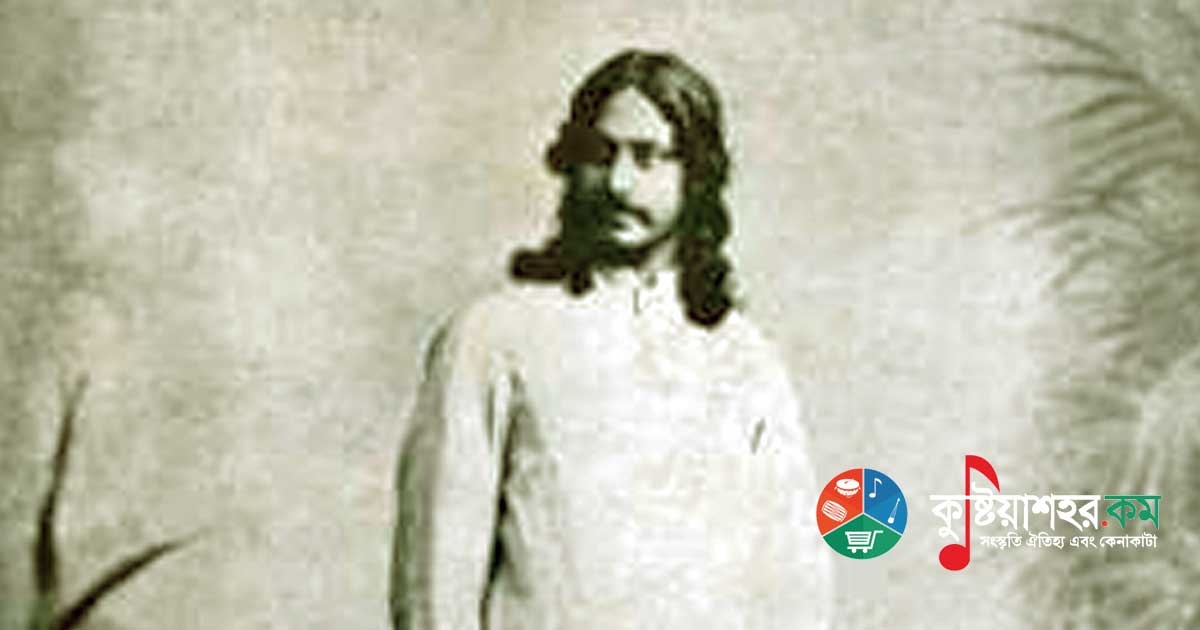
One of the foremost poets, lyricists, composers, storytellers, novelists, playwrights, educators, critics, linguists, painters, thinkers, philosophers and social reformers of the Bengali language.
Over a career spanning 65 years, Rabindranath created 52 volumes of poetry, 38 plays, 13 novels, 36 essays, a total of 95 short stories, nearly two thousand songs and around two thousand works of painting. Beyond these lie countless letters and speeches.
On 25 Boishakh of Bangabda 1268 (7 May 1861), at 2 hours 38 minutes and 37 seconds past midnight on a Monday, he was born at the Thakurbari of Jorasanko in Calcutta. His father’s name was Debendranath Tagore and his mother’s name was Saradasundari Devi. Rabindranath was the fourteenth child and the eighth son of his parents.
Rabindranath’s forefathers were from the Pirali area of Jessore district. Through the course of many events, his father, Debendranath Tagore of Calcutta, eventually came to live at Jorasanko. This house is known simply as the ‘Thakurbari of Jorasanko’.
It was the custom of the wealthy families of that era to appoint a wet nurse to breastfeed a child soon after its birth. Following this custom, Digambari (Digami) served as his wet nurse.
It may be noted that, to spread the message of the Brahmo Samaj, Debendranath Tagore launched a periodical called ‘Tattwabodhini’ on 21 December 1843. He then formally embraced the Brahmo faith along with 21 of his relatives. His remaining relatives abandoned him at the time. When Rabindranath was born, the religion of the father’s line had been forsaken in Debendranath’s household, although some feminine family customs still prevailed. Thus, after Rabindranath’s birth, certain rituals of the Sanatan (orthodox Hindu) faith were performed. Those ceremonies, however, did not come into conflict with the Brahmo faith.
In 1864 his primary education began at the little school of the Thakurbari. When his elder brother Soumendranath and his nephew Satyaprasad began attending the school, Rabindranath started going there and back with them. He was formally admitted to the school in January 1865. In April 1865, after much crying and pleading, he was admitted to the infant class of the ‘Calcutta Training Academy’. Although in his memoirs this school is referred to as the ‘Oriental Seminary’, it was later proved that the school was in fact named the ‘Calcutta Training Academy’. In November he left that school and enrolled in the same class at the ‘Government School’. The other name of this school was the Normal School. He studied there up to class six. In March 1872 he was admitted to the Bengal Academy. During this period his education was disrupted for various reasons.
In March 1873 Rabindranath travelled to Amritsar with his father Debendranath. In that very year — that is, in his eleventh year — he crossed into his eleventh year. Around this time he translated a devotional song of Guru Nanak, though there is debate over who really translated this song. Many believe that the real translator of the hymn was his elder brother Jyotirindranath Tagore.
The translation reads – ‘On the platter of the sky the sun and the moon burn as lamps,
the galaxy of stars twinkles like pearls. ......’
In 1874 he left the ‘Bengal Academy’ and enrolled in the ‘Vidyasagar School’, or the ‘Metropolitan School’. But he never went to this school even once. In the same year he joined the school department of St Xavier’s College in the ‘Fifth Year’s Class’, which was one class below the entrance class of that school and was called class five. He could not fit in at this school; feigning illness, he often ran away from it. From the beginning of 1876 he abandoned attending this school altogether.
In 1877 the monthly magazine Bharati began publication from the Thakurbari. It appeared serially from the Paush issue of its first year through the Chaitra issue. From its very first issue, Rabindranath’s writings began to be published in it.
On 20 September 1878 he went to England to study. He spent some days at Brighton there, and for three months he studied English literature under Professor Henry Morley of University College in London. On 5 November of that year his verse narrative Kabi Kahini was published.
Although Banaphul preceded it in terms of the time of composition, Kabi Kahini was the first of Rabindranath’s poetry books to appear in book form. Kabi Kahini was published on 5 November 1878. About this book Rabindranath wrote in his Jibansmriti –
This work, Kabi Kahini, was the first of my writings to come out in book form. When I was with my second elder brother in Ahmedabad, some enthusiastic friend of mine had the book printed and sent it to me, astonishing me. – First edition, p. 108.
There is a slight error in this remark of Rabindranath’s. In fact, the book was not published while he was staying in Ahmedabad. On 20 September 1878 he set out for England, and Kabi Kahini was published on 5 November. He never got to see the book in print. The “enthusiastic friend” mentioned by Rabindranath was Prabodhchandra Ghosh, the publisher of Kabi Kahini. Judged by the time of composition, Banaphul was the first complete book of poetry Rabindranath wrote. It was published in Bangabda 1286 [9 March 1880].
In February 1880 he returned home, leaving his education in England unfinished. As mentioned earlier, in that year his book Banaphul was published in book form.
On 22 April 1881, having set out for England a second time with the intention of studying for the bar, he returned by way of Madras. On 23 June of that year [1803 Shakabda] his dramatic poem Bhrantihriday was published, and on 25 June came out the short play Rudrachanda.
On 9 December 1883 he married Bhatarini, a resident of Jessore [later Mrinalini Devi]; Rabindranath later changed her name to Mrinalini. The duty of looking after the zamindari fell upon Saradaprasad Gangopadhyay, the husband of Rabindranath’s eldest sister Saudamini Devi. On the very day of Rabindranath’s wedding, he died at Shilaidaha. As a result, the joyous celebration of the marriage turned into mourning.
On 19 April 1884, Kadambari Devi, the wife of Jyotirindranath Tagore, committed suicide. This death was the first great sorrow of Rabindranath’s life.
After the death of Saradaprasad Gangopadhyay, Saudamini Devi’s husband, at Shilaidaha, the responsibility of looking after the zamindari passed to Rabindranath’s third elder brother Hemendranath Tagore. When Hemendranath died on 12 June of that year, that responsibility was laid upon Rabindranath. In the same year he also took up the post of secretary of the Adi Brahmo Samaj.
On 25 October 1886 his first daughter Bela, or Madhurilata, was born. In March–April 1888 he went to Ghazipur with his wife and daughter and stayed there for some days. His second child, Rathindranath, was born that very year.
In 1889, to look after the zamindari, he moved with his whole family from Calcutta to Shilaidaha in Kushtia and began living there. From there he also discharged the duty of supervising the zamindari of Sahajadpur in Pabna.
On 26 December 1890 [Friday, 12 Poush], the sixth session of the Indian National Congress was held in Calcutta. He took part in that session.
In 1901 he established a residential school at Santiniketan. Around this time he began living permanently at Santiniketan.
In 1902 his wife Mrinalini Devi passed away. Some days after his wife’s death, his middle daughter Renuka Devi also died.
In 1905 his father Debendranath Tagore died. In 1907 his youngest son Shamindranath Tagore died. From 1910 he began editing the magazine Tattwabodhini founded by his father Debendranath Tagore, and he edited it until 1915.
In 1913 he received the Nobel Prize.
In 1915 the British government conferred on him the title of knighthood (Sir).
In 1918 his eldest daughter Madhurilata passed away. On 13 April 1919, in protest against the Jallianwala Bagh massacre, he renounced the knighthood conferred by the British government.
In 1920–21 he travelled through various countries of Europe delivering lectures.
In 1926 he toured Germany. It was then that Rabindranath met the scientist Einstein. At that time the two of them discussed truth and beauty.
In July 1930 Rabindranath again toured Germany. At that time he had a conversation with Einstein. Towards the end of that year Rabindranath met Einstein for the last time, and they held their second conversation.
In 1936 a D.Litt. degree was conferred on him by the University of Dhaka.
On 7 August 1941 (22 Srabon 1348 Bangabda), at 12:10 in the noon, he passed away at the Thakurbari of Jorasanko.