বাংলা
 English
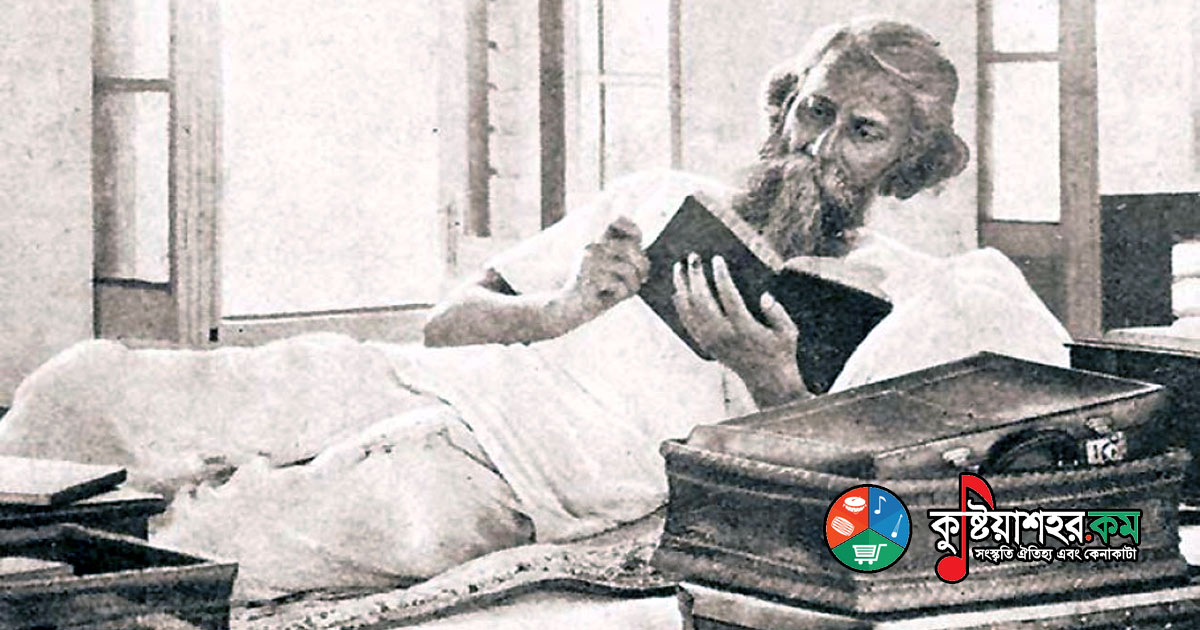
Novels: Rabindranath Tagore’s novels are among his most popular literary works in the Bengali language. Between 1883 and 1934 Rabindranath wrote a total of twelve novels. Notable among them are Chokher Bali, Gora, Ghare Baire, Chaturanga, Shesher Kobita, Char Adhyay, Bau Thakuranir Hat and others.
In poetry: The poems Rabindranath created have been discussed in terms of their literary value by dividing them into several periods. In 1887, at the age of only sixteen, his first poem appeared under the pseudonym “Bhanu Singha”. In his early life Rabindranath Tagore was a poet who followed Bihari Lal Chakrabarti. The influence of Bihari Lal is evident in his three verse works Kabi Kahini, Banaphul and Bhrantihriday. From the volume Sandhya Sangeet onward, Rabindranath began to speak in his own voice. Thereafter, one after another, came the volumes Sandhya Sangeet, Prabhat Sangeet, Chhabi O Gan and Kari O Komal; then Manasi (1890), Sonar Tari (1894), Chitra (1896), Chaitali (1896), Kalpana (1900) and Kshanika (1900), Naibedya (1901), Kheya (1906), Gitanjali (1910), Gitimalya (1914) and Gutali (1914), Balaka (1916), Palataka (1918), Purabi (1925) and Mahua (1929); and after them Punascha (1932), Shesh Saptak (1935), Patraput (1936) and Shyamali (1936) were published. Within his poems we find at times the melancholy of the human heart, thoughts of human love or romantic ideas of love and beauty, at other times Rabindranath’s spiritual thinking; and in several volumes he portrayed the contemporary problems of women’s lives. In place of the obscurity of ancient literature he adopted the framework of a simple and lively kind of verse. In the last decade of his life, in the volumes Rogshajyay (1940), Arogy (1941), Janmadine (1941) and Shesh Lekha (1941, published posthumously), he gave death and the love of this mortal life a new form of expression. His last poem, “Tomar Srishtir Path”, Rabindranath composed orally eight days before his death.
The best-known of Rabindranath’s books throughout the world is Gitanjali (Song Offerings). It was for this volume of poems that he received the Nobel Prize in 1913. The Nobel Foundation described the work as a “deeply sensitive, fresh and beautiful book of poems”.
In essays: In Rabindranath’s hands the literature of Bengali essays and prose writings expanded enormously. His essays in the syncretic style were of an entirely different kind. Taking a subject as his base and blending into it the sweetness of the writer’s mind, he composed his essays. He wrote countless essays in Bengali and English. In these essays he expressed his own views on many subjects — society, statecraft, religion, literary theory, history, linguistics, metre, music and more. Collections of his essays were published in volumes such as Samaj, Kalantar, Dharma (1909), Santiniketan, Bharatbarsha, Itihas, Sahitya (1907), Sahityer Pothe (1936), Sahityer Swarup (1943), Prachin Sahitya (1907), Adhunik Sahitya (1907), Lokosahitya (1907), Shikkha (1908), Sangitchinta (1966) and Sabhyatar Sankat (1941).
Short stories: Rabindranath Tagore was the first truly successful short-story writer of Bengali literature. In Bengali literature, the contribution of his short stories has remained hidden behind the fame of his poetic genius. Alongside Maupassant, Chekhov and Edgar Allan Poe — the creators of first-rank short stories of the world — Rabindranath’s name is also taken. He mainly wrote his short stories to meet the demands of monthly magazines such as Hitabadi, Sadhana, Bharati and Sabuj Patra. These stories are of high literary value. Notable stories in his collection Golpoguchchha include “Kankal”, “Nishithe”, “Monihara”, “Khudito Pashan”, “Strir Patra”, “Nastanirh”, “Kabuliwala”, “Haimanti”, “Dena-Paona”, “Musolmanir Golpo” and others. In his last years, in the story books Lipika, Se and Tin Sangi, Rabindranath composed stories in a new form. In his stories Rabindranath expressed views on surrounding events or on modern ideas. At times he gave greater prominence in his stories to intellectual analysis of psychological conflict.
Biographical works, letters and travelogues: Jibansmriti (1912), Chhelebela (1940) and Atmaparichay (1943) are Rabindranath Tagore’s autobiographical books. Rabindranath’s collected correspondence has so far been published in nineteen volumes. Besides these, three books — Chinnapatra and Chinnapatrabali (letters written to his grand-niece Indira Devi Chowdhurani), Bhanusingher Patrabali (letters written to Ranu Adhikari (Mukhopadhyay)) and Pothe O Pather Prante (letters written to Nirmalkumari Mahalanabish) — are three notable collections of Rabindranath’s letters. The world poet travelled the world twelve times. His travel writings are collected in Europe-prabasir Patra, Parasye, Rashiar Chithi and Japan-jatri.
In music: Rabindranath had an indomitable interest in music. Throughout his life he composed countless songs and set them to music, and he sang many of them in his own voice. His lyrics are as rich in poetic quality as their melodies are captivating. He introduced a new stream in Bengali song. Rabindranath holds the rare distinction of having written the national anthems of two sovereign states: “Jana Gana Mana Adhinayak Jaya He”, the national anthem of the Republic of India, and “Amar Shonar Bangla”, the national anthem of the People’s Republic of Bangladesh, are his compositions.
In drama, painting and the art of dance: Rabi had tremendous enthusiasm for the practice of drama. At the age of twenty he wrote his first play, ‘Valmiki Pratibha’. He did not stop at writing many plays; he directed them and even acted in them himself. He introduced a different stream in Bengali drama. He composed many musical dramas and dance dramas. He created many notable plays such as Chandalika, Achalayatan, Guru, Dakghar, Chirakumar Sabha, Tasher Desh, Malancha, Raja O Rani, Mukutdhara, Malini, Shyama, Jogajog, Raja, Mukut, Bisarjan and Shapmochan.
In his mature years he turned his attention to painting. Rabindranath began drawing at the age of sixty. He had no traditional or formal training in the art of painting. He began to draw in play, and in time it turned into an obsession. He left behind countless paintings; those paintings are the shining signature of his talent for drawing.
In Rabindranath’s time the practice of dance was forbidden in the educated families of Bengal. But along with music and painting, Rabindranath also included dance in the curriculum of Visva-Bharati. By blending the folk dances and classical dance styles of the different provinces of India he introduced a new style. This style is known as “Rabindra Nritya”. In his musical dramas and dance dramas, dance is indispensable alongside song. Behind the modern Indian dance stream pioneered by the eminent dancer Uday Shankar lay Rabindranath’s inspiration as well.