বাংলা
 English
Last Years (1932-1941)
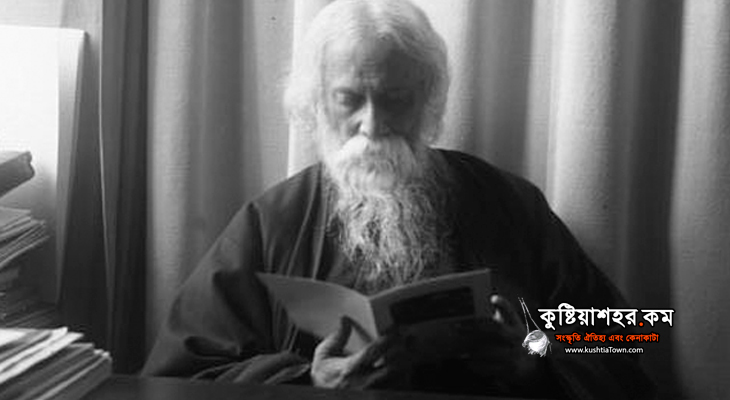
In the last decade of his life (1932-1941) a total of twenty-five books of Rabindranath were published. Especially notable among the poetry books of this period are Punashcha (1932), Shesh Saptak (1935) and Shyamali o Patraput (1936) — these three collections of prose poetry. During this period of life Rabindranath carried out experiments in various branches of literature.
The fruit of these experiments was his several prose-poems and the trilogy of dance dramas Chitrangada (1936; a form suited to dance performance of the verse drama Chitrangada of 1892), Shyama (1939) and Chandalika (1939). Besides, Rabindranath also composed his last three novels in this period — Dui Bon (Two Sisters, 1933), Malancha (1934) and Char Adhyay (Four Chapters, 1934). Most of his paintings were also painted in this period of his life.
At the same time, in the last years of his life Rabindranath became interested in science. In 1937 was published his collection of essays on science, Biswaparichay. In this book he recorded in simple Bengali prose the most modern conclusions of astronomy. The influence of the knowledge he had gained of physics and astronomy is also visible in his poetry. His stories centred on scientist characters are collected in the three story collections Se (1937), Tin Sangi (1940) and Golposalp (1941).
During this period of life Rabindranath gave the strongest reaction against religious bigotry and superstition. When in 1934 over a hundred people died in the earthquake in the British province of Bihar and Gandhiji called it the ‘wrath of God’, Rabindranath characterized such a statement of Gandhiji as unscientific and criticized him publicly. The economic distress of the ordinary people of Calcutta and the rapid socio-economic decline of the British province of Bengal deeply disturbed him. In a hundred-line poem composed in prose rhythm he also depicted this event.
The last four years of his life were a time of continuous physical illness. During this period he twice had to stay bedridden in a gravely ill state. In 1937 the poet once lost consciousness and was in a critical condition. Though he recovered that time, after falling ill in 1940 he could never recover again.
The poems Rabindranath composed in this period were some unforgettable lines created around the consciousness of death. Up to seven days before his death Rabindranath remained creative. After a long period of illness, in 1941 Rabindranath Tagore breathed his last at his residence at Jorasanko.