বাংলা
 English
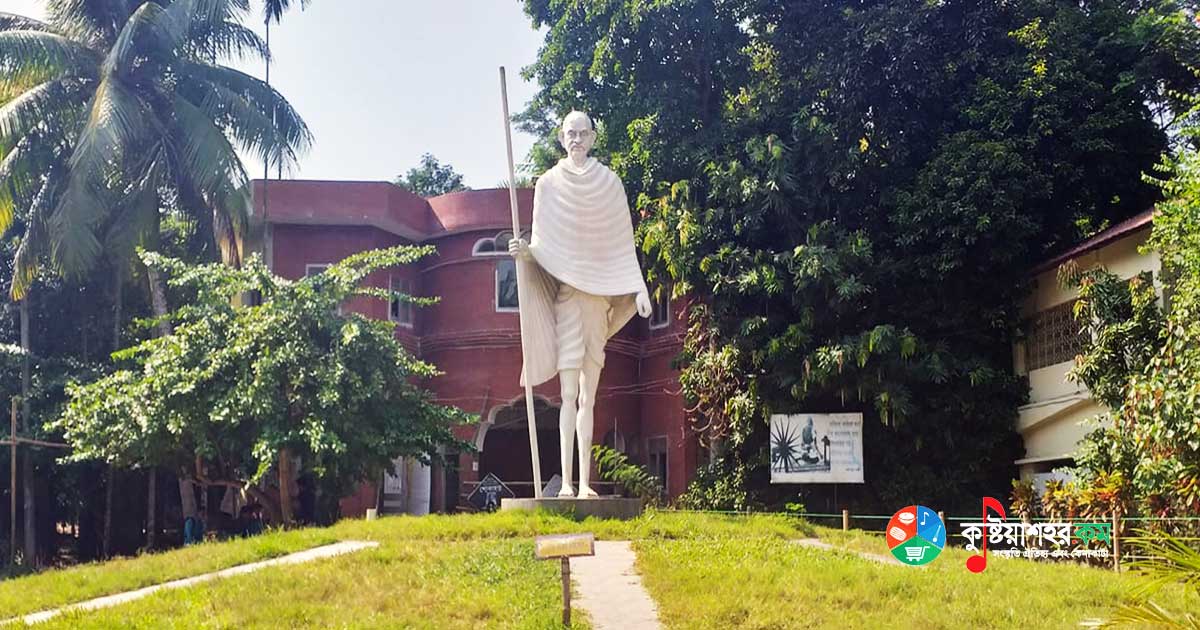
Mohandas Karamchand Gandhi (Mohandas Karmachand Gandhi) or Mahatma Gandhi (2 October, 1869 - 30 January, 1948) was one of the prominent Indian politicians, one of the pioneering figures of India's independence movement and an influential spiritual leader. He was the founder of the Satyagraha movement. Through it the people's civil disobedience against autocracy was declared. This movement was founded on the doctrine or philosophy of non-violence, and it was one of the driving forces of the Indian independence movement and one of the inspirations of the movements of people all over the world for freedom and rights.
Gandhi is known in India and across the world as Mahatma (great soul) and Bapu (father). The Government of India declared him the Father of the Nation in his honor. His birthday, 2 October, is observed in India with due dignity as Gandhi Jayanti. On 15 June 2007 the United Nations General Assembly declared 2 October the International Day of Non-Violence. All the member countries of the United Nations have consented to observe this day.
As an educated British lawyer in South Africa, Gandhi first applied his ideology of non-violent peaceful civil movement in the movement for the rights of the citizens of the oppressed Indian community. After returning to India, taking with him some distressed farmers and laborers, he built a movement against the discriminatory tax collection system and against much widespread discrimination. After coming to the leadership of the Indian National Congress, Gandhi began campaigning on various subjects, including the nationwide eradication of poverty, women's freedom, the establishment of brotherhood among the various ethnic groups, the eradication of caste discrimination and the economic prosperity of the nation. But all of these were with the aim of Swaraj, that is, of freeing India from foreign rule. In 1930 Gandhi led the 400 kilometer (248 mile) long Dandi Salt March in protest against the Indians' salt tax, which in 1942 initiated the direct Quit India movement against the English rulers. He was imprisoned several times, at various times and for various reasons, in South Africa and in India.
Mahatma Gandhi remained firm on the doctrine of non-violence and on truth in all situations. He lived a simple life and established a self-governing ashram. His own clothing was the traditional Indian dhoti and shawl, which he himself wove on the charkha. He ate simple vegetarian food. In later life he ate mostly fruits. For self-purification and for protest he would fast for long periods.
After the communal riot of Rayat in 1946, Mahatma Gandhi toured Begumganj upazila of Noakhali district; and when he went to visit a place named Joyag Bazar of the present Sonaimuri upazila, the then zamindar, the late barrister Hemanta Kumar Ghosh, donated all his property through a trust for the propagation of Gandhiji's ideals and for the preservation of Gandhiji's memory, and established an ashram in the name of Gandhiji. Although the trust was first registered as the Ambika Kaliganga Charitable Trust, in 1975 its name was changed and it became the Gandhi Ashram Trust. At Gandhi Ashram there is also a museum in the name of Gandhiji, in which over a hundred pictures of Gandhiji's then trip to Noakhali, the objects he used and his published writings are preserved. At present the ashram, as a trust, works with the vow of rural development.
Gandhi Ashram is a sight-worthy historical monument of Noakhali. Its location is beside the road adjacent to Joyag Bazar of Sonamuri upazila, about 25 km north of the Noakhali district headquarters Maizdi Court. The said Gandhi Ashram was established at the house of the then zamindar, the late Barrister Hemanta Kumar Ghosh. At present the Gandhi Ashram has gained nationwide fame as a service-oriented organization of Noakhali. As far as can be known about the brief history of this exceptional institution, in the latter part of 1946 the poisonous fumes of communalism spread throughout India. Then the influence of West Bengal's communal riot came upon Noakhali. Especially in Ramganj thana of Lakshmipur district the tandava dance of communalism broke out. Many arranged households were burnt in the fire of torches, and the green soil turned red in the flood of blood of the communal riot.
Rushing to Noakhali as the vanguard of the peace mission came Mahatma Gandhi, the foremost of the non-cooperation and non-violence movement. On 7 November 1946 Mahatma Gandhi first set foot on the soil of Noakhali at Chaumuhani railway station. At the initiative of the then M.L.A. Sri Haran Ghosh Choudhury, Noakhali's first public meeting was held at Chaumuhani. Mahatma Gandhi gave the first speech at that public meeting. Then he held a public meeting in Dattapara village. In succession his journey continued. Thus, moving about, on 29 January 1947 he arrived at Joyag village.
That very day Hemanta Kumar Ghosh Mahashay, the talented son of Joyag village and the first barrister of Noakhali district, dedicated his zamindari's immovable and movable property to be spent for public welfare, in the name of Mahatma Gandhi. The responsibility of running the ashram was given to Gandhiji's beloved, devoted to the vow of public service and a lifelong bachelor, Sriyukt Charu Choudhury Mahashay. From then onwards, through the proper use of the said property, activities began for the improvement of the fortune of the local inhabitants. At present Srimati Jharna Dhara Choudhury (72) is working as the secretary of the Gandhi Ashram Trust.
How to go from Kushtia:-
There is no direct bus from Kushtia to Noakhali. From Kushtia to Dhaka, and from Dhaka to Noakhali, many buses are available. From the Noakhali district headquarters Maizdi, by any local bus service/CNG auto-rickshaw going toward Sonaimuri, get down ahead at Joyag Bazar; going half a kilometer east by rickshaw or on foot, the Gandhi Ashram can be reached.